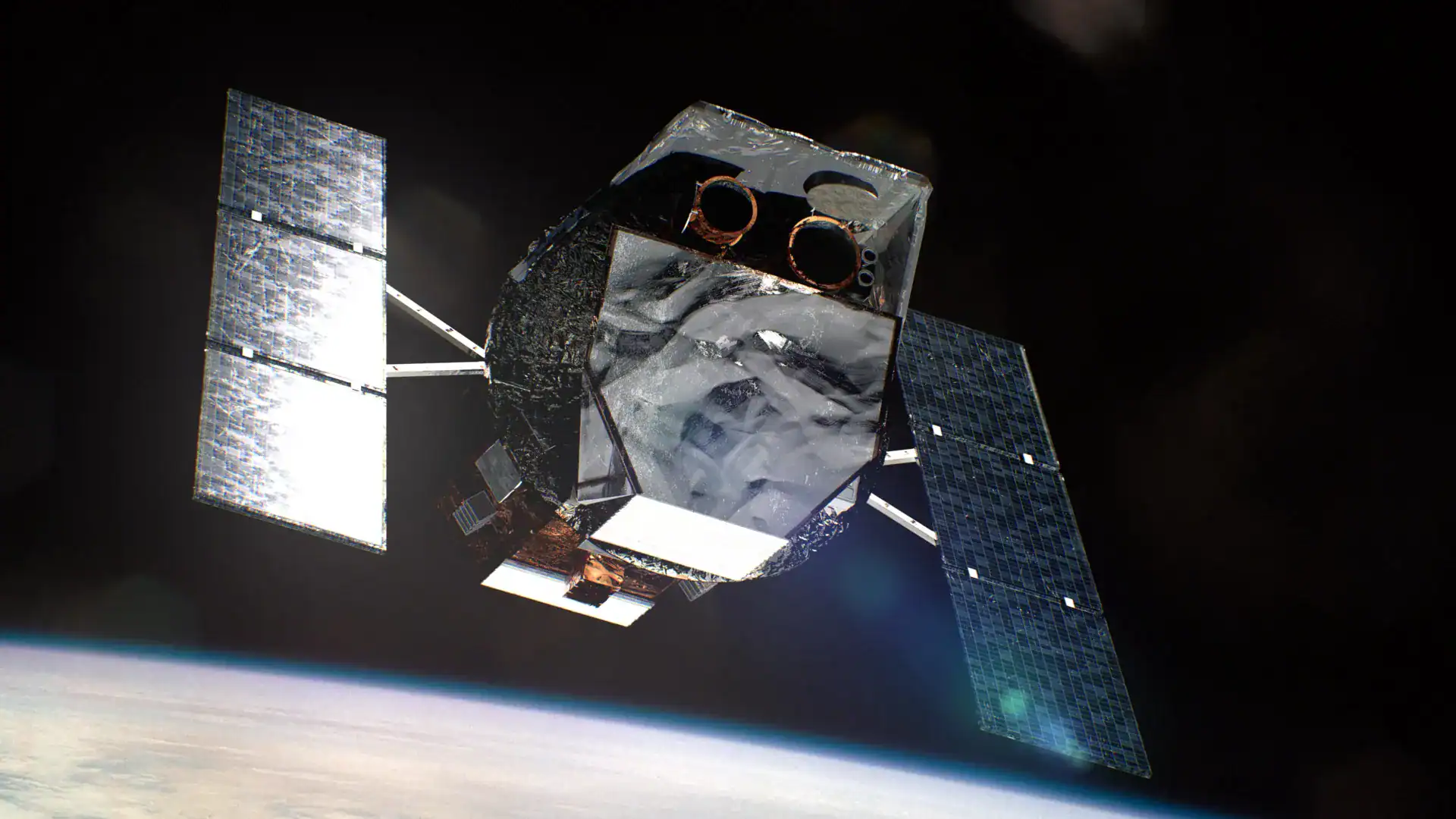

Two of Swift’s three science instruments came back on Aug. 26. The spacecraft carrying them is still falling out of the sky.
That’s the honest summary of where NASA’s Neil Gehrels Swift Observatory stands right now. The Ultraviolet/Optical Telescope and the X-ray Telescope are collecting data again after being switched off in February. The rescue mission that was supposed to buy them years of extra life isn’t happening.
What came back, and what didn’t
Both instruments were shut down in February to cut atmospheric drag and stretch Swift’s remaining orbital time while NASA worked on a possible boost. They were switched back on Wednesday, Aug. 26.
The third instrument, the Burst Alert Telescope, is still dark. NASA stopped using it in April to lower the spacecraft’s power draw, which let engineers angle Swift’s solar panels into a lower-drag position. The team expects to restore it to data collection within the next few weeks.
So Swift is roughly two-thirds of an observatory at the moment, and the missing third is the one that spots the bursts.
The rescue that fell apart
NASA contracted Katalyst Space in September 2025 to do something nobody had done for a science telescope: launch a second spacecraft, grab Swift, and haul it into a higher orbit.
Katalyst had one year to design, build, test and launch that spacecraft, called LINK, then fly it to Swift and complete the boost. One year. For a rendezvous-and-capture mission.
LINK launched in July on a Northrop Grumman Pegasus rocket. Later that month it developed problems controlling its orientation, which is a bad thing to have go wrong on a vehicle whose entire job is precise close-quarters maneuvering.
On Aug. 19, NASA and Katalyst announced LINK would no longer attempt to capture and raise Swift.
The flight isn’t over. Katalyst still plans to bring LINK near Swift for rendezvous and proximity operations, a demonstration of technologies that could be used for in-space satellite servicing, including future missions where one spacecraft approaches and works near another. Useful data. Not a saved telescope.
Why the Sun is to blame
Swift has no propulsion system that can raise its own orbit, so it can’t fight drag directly. And even hundreds of miles up, there’s enough leftover atmosphere to slow a spacecraft down and pull its orbit lower over time.
Recent solar activity made that worse. A more active Sun dumps extra energy into Earth’s upper atmosphere, which expands and pushes its outer layers farther into space. For anything in low Earth orbit, that means more drag.
For Swift specifically, it meant losing altitude faster than expected.
The number that matters is 185
NASA had estimated that Swift’s low-drag operating mode would hold the observatory above 185 miles (300 kilometers) until October.
Below 185 miles (300 kilometers), operating the telescope gets harder, and the spacecraft is expected to shed altitude faster as drag increases. It’s a threshold, not a cliff, but it’s the point where the mission stops being routine.
With science observations running again, the team now expects Swift to hit that mark within the next one to two months.
Twenty-one years of catching things that don’t wait
Swift has been working for 21 years, observing across multiple wavelengths of light, and its real value has always been speed. When it detects an outburst, it can slew toward the source and alert other observatories on the ground and in space fast enough for them to catch the event before it fades.
That’s the capability sitting on a countdown right now. If you follow transient astronomy, the practical takeaway is that follow-up alerts from Swift are a resource with a known expiration window, and the Burst Alert Telescope’s return in the coming weeks determines how much of that window is actually usable.
Until then, Swift keeps watching, and keeps dropping.