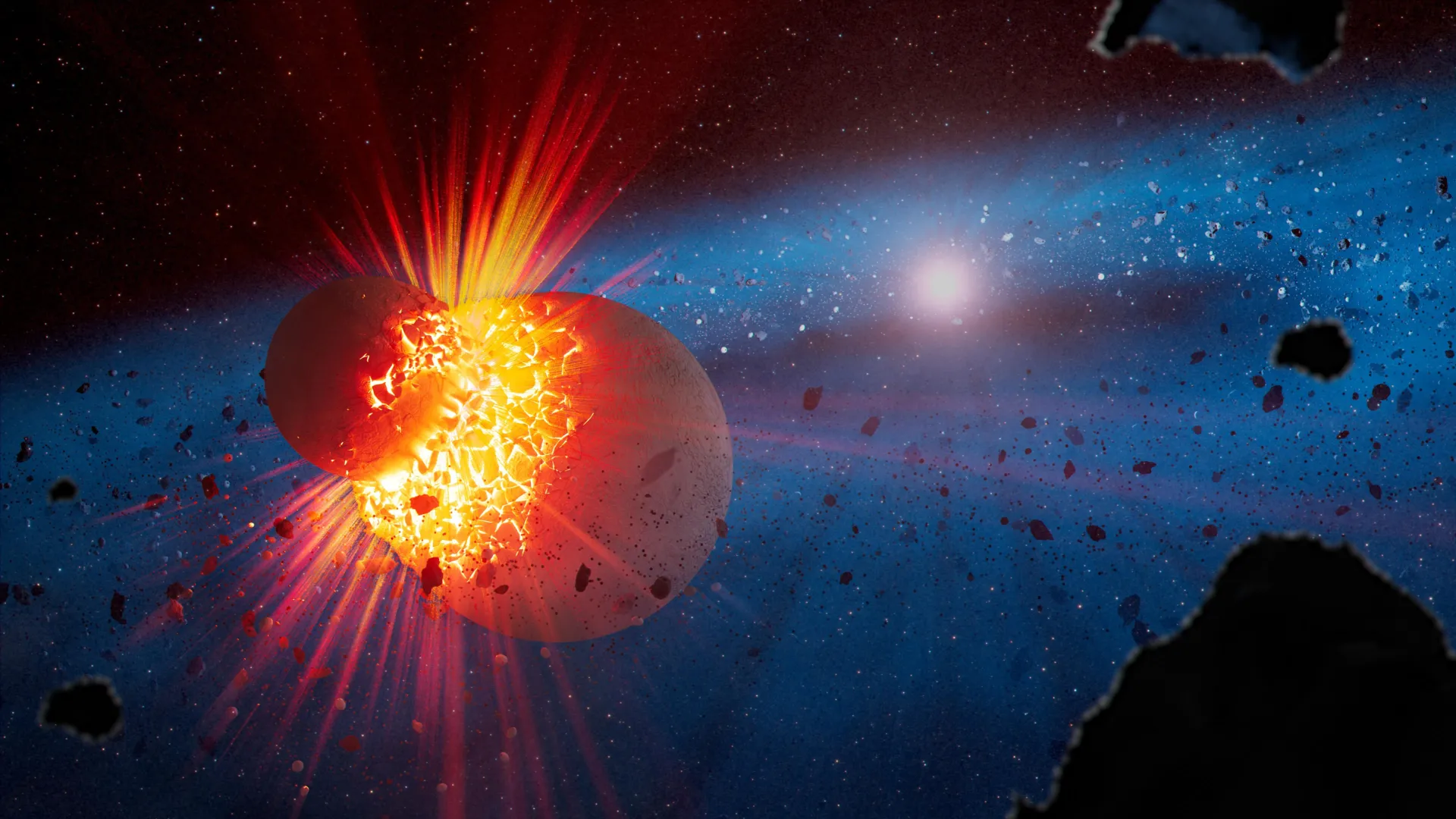

Only about 1% of young stars show any sign of the violent phase astronomers call an extreme debris disk. Theory says that number should be higher. A new survey from NASA's James Webb Space Telescope doesn’t settle that mismatch, but it does start to explain what’s going on inside these rare, dusty systems. And some of them look like the aftermath of Mars-sized worlds hitting each other.
That should sound familiar. Scientists think the young Earth took a hit from a Mars-sized body called Theia. The impact likely vaporized huge amounts of rock and threw material into space, and some of that debris eventually came together to form the Moon.
The team’s findings were published Oct. 1 in The Astrophysical Journal. The work is the first time researchers have had enough of these systems to treat them as a class instead of a set of oddities.
Two kinds of dust, two kinds of crashes
The most useful result comes from the minerals. When the researchers looked at what the dust is made of, the disks split into two broad groups: silica-rich and silica-poor.
Roughly one-third of the sample is silica-rich. The researchers said these systems likely formed after extremely energetic collisions between Mars-sized bodies, impacts strong enough to vaporize a substantial amount of rocky material.
The other two-thirds are silica-poor. Those appear to come from lower-energy collisions, including grazing impacts between Moon-sized objects.
If you want a feel for the difference, look at rocks you’ve seen on Earth. Volcanic glass such as obsidian is silica-rich. Forsterite, a silica-poor mineral, shows up as green sand grains on certain beaches in Hawaii.
Whether a disk is rich or poor in silica tells you something about the collision that made its debris. It may also explain why some disks swing more sharply in infrared brightness than others.
“To just see their mid-infrared emission and beautiful spectral features with Webb, which allowed us to identify their compositions, was the most exciting thing for me,” said Agnes Kospal of Konkoly Observatory in Budapest, Hungary, a coauthor of the study. “We have no other way to study these planetary embryos directly because they are too small.”
Age is the tell
The split isn’t random. Silica-rich disks have only been found around stars younger than 300 million years. Silica-poor disks turn up around stars across a much wider range of ages, and they tend to show stronger changes in brightness.
The team suggests that flickering comes from newly created debris evolving fast. Shifts in the material’s orbit, plus more collisions, could push the infrared brightness up and down over time.
That age cutoff is where the Moon comes back in. Computer simulations suggest terrestrial planets, Earth included, should emerge within the first few hundred million years after a solar system starts forming. That window matches the ages of the silica-rich disks seen so far. It also fits estimates that Earth and the Moon formed roughly 100 million years after the Sun, with the Moon likely the product of a collision between Earth and a Mars-sized object.
Our solar system may have done this twice
The silica-poor disks raise a different question: whether the Sun once went through that phase too.
If the older silica-poor disks and their seemingly random bursts of infrared brightness are caused by orbital instability, the pattern would be broadly compatible with the Late Heavy Bombardment hypothesis. In that scenario, the giant planets moved significantly from where they formed. Their migration scrambled the orbits of smaller objects, triggering catastrophic collisions and brief, dust-heavy periods similar to what astronomers now see in extreme debris disks.
So our solar system could have passed through more than one extreme debris disk phase. That’s a hypothesis, not a finding, and the researchers are careful about it.
“How rocky planets formed and giant planets evolved are part of the broader story of the solar system’s formation. It’s all one story,” said Kate Su of the Space Science Institute in Boulder, Colorado, who led the team. “Our work on extreme debris disks helps us bring together the big picture of what we currently understand.”
What makes a disk “extreme”
Some background helps here. The material around a star changes as it ages. Young stars start with a gas-rich protoplanetary disk where planets can form, and that environment later becomes a gas-poor debris disk.
NASA’s now-retired Spitzer Space Telescope studied those debris disks and flagged an unusual category. Extreme debris disks hold exceptionally large amounts of warm dust close to their stars, in roughly the same zone where rocky planets orbit in our own solar system.
The new work confirms three defining traits. The dust grains are smaller than those in protoplanetary or more typical debris disks. The disks carry unusually high concentrations of warm dust. And their brightness changes irregularly over time. Webb and Spitzer picked up all three through mid-infrared spectra.
Because these systems are rare, building a sample took some work. The team assembled 21 extreme debris disks: five from archival Spitzer observations and 16 studied with Webb. Of the Webb group, 12 were newly observed and four were follow-ups on systems Spitzer had already looked at.
“This is the first time we have gathered enough systems to truly understand this subclass that we call extreme debris disks,” Su said. “Before Webb, we had limited information. We knew that they are weird and very different from the typical cold debris disks that we know, like Vega and Fomalhaut. Now that we have more data, we can pin down what these disks represent for planet formation and evolution.”
The sample is still thin
Twenty-one disks is a real step up from where the field was. But the claim that older systems shouldn’t be silica-rich rests on very few data points, and the team says so.
“Of course, there’s many things we still don’t know about these disks,” said Attila Moor of Konkoly Observatory, a coauthor of the study. “We expect no silica-rich systems among older extreme debris disks. We only have three disks in our sample that fit that age criteria, so it’ll be nice to observe more of these systems to confirm our hypothesis.”
Three disks. That’s the number to watch. If Webb finds a silica-rich disk around an older star, the tidy link between high-energy, Mars-sized collisions and the planet-building years falls apart. If it doesn’t, astronomers will have a working picture of the kind of crash that made our Moon, seen happening around other stars.