

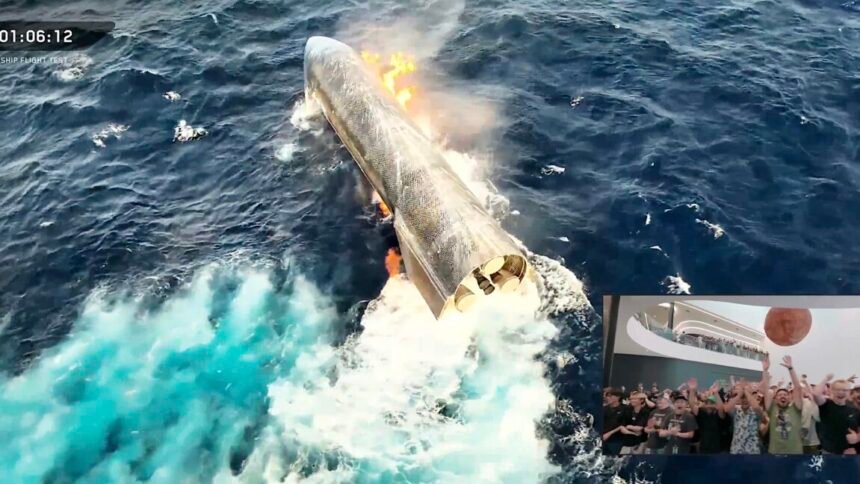
Thirteen full-scale Starship (official site) flights in, and SpaceX just did something it had never managed before: put a ship in the water without setting it on fire.
Friday’s flight sent Starship halfway around the world from South Texas to a splashdown in a remote stretch of the Indian Ocean west of Australia. The ship tipped over gently and floated. Every previous water landing ended in a conflagration, an outcome SpaceX officials had come to expect.
That difference is the whole story.

SpaceX engineers flew drones over the floating vehicle to inspect its heat shield, getting their best look yet at how more than 18,000 ceramic tiles insulating the ship’s stainless steel airframe held up. Those tiles took temperatures up to 2,600° Fahrenheit (1,430° Celsius) as Starship came back into the atmosphere at the end of its hour-long flight from Starbase, Texas.
Why a floating rocket matters more than a launch
The heat shield has been the program’s hardest engineering problem for years, and not because it’s hard to survive one reentry. SpaceX wants rapid turnarounds and eventually multiple flights per day. That only works if the shield shrugs off launch vibration and reentry heat without being refurbished or replaced after every flight.
Until Friday, engineers were reading that story backward from wreckage.
“This is the first time we’ve put an intact Starship in the water,” said Dan Huot, a SpaceX communications manager providing commentary on the company’s live webcast. “This is a dream scenario for the team that’s trying to get this heat shield data.”
Huot added a detail that’s easy to skip past. “This is so critical for refining the heat shield and everything else. The really good news is … you’re looking at a pretty intact-looking heat shield,” he said. “We were flying at a significantly higher dynamic pressure, so putting way more stress on this vehicle on the way uphill, and it’s sitting there in the water.”
More stress on the way up, less damage on the way down. That’s the combination SpaceX needed.
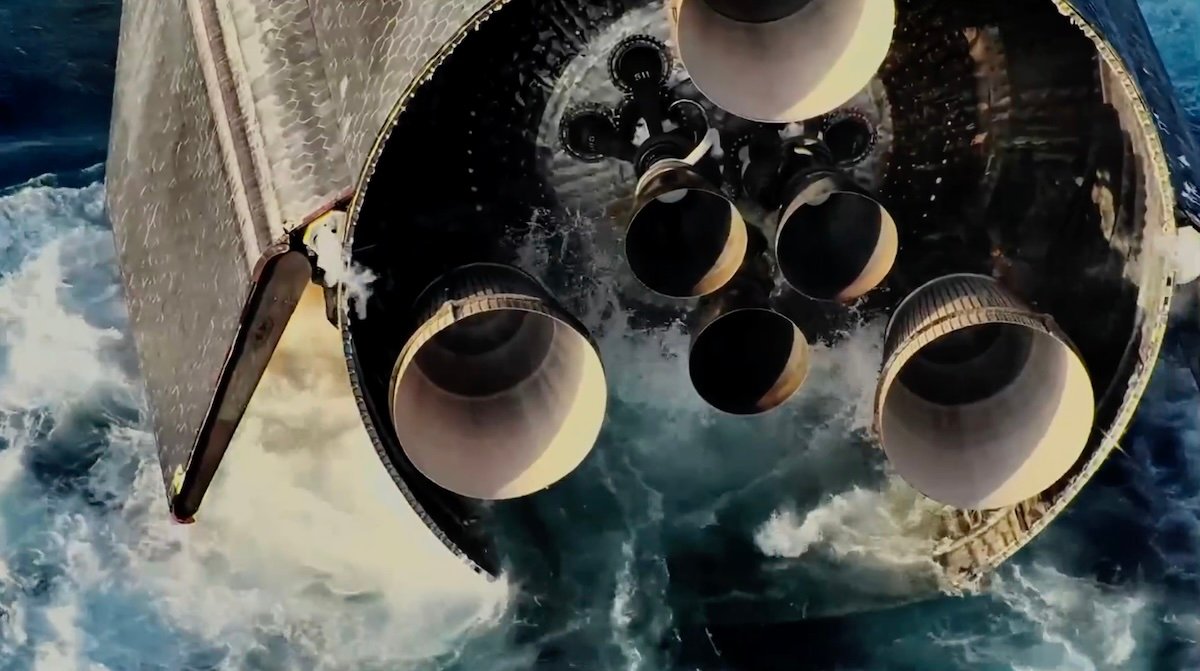
The intact splashdown also opens the door to towing the rocket back to shore, probably somewhere in Australia, for closer inspection. Starship is built for reuse, but not after a salt water bath, so this one is a specimen, not a flight article.
SpaceX kept receiving signals from the ship after splashdown through its own Starlink (official site) network. A camera onboard showed no external damage to the six Raptor engines as water lapped against the lens.
The next flight is the one to watch
Encouraged by how Friday ended, SpaceX is likely to take the next leap on the very next launch, according to founder and CEO Elon Musk. That means a longer-range trajectory, perhaps into low-Earth orbit, and a return to the launch site, where mechanical arms on the tower will try to grab the ship as it slows to a hover.
“Unless we discover problems after mission data review, SpaceX will attempt to catch the ship with the tower on next flight,” Musk wrote on X Friday evening.
SpaceX has caught the Super Heavy booster this way already. But the booster, for all its size and weight, comes home at a fraction of Starship’s speed. Catching the ship is a different problem.
The booster is the part nobody should gloss over
One item on the Flight 13 checklist went unfinished, and it wasn’t a small one. Super Heavy was supposed to relight its engines for a landing burn off the Texas coast, simulating the return-to-pad maneuvers required for recovery and reuse.
Some Raptors didn’t restart. The booster hit the ocean at high speed.
SpaceX had booster splashdown trouble on the last flight in May too. Friday showed progress, not a fix.
“The booster successfully completed the high thrust portion of the boostback burn with all 33 engines, the first time with a Super Heavy V3, before ending the burn early,” SpaceX officials wrote in an update on the company’s website. “It attempted to relight its engines for the landing burn, with a subset successfully igniting before experiencing a hard splashdown in the Gulf.”
Worth keeping in perspective: SpaceX recovered and re-flew Super Heavy boosters twice with the Starship Version 2 design. Not once with Version 3.
Twenty satellites, deployed and deliberately destroyed
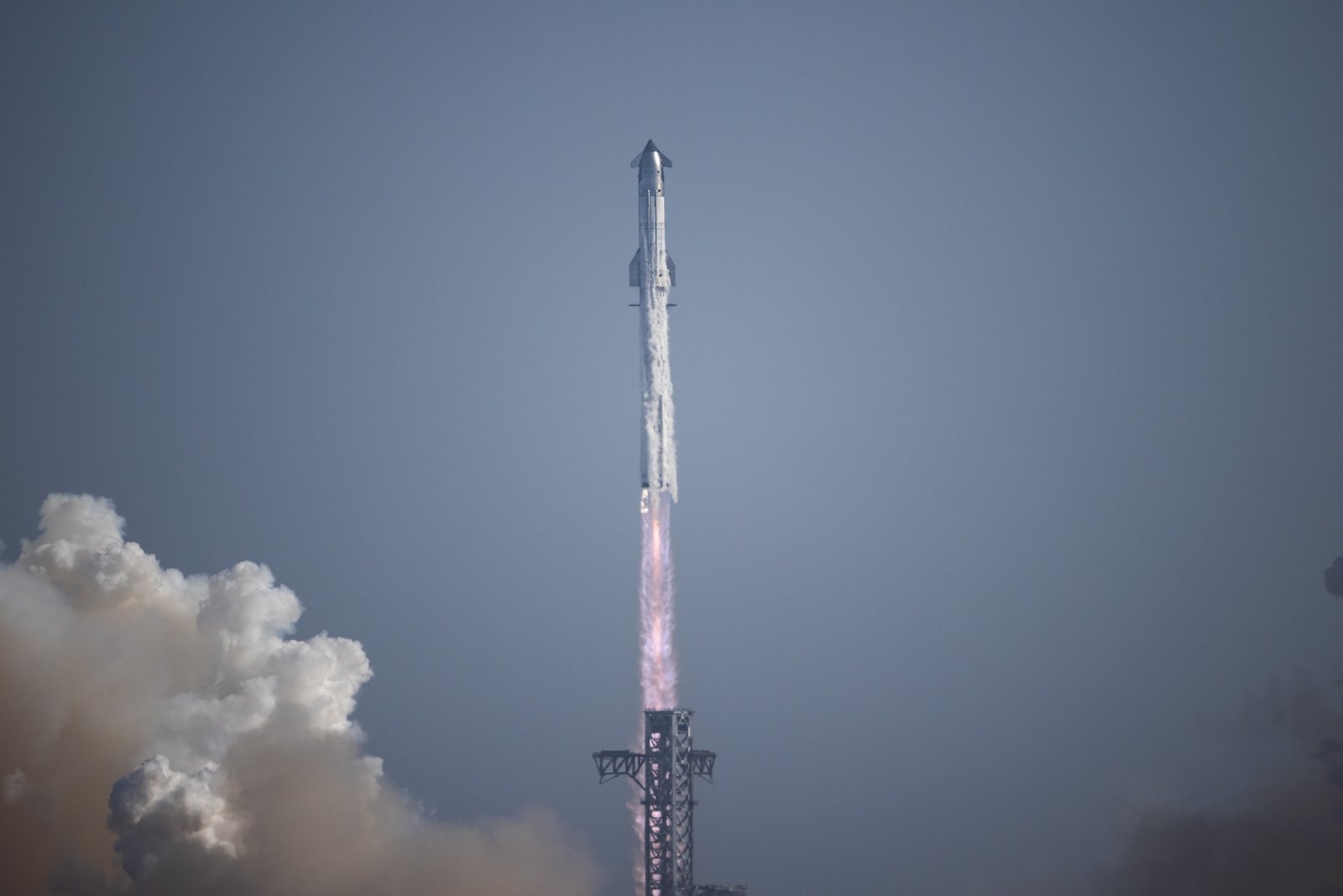
The 408-foot-tall (124-meter) rocket lifted off from Starbase, a few miles north of the US-Mexico border, at 5:51 pm CDT (6:51 pm EDT; 22:51 UTC). Thirty-three methane-fueled Raptor engines steered it east over the Gulf of Mexico before the booster separated.
Starship fired its own six engines for more than five minutes, then coasted for half an hour over the Caribbean, the Atlantic and South Africa. A few minutes after engine shutdown it opened its payload bay door and pushed out a stack of 20 Starlink satellites through a slit-like opening on the side of the spacecraft, Pez dispenser style.
These were the first of the upgraded Starlink V3 model, with significant improvements in throughput and power. They’re also bigger and heavier than V2s, which means they won’t fit on the Falcon 9 at all. Starship isn’t a nice-to-have for that constellation upgrade. It’s the only ride.
The flat panels never reached orbit. They rode the same arcing suborbital trajectory as the ship and were designed to burn up on reentry less than an hour after launch. Ground teams reached each satellite by radio and laser link and “downloaded key telemetry” before they were destroyed, giving engineers their first look at V3 performance in space.
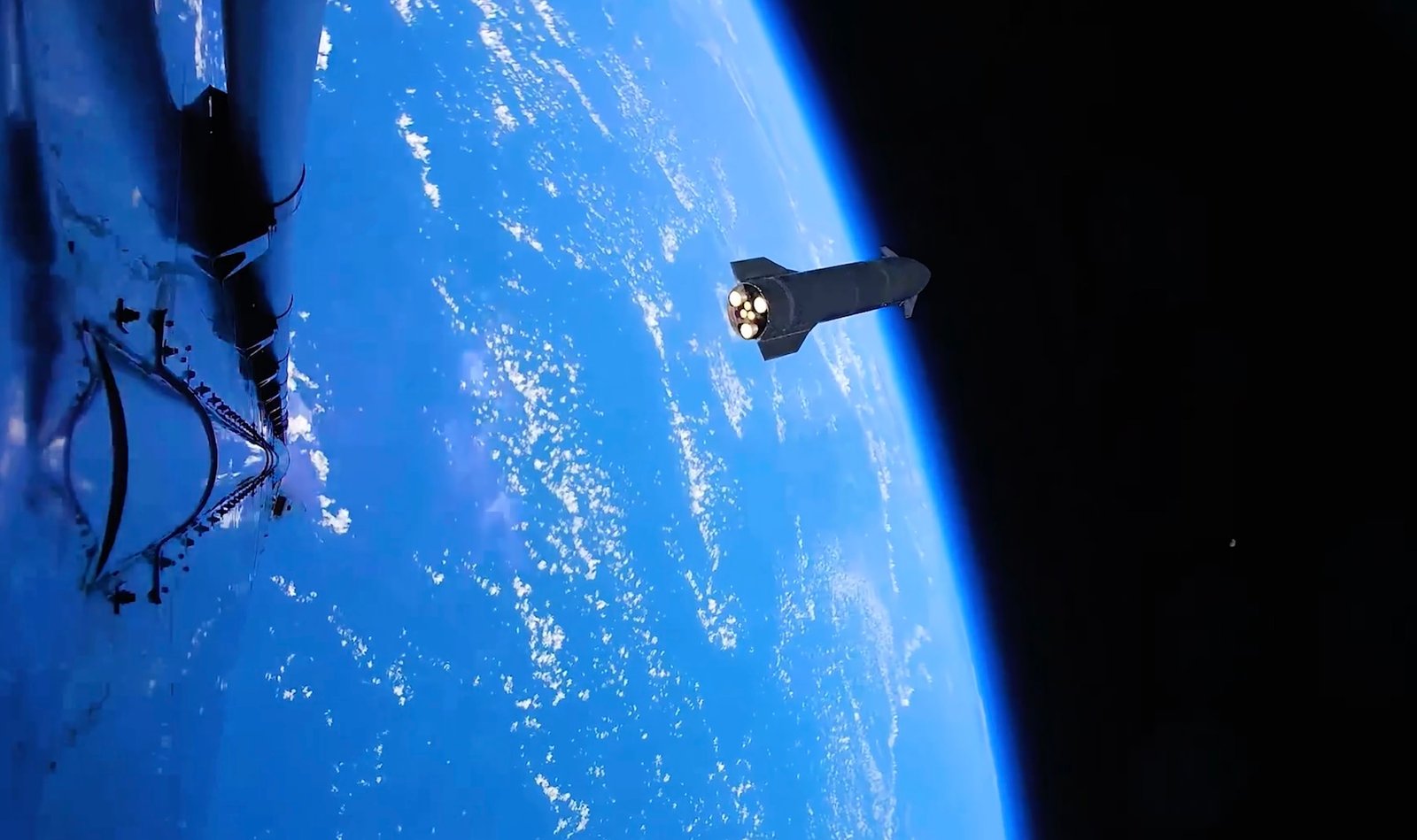
Then came a brief restart of one of the ship’s Raptor engines, a step engineers skipped on the previous flight. The burn ran roughly 14 seconds and was visible from South Africa. SpaceX called it a “core capability for future orbital missions.” It’s the deorbit burn, and without it there’s no controlled return from orbit.
What’s actually riding on this
Getting to orbit and back to the pad unlocks operational Starlink V3 launches, higher-speed direct-to-device connectivity for consumers and the US military, and the revenue attached to it.
For NASA, orbit is the gateway to orbital refueling. That demonstration is vital for any Starship flight beyond low-Earth orbit, including Moon missions supporting the Artemis program. NASA is working with SpaceX and Blue Origin on human-rated versions of Starship and the Blue Moon lander.
“Excited for what will be learned from this mission,” NASA Administrator Jared Isaacman wrote on X after the launch. “When Starship comes online, its capabilities will be game-changing, not least of which will be ensuring we never give up the Moon again!”
The refueling demo requires two Starship launches, a rendezvous and dock in orbit, then a transfer of methane and liquid oxygen through automated couplers. Refilling one ship with enough propellant to reach the Moon takes multiple runs in rapid succession, which means rapid reuse of ships and boosters across multiple pads.
SpaceX has one active Starship pad in Texas and a second undergoing renovations. Two more are under construction at Kennedy Space Center and Cape Canaveral Space Force Station in Florida.
“Really critical data collected this mission on a demonstration deorbit burn for Raptor, and a first flight for the next generation Starlink satellites,” Shana Diez, SpaceX’s director of Starship flight reliability, wrote on X.
“It feels like we are ready to kick into gear on delivering payload to orbit, which I am very excited for,” Diez added. “Development vehicles are fun but at the end of the day, we are here to put things into space and I am psyched about this rocket’s game changing capabilities.”
Here’s the number to hold onto while SpaceX preps Flight 14: zero. That’s how many Super Heavy V3 boosters have come back in one piece. The ship is floating off Australia with its tiles intact, and the tower catch is on the table. The half of the rocket that’s supposedly the solved problem is the half still hitting the water hard.