

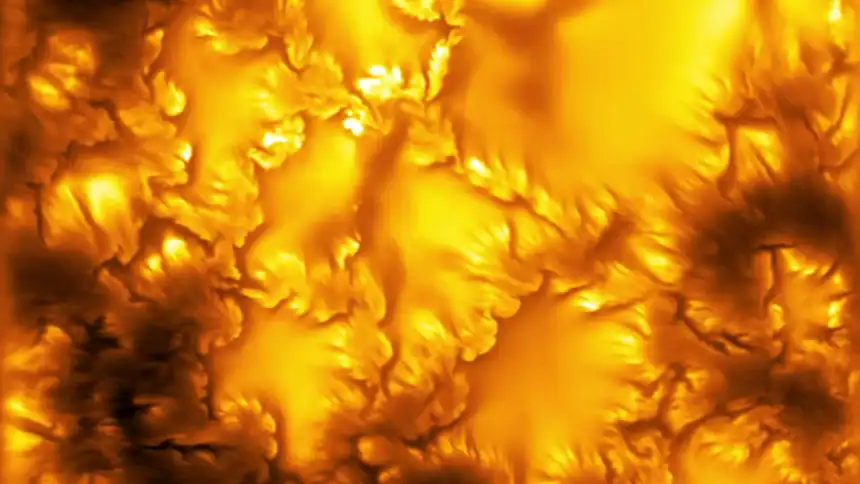
Twenty kilometers. That’s the size of the structures scientists had to resolve on the surface of the sun to catch what they were looking for, and it sits right at the edge of what the largest solar telescope on Earth can do.
They got it. Researchers using the NSF Daniel K. Inouye Solar Telescope have imaged plasma vortices swirling across the solar surface that nobody had ever seen, tiny structures that may explain how our star stores, moves and releases magnetic energy.
The work comes out of the U.S. National Science Foundation National Solar Observatory (NSF NSO), the Max Planck Institute for Solar System Research (MPS) in Germany and the High Altitude Observatory (HAO) in the USA. The team paired observations from the Inouye telescope, the world’s largest solar telescope, built and operated by the NSO in Hawaii, with advanced computer simulations. The imaging came from a broadband camera supplied by MPS.

What 20 kilometers looks like from here
"To detect the vortices, we needed to resolve structures on the solar surface about 20 kilometers in size. That is at the limit of what even the world’s largest solar telescope and state-of-the-art simulations can achieve," said MPS scientist Michiel van Noort, a co-author of the new publication who worked on the observations, the data reduction and the image restoration.
Some of the newly resolved features measure only slightly more than 20 kilometers across. Picking that out on the sun is roughly like identifying a one euro coin from 180 kilometers away.
The whirlpools live on the edges of granules
The vortices show up along the boundaries of granules, the structures that densely cover the visible surface of the sun. An individual granule runs between 500 and 2,000 kilometers across.
Collectively they form the sun’s granulation, a pattern in constant motion that looks like bubbles in a boiling liquid. That comparison holds up, because granulation is made of moving plasma. Hot plasma rises from deeper inside the sun, cools near the surface and sinks back down.
What’s new is the fringe-like detail along the edges of those granules. It had never been resolved before. And those fringes keep developing swirling motions that look like ocean waves at the moment they start to break.
Physics you can watch on a lake
The researchers think the swirls are Kelvin-Helmholtz instabilities, which is not an exotic explanation. It’s standard fluid dynamics.
Kelvin-Helmholtz instabilities form when two fluids move past each other at different speeds. The velocity difference creates shear forces at the boundary, and small disturbances there can grow into waves or vortices.
You find the same process at wildly different scales: on the surfaces of lakes, in ocean waves, in cloud formation, in the atmospheres of Jupiter and Saturn, and where the solar wind meets planetary magnetospheres. At the edges of solar granules, neighboring layers of plasma also appear to move at different speeds, which is exactly the setup the instability needs.
The twist nobody could account for
Here’s why this matters beyond a pretty image. Current theory holds that magnetic energy accumulates as the sun’s magnetic field lines get twisted and coiled, the way mechanical energy sits inside a tightly wound metal spring. More twist means a configuration that’s both more energetic and less stable.
That energy eventually comes out through magnetic reconnection, when twisted field lines snap open and reconnect in a new arrangement. Tiny bursts of radiation called nanoflares are part of the same story.
The gap has always been the first step. What twists the field lines to begin with?
The vortices could supply part of that answer. The researchers find these small whirlpools appearing continuously wherever the magnetic field is strong enough, which makes them a persistent candidate mechanism for putting twist into the sun’s field lines.
An eleven-year clock that models struggle to explain
The analysis also suggests the mini-vortices are highly effective at mixing magnetized and non-magnetized plasma at the solar surface. That mixing could move magnetic fields quickly from the surface up into the sun’s atmosphere.
Changes in the sun’s magnetic field drive its roughly eleven-year activity cycle, which is exceptionally fast on a cosmic scale. To reshape a magnetic framework that quickly, magnetic flux has to be transported away through the solar atmosphere efficiently, and existing models have a hard time explaining diffusion that rapid. The vortices could be a missing piece there too.
"The newly discovered plasma vortices impressively demonstrate how minute processes — at the limit of what we can resolve using all available techniques — significantly determine the nature of our star," said Sami K. Solanki, director of the MPS and co-author of the new publication.
Which is the honest read on this result. Nothing here rewrites solar physics on its own, and the team is careful to say the vortices could provide a mechanism, not that they’ve proven one. But the next time someone tells you the sun’s magnetic cycle is understood, remember that a central part of it may hinge on structures the size of a euro coin seen from 180 kilometers, which we managed to photograph for the first time only now.