
Two thousand robotaxis. Four European cities. No launch date, and no word on which cities.
That’s the shape of the expanded partnership between Uber and Chinese autonomous vehicle maker Pony.ai, and the gap between the headline number and the missing details tells you where the robotaxi business actually sits right now.
The companies said details would be revealed in phases. Which is a polite way of saying the deal is real, the cars aren’t there yet.
Who does what in this arrangement
The division of labor is the most concrete thing to come out of the announcement. Pony.ai, based in Guangzhou, supplies the autonomous driving technology. Uber supplies the ride-hailing platform and the riders on it.
Fleet management is the part nobody talks about at press-release time, and it’s the part that eats margins: maintenance, cleaning, charging. According to the companies, that can be handled by a local provider.
Ownership stays deliberately loose. The robotaxi fleet may be owned by different partners depending on the market.

The ‘joint-deployment model’ finally has a path
Pony.ai has been pitching a joint-deployment model for a while. The expanded partnership does appear to have cleared up some of the terms, giving that model a clearer path to commercial scale.
Translation: Pony.ai doesn’t want to own and operate thousands of vehicles itself, and it has now found a structure where it doesn’t have to.
That’s a sensible read of the economics. It’s also an admission that the capital required to run a robotaxi fleet at scale is a problem neither company wants sitting on its own balance sheet.
Uber’s strategy is breadth, not bets
Uber has partnered with more than 30 autonomous vehicle companies over the past several years, Pony.ai among them. That number is worth sitting with.
No company signs 30-plus partnerships because it knows which technology wins. It signs them because it doesn’t, and because owning the demand side means you can afford to stay agnostic about the supply side.
Uber’s position here is the platform. Whoever builds the car that works, Uber wants to be the app that dispatches it.

Pony.ai’s map is already bigger than China
Pony.ai has launched in four Chinese cities. It has also locked in partnerships with local transportation authorities as it pushes toward European and Middle Eastern countries, including Qatar.
That authority-first approach matters more in Europe than it does almost anywhere else. Regulators, not riders, decide how fast this goes.
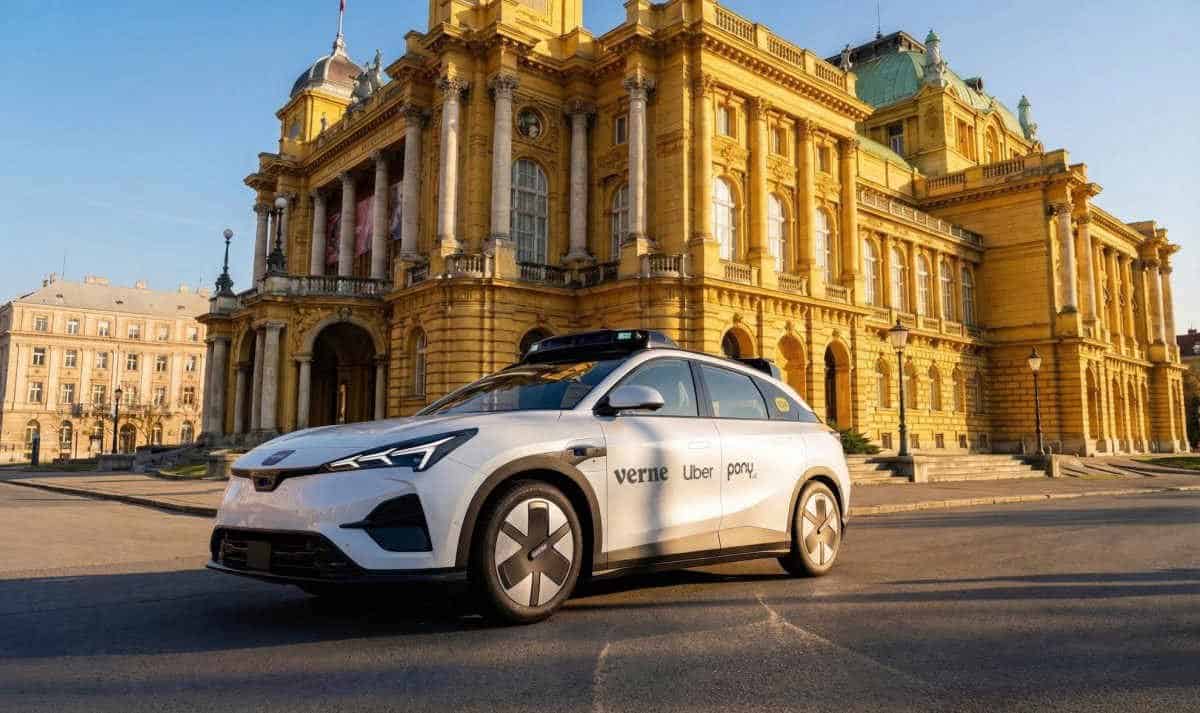
The two companies first partnered in May 2025 with a focus on the Middle East. Earlier this year they turned to Europe and announced plans to launch a commercial robotaxi service in Zagreb, Croatia with local company Verne.
What to watch instead of the headline number
Ignore the 2,000 figure for now. It’s an ambition, not a delivery schedule, and it isn’t attached to a timeline the companies have been willing to state.
Watch Zagreb. That service is the one with a named city, a named local partner and a stated commercial intent, and it’s the closest thing either company has to a European proof point.
If Verne and Pony.ai make Zagreb work, the four unnamed cities start to look like a plan. If they don’t, 2,000 stays a number in a press release.