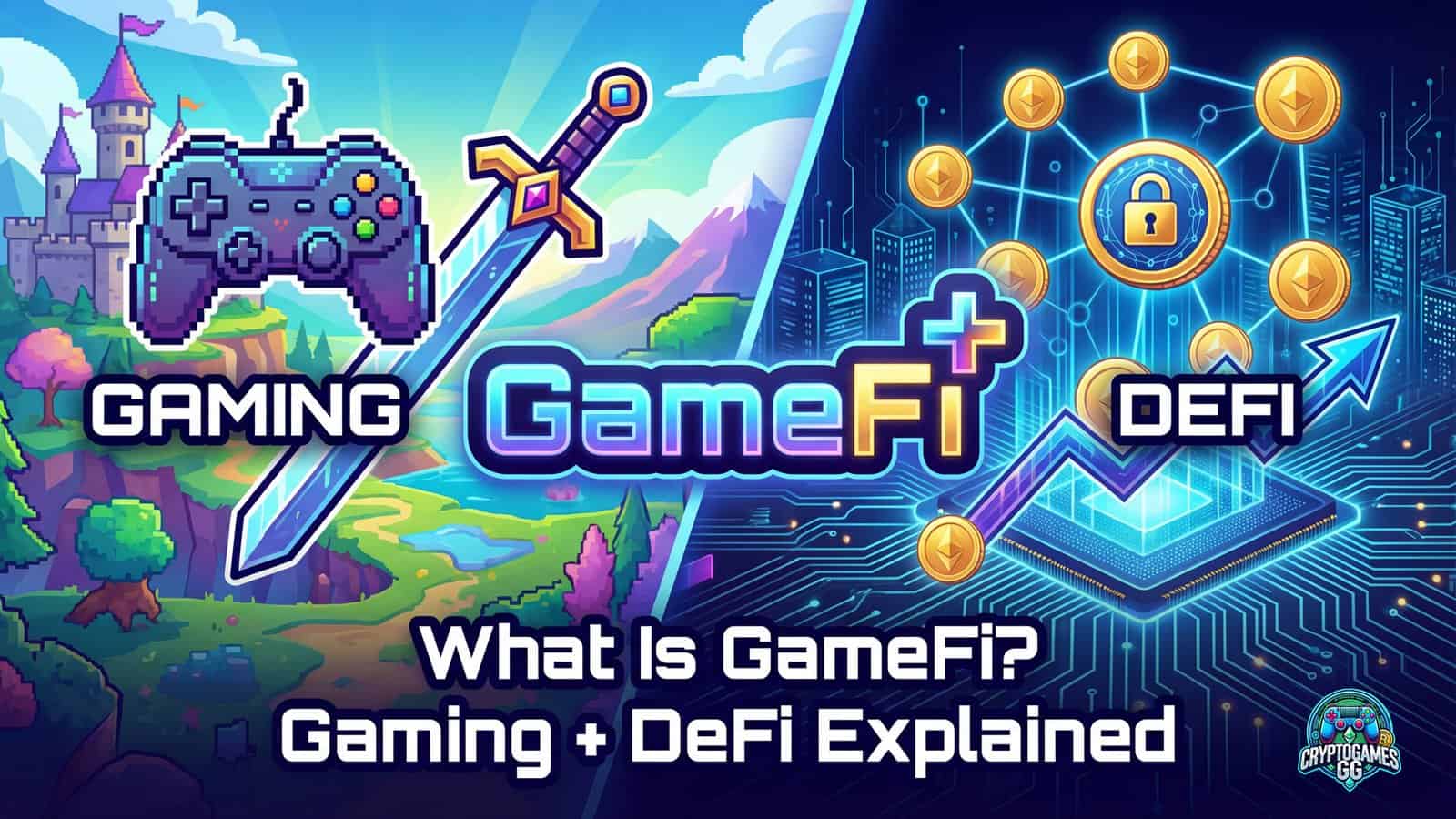




GameFi is what happens when a video game connects its economy to decentralized finance. Your quests, battles, and crafting sessions generate tokens with real market value. Those tokens can be traded, staked for additional yield, or used to vote on how the game develops. GameFi is not a genre of game. It is an economic model built on blockchain technology. The global Web3 gaming market, of which GameFi forms the core, was valued at approximately $37.55 billion in 2025 and is growing at a compound annual rate of roughly 19%.
Quick Answer: GameFi stands for game finance. It combines video gaming with DeFi mechanics like staking, yield farming, and liquidity pools. Players earn cryptocurrency tokens through in-game activities, and those tokens have real market prices. Governance tokens let players vote on game development. The result is a game economy where your time and skill generate real, portable financial value.
Where GameFi Came From
The term GameFi emerged around 2020, combining gaming with DeFi, which stands for decentralized finance. DeFi had already proven that financial services like lending, trading, and yield generation could run on blockchain without banks. GameFi asked what happens when players earn from those financial systems by playing a game.
Axie Infinity was the proof of concept. By 2021, players in the Philippines earned hundreds of dollars per month breeding, battling, and trading digital creatures called Axies. Each Axie was an NFT. Gameplay generated SLP tokens that had real exchange value. The model spread globally and sparked billions in investment across the space.
The 2022 token price collapses that followed taught the industry hard lessons about tokenomics sustainability. The GameFi projects that survived and grew through 2023 to 2026 are those that built genuine gameplay value alongside the financial mechanics. That distinction, game quality combined with sound economics, defines the better GameFi projects operating today.
How a GameFi Economy Is Structured
Every GameFi game operates three distinct layers that work together to create a complete economic system.
The game layer is the actual gameplay. Quests, combat, crafting, resource management, social systems. This layer must be engaging enough that players keep returning. Without an active player base, the token economy loses its foundation. The best GameFi games in 2026 are ones where players would keep playing even if the tokens had no financial value.
The token layer connects gameplay to real-world value. When you complete a qualifying action, a smart contract releases tokens to your wallet automatically. Those tokens trade on decentralized exchanges at real prices determined by supply and demand.
The DeFi layer extends value generation beyond active play. Tokens and NFTs can be staked to earn yield. They can be contributed to liquidity pools. In some cases, in-game assets serve as collateral for loans through DeFi lending protocols. Your game items become financial instruments, generating returns even while you sleep.
Pro Tip: Before evaluating any GameFi project financially, check the daily active wallet count on DappRadar first. Token price can be manipulated through wash trading. Daily active wallets representing real players cannot be easily faked. A rising wallet count, combined with a stable token price, is a healthier signal than a rising price on declining wallets.

The DeFi Mechanics Inside Games
Staking means locking tokens or NFTs in a smart contract for a defined period. In return you receive additional tokens as yield. In a GameFi context, staking your governance tokens might generate a daily reward regardless of whether you play that day. Some games let you stake character NFTs, your game items themselves, to earn passive token income.
Yield farming goes further. You deposit tokens into a liquidity pool, pairing them with a stablecoin like USDC. Other traders use that pool to buy and sell the token. You earn a percentage of every trade fee generated by the pool. This creates passive income from the game’s trading activity without requiring gameplay at all.
Liquidity pools are what make decentralized token trading possible. When you buy a game token on a decentralized exchange, you buy it from a pool of tokens deposited by liquidity providers. The deeper the pool relative to trade size, the less slippage on each transaction. Healthy pools indicate genuine economic activity.
Governance voting uses tokens to let holders vote on proposals that affect the game. New features, emission schedule changes, treasury allocations, balance updates. Holding governance tokens turns you from a customer into a co-owner with real decision-making power over the game’s future.
Dual Token Models Explained
The dual token model emerged as the standard solution to early GameFi’s inflation problem. When a single token serves as both gameplay reward and governance mechanism, the inflation from freely minted gameplay earnings destroys the governance token’s value. Separating them into two distinct assets solved this.
The governance token has a fixed or tightly controlled maximum supply. It represents long-term ownership in the game ecosystem. Holders earn protocol fees and vote on major decisions. Because supply is genuinely scarce, sustained player demand can support its price over time. This is why AXS, Axie Infinity’s governance token, held value better than SLP even during the 2022 crash.
The utility token is earned freely through gameplay. Players spend it on actions like breeding, upgrading items, crafting, or entering competitions. These spending mechanisms are called token sinks. When sinks match the rate of token emission, the utility token maintains value. When emission outpaces sinks, inflation destroys earning value. This balance is the central design challenge of every GameFi project.
RavenQuest on Ronin Network implements this model with its QUEST token. The crafting economy, guild mechanics, and seasonal competitive events create multiple natural sinks that have helped maintain token value through volatile market conditions in 2025.
How GameFi Is Different from Regular Play-to-Earn
Play-to-earn is a subset of GameFi. All P2E games are actual crypto games and fall under GameFi, but not all GameFi games are primarily P2E. The distinction matters.
A pure play-to-earn game focuses on generating tokens through gameplay. The financial mechanics are simple: play, earn tokens, sell tokens. The DeFi layer is minimal or absent. Early Axie Infinity was primarily play-to-earn with some governance token mechanics.
A full GameFi ecosystem integrates the game, token layer, and DeFi layer deeply. Players can earn through gameplay, stake their NFTs passively, contribute to liquidity pools, borrow against in-game assets, and vote on protocol parameters. The game becomes a complete financial ecosystem, not just a token distribution mechanism.
Illuvium represents the more complete GameFi vision. Its ILV token has governance utility, staking rewards, protocol fee distribution, and is backed by genuine AAA game production. The game’s economics connect to the broader DeFi ecosystem through Immutable X’s infrastructure.
GameFi Tokenomics: What to Evaluate
Maximum token supply. Fixed supply means tokens cannot be infinitely inflated. Uncapped supply means developers can mint more whenever they choose. Always check whether a supply cap exists and what percentage of total supply is currently circulating.
Token emission rate. How quickly are new tokens entering circulation? Compare the daily emission rate to the total daily trading volume. If new tokens entering circulation each day exceed what the market is buying, prices will fall over time regardless of game quality.
Token sinks. What mechanisms remove tokens from circulation? Breeding fees, upgrade costs, crafting materials, tournament entry, and land development are all examples of strong sinks. Cosmetic item purchases are weak sinks. The best GameFi games design sinks that feel natural and fun, not like arbitrary barriers to prevent inflation.
Vesting schedules. Check when team and investor tokens unlock. A large cliff unlock creates selling pressure that can crash prices regardless of game quality. Responsible projects span multiple years. According to CoinMarketCap’s GameFi glossary, token distribution and vesting are among the most important factors in evaluating any GameFi project’s long-term viability.
Pro Tip: Read the full tokenomics section of any GameFi project’s whitepaper before investing. Focus specifically on the emission schedule, the sink mechanisms, and team token unlock dates. If any of these three are vague or missing, treat that as a warning sign and move on to better-documented projects.
The Real Risks of GameFi
Token price volatility is inherent. The tokens you earn have prices that move with broader crypto markets. An asset worth $1 today can be worth $0.05 in three months. Your earnings in dollar terms are not stable income. Always convert meaningful earnings to stablecoins or fiat as you generate them rather than holding everything in game tokens.
Ponzi dynamics exist in poorly designed games. Some GameFi projects only sustain token prices as long as new players keep entering and buying. When new investment slows, prices fall, existing players exit, prices fall further. This cycle does not describe all GameFi projects, but it describes the failure mode of many. The presence of genuine gameplay and strong token sinks is the clearest signal of sustainability.
Smart contract exploits can result in total loss. The Ronin bridge hack in March 2022 resulted in $625 million stolen from the Axie Infinity ecosystem. Always verify that a game’s contracts have been audited by a reputable security firm like Certik or Trail of Bits before depositing significant assets.
Regulatory classification is evolving. Some jurisdictions are beginning to classify GameFi tokens as securities. Others treat earnings as taxable income from the moment of receipt. The legal landscape is changing. Keep records of everything you earn and consult a crypto-aware tax professional if your earnings are meaningful.
The Best GameFi Projects in 2026
RavenQuest on Ronin Network is one of the strongest new GameFi titles of 2025 and 2026. Its QUEST token economy is built around genuine MMORPG gameplay. The crafting system and guild mechanics create strong natural token sinks. The game attracted a substantial new wallet count on Ronin throughout 2025.
Gods Unchained on Immutable X generates consistent NFT trading volume through its card game format. Skill directly determines earnings. Better players open more reward packs through ranked play, creating a merit-based earning structure that sustains genuine player engagement beyond speculative interest.
Illuvium on Immutable X takes the most complete approach to GameFi. AAA game production, carefully managed ILV governance tokenomics, and deep integration with DeFi mechanics through Immutable’s infrastructure. It represents the direction the best GameFi projects are moving toward.
Axie Infinity on Ronin remains the most recognized GameFi brand. The game has evolved significantly since 2022, with new game modes and improved token mechanics built on lessons from the SLP collapse. The Ronin Network it built has become home to multiple other strong GameFi titles.
Frequently Asked Questions
What does GameFi stand for?
GameFi stands for game finance. It is a combination of gaming and DeFi, which stands for decentralized finance. The term describes blockchain games that incorporate financial mechanics, including token earning, staking, yield farming, and governance voting directly into their game systems.
How is GameFi different from regular gaming?
In regular gaming, the value you create stays inside the game as points, levels, or cosmetics. In GameFi, you earn tokens and NFTs with real market prices that you can convert to other cryptocurrencies or fiat currency. Your time and skill have externally verifiable financial value.
Is GameFi the same as play-to-earn?
Play-to-earn is a subset of GameFi. All P2E games are GameFi, but GameFi is broader. It includes staking, yield farming, liquidity provision, governance, and other DeFi mechanics beyond simply earning tokens by playing. A game can be fully GameFi without having a primary play-to-earn focus.
Can you make real money with GameFi?
Yes, though it is not guaranteed. Earnings depend on the game, your time investment, skill level, and current token market conditions. Some players earn meaningful supplementary income. Most earn smaller amounts. Treat GameFi as a side income opportunity with real upside and real risk, not a salary replacement.
What happened to GameFi after the 2022 crypto crash?
Projects that relied on new player investment to sustain token prices failed. The survivors built genuine gameplay and sustainable tokenomics. The space contracted significantly in 2022 and 2023, then began recovering as better-designed projects launched. Games released from 2023 onward tend to have more mature economies than those from the 2021 generation.
GameFi is not a guaranteed money machine. It is a genuinely new economic model for games. The best projects in 2026 are those where you’d enjoy playing even if the tokens had no financial value. When genuine gameplay and sound economics come together, the GameFi model works sustainably. That combination is your most reliable filter for identifying which projects are worth your time.