

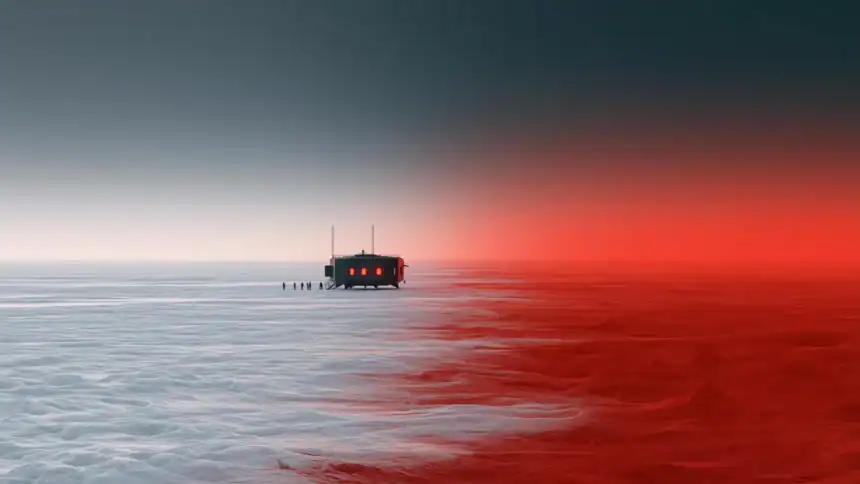
More time spent near your crewmates made things worse, not better.
That’s the headline result from a study of a ten-month overwintering mission at Concordia Station in Antarctica, where an international research group tracked 12 crew members through the darkest, coldest stretch of the year. Participants who had more frequent contact with others were also more likely to report increased conflict, greater mistrust, and lower performance.
Which is not what most people assume about isolated teams. The intuition says loneliness is the enemy and togetherness is the cure. The sensor data says the arithmetic is messier than that.

Why Antarctica stands in for Mars
Concordia sits among the most remote places on Earth. Winter temperatures there fall as low as minus 80 °C (-112 °F), and nobody is coming to get you until the season turns.
That combination of distance, confinement and no exit makes it one of the strongest real-world stand-ins for future extended missions to the Moon or Mars. Long space missions can force small crews to endure isolation, cramped living conditions, and intense psychological pressure for months at a time. Concordia does the same thing, on this planet, where researchers can actually measure it.
The work was led by Jan Schmutz, a professor in the Department of Psychology at the University of Zurich, and Andrea Cantisani, a psychiatrist and research associate at the University of Bern.
Questionnaires alone wouldn’t have caught this
The 12 crew members completed questionnaires at four points across the ten months. That part is standard.
The less standard part: they also wore sensors that automatically measured when they were physically close to other team members and how long those encounters lasted. So the study has a record of who was actually near whom, and for how long, rather than only what people remembered and chose to write down.
Combining the two let the researchers follow changes in loneliness, trust, conflict, social relationships, team cohesion, and perceived performance as the mission went on.
"In small teams under extreme conditions, more contact doesn’t automatically equate to social support, but can actually increase tensions," said Schmutz.
The caveat the researchers put on their own result
This is correlation. The team says so plainly, and it matters.
People who felt lonely may have sought out more interaction, even when those encounters did not provide the support they needed. Run that scenario and you get exactly the pattern in the data without contact causing any of the harm. The study can’t separate the two.
What it does support is a softer claim that’s still useful: constant closeness can become another source of pressure in confined environments. Isolation is hard. Having nowhere to be alone is also hard.
The crew split along language lines
The proximity sensors picked up something the crew may not have narrated to themselves. As the mission continued, the group gradually separated into smaller subgroups, with people increasingly spending time alongside colleagues who shared their language or nationality.
Read that generously and it’s a coping mechanism. Those connections may help individuals feel supported and grounded during stressful periods.
Read it the other way and it’s a fracture. The same clustering may encourage social divisions and weaken unity within culturally diverse teams, which is a description of most crewed mission rosters.
What this changes for mission planning
Astronauts on extended missions may have very little privacy and only limited communication with people outside the spacecraft or habitat. If more forced proximity doesn’t reliably buy you cohesion, then habitat design and crew scheduling are doing more psychological work than a team-building brief ever will.
"The results show how important it is to identify social dynamics early on and provide teams with targeted support," said Schmutz.
The findings may also apply to other demanding environments, including submarines, offshore oil platforms, and remote research stations. Anywhere a small group is sealed in together for a long time, the same dynamics are in play.
The hardware held up, which is its own result
Wearable proximity sensors running reliably at minus 80 °C is not a given, and the study showed they can operate in extreme environments. They let researchers monitor changes in everyday social patterns without substantially disrupting the crew’s routines, which is the whole trick with this kind of observation.
The open question is granularity. Not all contact is the same contact, and the next round of work will look more closely at which types of social interaction help relieve stress and which ones may add to it. Until somebody answers that, a Mars crew plan that treats time together as automatically good is running on an assumption this data doesn’t back.