
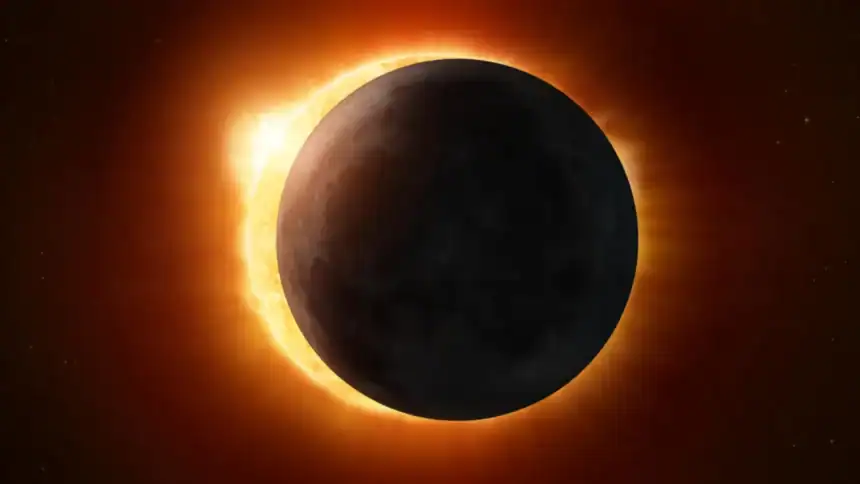
The narrow path where the Moon fully blocks the Sun on Aug. 12, 2026 clips a corner of Europe and not much more. Greenland, Iceland, a small part of northeastern Portugal, then Spain. Everyone else on the continent gets a partial eclipse, which is a different experience entirely.
That’s the honest framing before you plan anything. If you’re outside that strip, you’ll see the Moon take a bite out of the Sun and the daylight go slightly flat. Impressive, but not the thing people fly across the world for.

The whole show at Javalambre lasts 1 minute and 21 seconds
The European Space Agency is broadcasting live from the Observatorio Astrofisico de Javalambre in Teruel, Spain, and totality there hits at 2:31 p.m. EDT (11:31 a.m. PDT). Eighty-one seconds. Then it’s over and the observatory comes back into daylight.
The stream starts earlier, at 1:30 p.m. EDT (19:30 CEST), on ESA Web TV and ESA’s YouTube channel. It’s expected to wrap around 2:45 p.m. EDT (11:45 a.m. PDT), in English throughout.
Why they picked a mountain observatory and not a scenic overlook
Javalambre sits directly inside the path of totality, which is the non-negotiable part. But the site selection goes further than that.
Cloud cover there is uncommon and light pollution is low. The clincher is the view toward the western horizon, which is unusually clear, and that matters here because the Sun will be heading toward sunset while the Moon crosses it. A low Sun and a blocked western sky would have killed the shot.
The observatory isn’t a tourist installation either. Its two main professional telescopes run wide-sky surveys used to study galaxies, dark energy and the large-scale structure of the cosmos. Observatory director Javier Cenarro will talk during the broadcast about the site and what it means for a future ESA space science mission.
Several extra small telescopes are being hauled up specifically for the eclipse. Their feeds run continuously so you can watch the Moon creep across the Sun through each stage rather than cutting straight to the money shot.
Three feeds, because one sky can betray you
ESA isn’t betting everything on Teruel. Two more live feeds come from other spots inside the path of totality, which raises the odds that at least one camera has a clean view when it counts.
One comes from ESA’s public event in Leon. The other originates in Fromista, in Palencia, where collaborator Alejandro Sanchez de Miguel is running eclipse observations. He’s affiliated with the Institute of Astrophysics of Andalusia, the Complutense University of Madrid and the Stars4All Foundation.
Redundancy like that is the tell of a team that has been burned by weather before.
Who’s on camera
Award-winning space scientist and science communicator Dame Dr Maggie Aderin hosts. Guests include ESA’s Director of Science Professor Carole Mundell, ESA scientists Andy To, Miho Janvier and Martin Hewitson, plus Cenarro.
Coverage mixes telescope views with drone footage, and ESA is planning to show Maggie and Carole reacting as totality lands. That’s a deliberate choice. Reaction shots during an eclipse are usually the most watchable footage anyone gets.
The interviews cover the Sun and its corona, the eclipse that helped rewrite our understanding of gravity, and ESA’s work creating artificial solar eclipses in space.
What you’re actually looking at
An eclipse happens when the Moon slides directly between Earth and the Sun, hiding it and dropping a narrow band of Earth into darkness.
With the Sun’s bright surface covered, its faint wispy atmosphere shows up. Stars and planets can appear, temperatures can drop and winds may strengthen. Birds and insects sometimes start acting like night has arrived, which is the detail that tends to unsettle people more than the sky does.
If you’re in Spain and not at an observatory, you’re in a decent spot regardless. Conditions across the country are expected to be excellent as the eclipse tracks west to east. If you’re anywhere else in Europe, open the stream at 1:30 p.m. EDT and set a second alarm for 2:31 p.m. EDT, because the part everyone remembers is shorter than the ad break before it.