

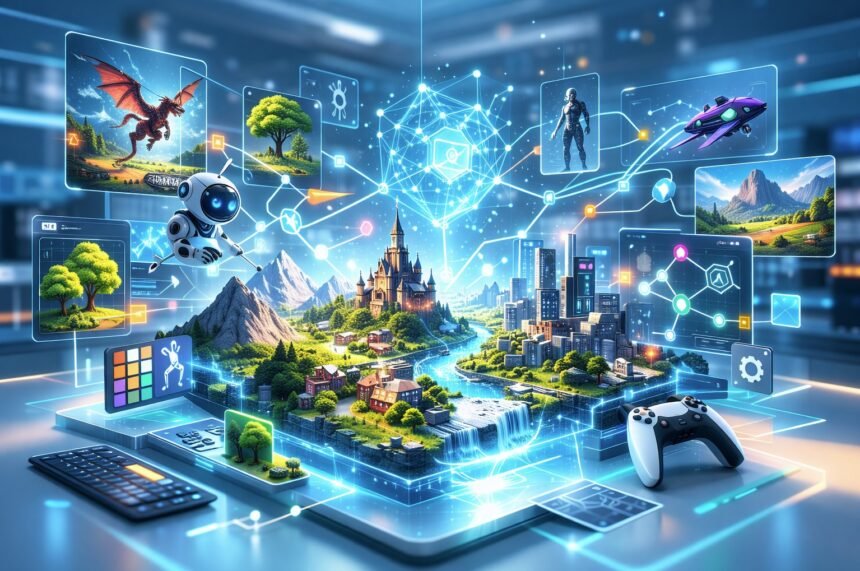
Video game development is undergoing a dramatic transformation, with gamers no longer just passive consumers of content, instead becoming real participants in their creation. You can thank generative AI for driving this shift – it’s putting powerful creative capabilities into the hands of everyone, enabling developers to move away from designing every aspect of their games and instead giving more control to their audiences.
We’re talking about a future of video games where players get to help build the narrative, decide what the characters look like and how their storylines arc, dictate the environment and much more besides.
Developers will always be crucial, but they’ll be much more focused on the fundamental game mechanics – things like the foundational rules, the physics and the core narrative or premise. But it’ll be the players that get to decide what the finer, more personal details of games look like. In future, they’ll be able to help design both playable and non-playable characters, how the storyline flows and evolves, and more. User input, thanks to AI, is becoming the new fuel of game creation.

Video Game Developers Can No Longer Ignore Gamer’s DesiresThis is not just some speculative future. It’s a trend that’s accelerating now. We’re seeing it in multiple game genres. For instance, the online casino Stake.com is leading the generative AI push in casino games development with SlotGPT, which is a platform that enables slot machine fans to design the very machines they gamble on for real money. With SlotGPT, players can create slots with almost any kind of theme – perhaps a favorite movie like Terminator, an NFL-themed slot or something with dozens of cute kittens. Whatever they desire.
SlotGPT gives players a surprising amount of control. Besides the theme, they can even specify the sound effects and vocals, and they can even adjust the frequency at which players win, albeit only within reasonable limits. It provides an early taste of what the future of personalized gaming will bring.
Generative AI is actively shaping game narratives, too. Before, most games were fairly linear, with only a few variations in how the story arc progresses. But titles such as Fallout and The Elder Scrolls give players much greater agency, enabling them to experience evolving stories that adapt based on their in-game actions and choices. Each time the player makes a decision, generative AI models use those inputs to generate an entirely novel narrative, ensuring each player’s journey is completely unique. It’s a far cry from the static, pre-determined plot structures we’re used to.
Some developers have emerged that are entirely focused on harnessing player inputs. For instance, GoodAI is the creator of a new game called AI People that allows players to create different scenarios and non-playable characters, dictate how they behave and so on. AI People are like virtual inhabitants that live in the game, have feelings and emotions, pursue their personal goals and so on. They live almost complete virtual lives, and interact with their environment fully autonomously, but it’s the players who decide their character, how they look, where they live and so on.
While this shift is still in its very early stages, it’s gaining traction at a rate that’s impossible to ignore. Players are no longer just consumers. They’re becoming active collaborators in the game creation process, building in-game experiences that better reflect what they’re looking for. The future of video gaming will be more personal, more enjoyable and more original, with different outcomes for every kind of player.