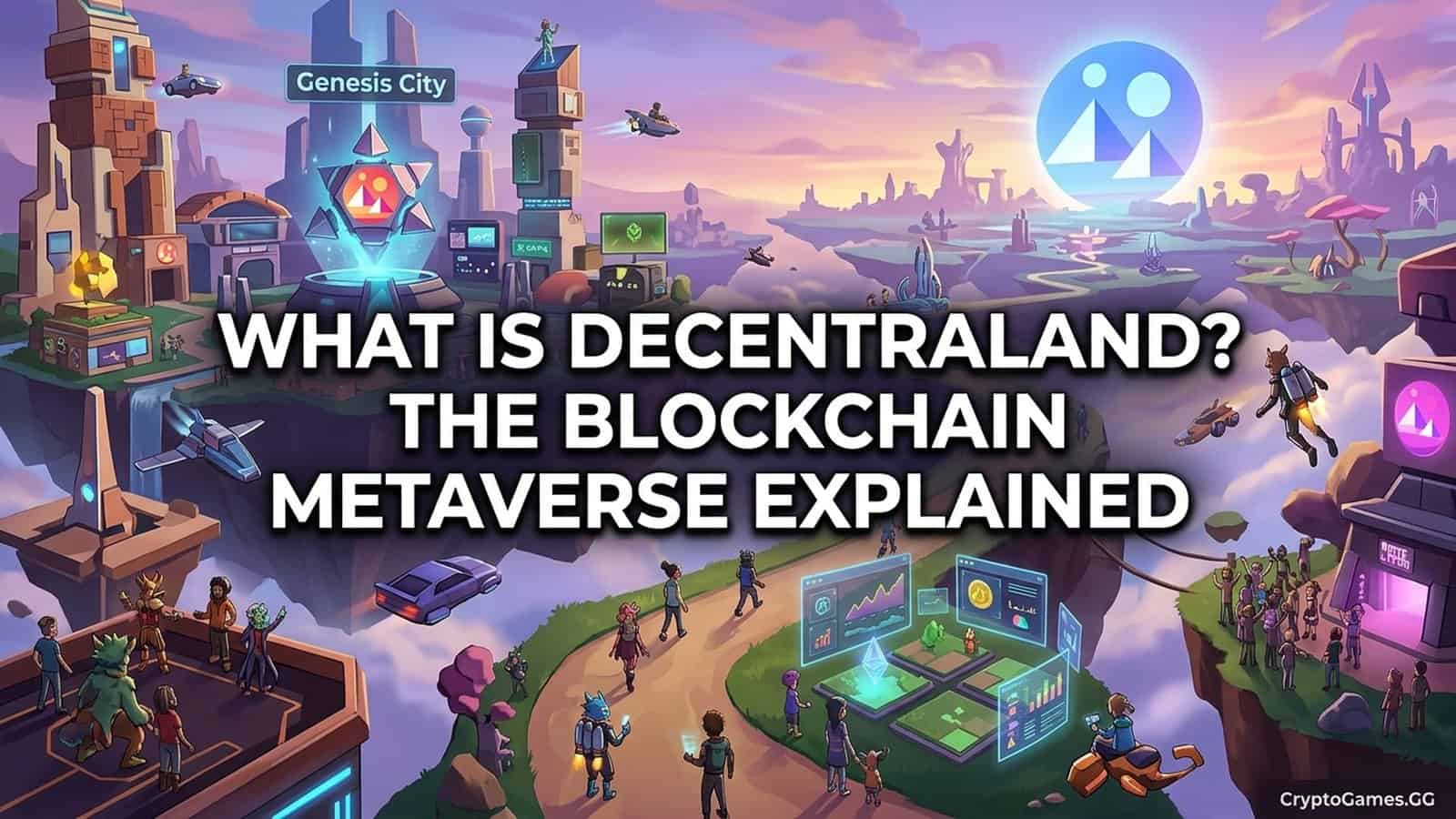


What Is Decentraland? The Blockchain Metaverse Explained
Decentraland MANA $0.08853 ▼ -1.1% is a browser-based 3D virtual world where users own parcels of virtual land as Ethereum NFTs, build interactive experiences on that land, and interact through an avatar system. Launched in 2020, it was one of the first blockchain-based metaverse platforms to reach public availability. The MANA token governs the platform and serves as its primary currency. In 2026, Decentraland occupies an important historical position in blockchain gaming while its actual daily active user counts remain modest compared to the ambitions expressed during its 2021-2022 peak valuation period.
Quick Answer: Decentraland is a blockchain-based 3D virtual world on Ethereum where users own virtual land parcels as NFTs called LAND. The platform runs on a DAO governed by MANA and LAND token holders. Users explore districts, attend events, play games built by other users, and trade virtual real estate. The MANA token is used for marketplace transactions and governance. The platform is browser-accessible without special hardware.
Table of Contents
- How Decentraland Works
- LAND: The Virtual Real Estate System
- MANA: The Token Economy
- What You Can Do in Decentraland
- Building in Decentraland
- Decentraland DAO: Community Governance
- Honest Assessment: Where Decentraland Stands in 2026
- Frequently Asked Questions
How Decentraland Works
Decentraland is accessible through a web browser without requiring a special application download. Users visit decentraland.org, connect an Ethereum wallet or use a guest mode, and enter the 3D virtual world through the browser interface. The world runs on WebGL graphics rendered in the browser, which makes it accessible but limits the visual fidelity compared to native game applications.
The virtual world is a large grid divided into parcels called LAND. Each LAND parcel is 16 meters by 16 meters in virtual space. Adjacent parcels can be combined into Estates, which allow larger continuous building projects. The total LAND supply is fixed at 92,598 parcels, making virtual real estate genuinely scarce by design.
Users navigate the world with keyboard and mouse controls. Avatar customization is available through wearables, which are NFT cosmetic items that can be purchased from the Decentraland Marketplace or from third-party marketplaces. Wearables range from clothing and accessories to complete avatar transformations.
LAND: The Virtual Real Estate System
LAND is the core NFT asset of Decentraland. Each LAND parcel is an ERC-721 token on Ethereum, representing ownership of a specific coordinate location in the Decentraland world. Owning LAND entitles the holder to build on that parcel, control what experiences visitors encounter there, and determine how the space looks and functions.
LAND value depends primarily on location. Parcels adjacent to Genesis Plaza, the central hub where new users typically land, command premium prices due to traffic. Parcels in developed districts near popular experiences also attract higher valuations. Remote parcels far from active areas trade at lower prices.
Estates are formed by combining adjacent LAND parcels into a single NFT. Estates simplify management of multi-parcel projects and allow larger continuous building projects. The most prominent estates include the Fashion District, Crypto Valley, and the Vegas City entertainment area.
LAND can be rented to other users who want to build experiences without purchasing land outright. Rental income from high-traffic LAND generates passive MANA income for landowners who do not want to develop the property themselves.
MANA: The Token Economy
MANA is the primary currency of the Decentraland ecosystem. It is used to purchase LAND and wearables on the Decentraland Marketplace, to pay for names and other registry items, and to participate in DAO governance votes.
MANA is an ERC-20 token on Ethereum. The supply is not fixed — additional MANA can be minted through governance decisions by the Decentraland DAO. However, LAND purchases burn MANA, creating a permanent removal of tokens from circulation that counteracts inflation from any new issuance.
Governance in Decentraland requires converting MANA into voting power tokens called wMANA. The conversion is reversible. One wMANA equals one vote in DAO proposals. Larger MANA and LAND holders have proportionally more governance weight, creating a property rights-weighted governance model.
The MANA price peaked above $5 in November 2021 during the metaverse hype cycle and declined through 2022 alongside the broader crypto market. It has traded at significantly lower levels through 2023-2026. Price recovery depends on genuine platform growth in active users and economic activity.
What You Can Do in Decentraland
Decentraland functions as a social platform and event venue more than a traditional game. Most visitor activity centers around exploring community-built experiences, attending events, and socializing.
Events and concerts have been Decentraland’s strongest use case since launch. Virtual concerts, art exhibitions, and conferences have drawn meaningful attendance from users interested in the format. Metaverse Fashion Week, held annually in Decentraland, has attracted real fashion brands including Tommy Hilfiger, Dolce and Gabbana, and Philipp Plein.
Games and interactive experiences built on LAND parcels by community members range from simple gambling games to elaborate escape rooms and scavenger hunts. Quality varies enormously based on the builder’s skill and investment level.
Art galleries and museums exhibit digital art, NFT collections, and virtual installations. Some galleries represent real-world artists with digital versions of their work. The museum district contains community-maintained exhibition spaces.
Social interaction through voice and text chat allows users to meet other avatars. Events are the most effective context for social interaction as they provide shared activity to structure conversation.
Building in Decentraland
LAND owners can build using the Decentraland Builder, a drag-and-drop tool that does not require coding for basic scene creation. More complex interactive experiences require the Decentraland SDK (Software Development Kit), which uses TypeScript and allows sophisticated scripted interactions, game logic, and animated content.
Published scenes are stored in a decentralized way through IPFS (InterPlanetary File System), meaning the scene content is not stored on Decentraland company servers. This makes published content resistant to removal even if the Decentraland Foundation ceased to operate.
Building quality directly affects traffic. Well-designed, actively promoted experiences on prime LAND locations generate visitor traffic. Empty parcels or poorly designed scenes attract essentially no visitors regardless of location.
Decentraland DAO: Community Governance
The Decentraland DAO controls the core smart contracts governing the platform. This includes the LAND registry, the Marketplace contract, the Wearables registry, and the Treasury that holds platform funds.
The DAO has passed meaningful governance proposals including fee changes, land auction parameters, and development fund allocations. The DAO Security Advisory Board reviews technical proposals for security implications before governance votes. This structure gives genuine governance power to MANA and LAND holders over the platform infrastructure.
The degree of decentralization is notable compared to most blockchain gaming platforms. The Decentraland Foundation is separately organized from the DAO and performs development and marketing functions, but cannot unilaterally change the core protocol contracts that the DAO controls.
Honest Assessment: Where Decentraland Stands in 2026
Decentraland’s actual daily active user numbers have remained modest relative to its peak valuation. The 2021-2022 period saw MANA and LAND prices reach levels that implied massive platform adoption that has not materialized in real user metrics. In 2026, the platform has genuine activity concentrated in events and specific experience hubs, but it is not the mass-market metaverse that some predicted.
The platform’s strengths are real: genuine DAO governance, truly decentralized content storage, established brand partnerships willing to host events, and a functional development toolchain. These give Decentraland durability as a platform even without explosive user growth.
The limitations are also real: browser-based WebGL graphics that cannot match native game visual quality, load times that frustrate casual visitors, an experience catalog where quality varies enormously, and daily active user counts that remain a fraction of traditional metaverse platforms like Roblox.
Decentraland makes most sense for: NFT art collectors who want virtual exhibition space, event organizers exploring virtual event formats, and developers building decentralized experience infrastructure. It makes less sense as a primary gaming destination compared to platforms with more developed game content.
Frequently Asked Questions
What is Decentraland used for?
Decentraland is primarily used for attending virtual events and concerts, exploring community-built games and interactive experiences, exhibiting and viewing NFT art, and socializing through avatar interactions. It is also used for virtual real estate investment through LAND ownership and development.
Is Decentraland free to use?
Yes. Entering and exploring Decentraland as a visitor is free using guest mode or a connected Ethereum wallet. Purchasing LAND, wearables, or names requires MANA. Creating and publishing experiences on land you own is also free using the Builder tool, though the Decentraland SDK requires developer skills for complex experiences.
What is MANA used for?
MANA is used to purchase LAND parcels, wearables, and names in the Decentraland Marketplace. It is also used for DAO governance by converting to wMANA for voting weight. MANA is burned when used to purchase LAND, permanently removing those tokens from circulation.
Is Decentraland still active in 2026?
Yes, though with modest daily active user numbers compared to its 2021-2022 peak valuation. The platform continues to host events including Metaverse Fashion Week, maintain its DAO governance, and host community-built experiences. Brand partnerships continue for virtual events. The platform functions but has not achieved the mass-market adoption that its peak valuation implied.
Decentraland represents a genuine attempt to build a decentralized user-owned virtual world with real governance and decentralized content storage. Whether its user base eventually grows to match that architectural ambition depends on whether virtual event and experience formats develop broader mainstream appeal. In 2026, that growth has been slower than optimists hoped and more durable than pessimists predicted.