
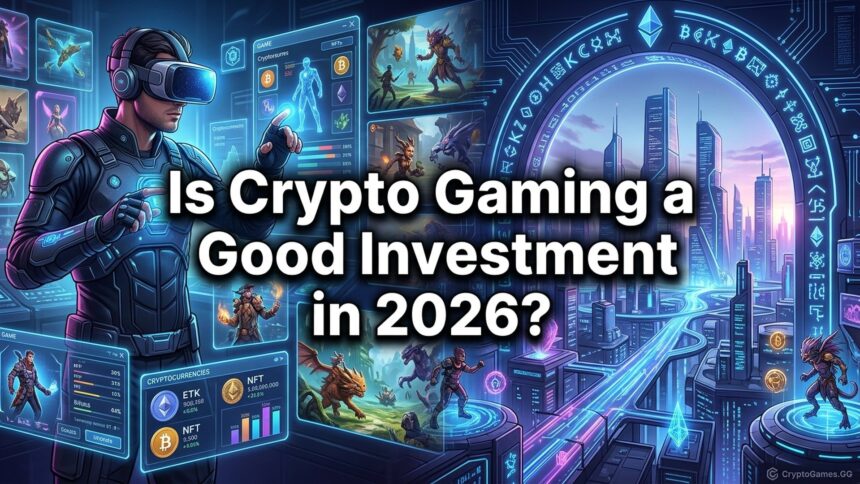
The honest answer is: it depends entirely on what you mean by investment, how much capital you’re willing to risk, and which part of the ecosystem you’re participating in. Crypto gaming is not a monolithic asset class — it ranges from ultra-speculative new game tokens to more established projects with track records, and the risk profiles are radically different. This article gives you the framework to think about it clearly.
What You’re Actually Investing In
When people talk about investing in crypto gaming, they’re usually talking about one or more of these: buying game tokens as speculative crypto assets, purchasing NFT game assets to use in play or rent out, buying shares in publicly listed blockchain gaming companies, or investing time (rather than capital) to earn through gameplay. Each has a completely different risk/reward profile.
Game tokens are the highest risk and highest potential reward. They behave like small-cap crypto with additional exposure to the specific game’s adoption risk. NFT assets are more stable than tokens in some games but still highly illiquid and project-specific. Listed gaming companies offer more conventional equity investment characteristics — regulated, auditable, but with significant exposure to crypto market sentiment regardless of their own fundamentals.

The Case For Investing in Crypto Gaming
The global gaming market is enormous — over $200 billion annually — and blockchain gaming’s share of that market has grown from near-zero in 2019 to a measurable percentage today. If Web3 mechanics become standard features in mainstream gaming, early-mover investments in the infrastructure, guilds, and leading games have significant upside. The technology is maturing, major studios are experimenting with the space, and player numbers across leading titles have stabilised at meaningful levels.
Additionally, the investment landscape in 2026 is cleaner than it was in 2021–2022. Many purely speculative projects have failed, leaving a smaller number of games with genuine players, real economies, and teams with track records. Due diligence is more meaningful now — you can look at actual player count data, token velocity metrics, and tournament participation figures rather than just whitepapers and Discord member counts.
The Case Against (The Risks)
Most crypto gaming tokens have lost significant value from their peaks. The structural challenges are real: player numbers need to be sustained to support token demand, game development is expensive and risky, and the genre is littered with projects that raised large amounts and delivered nothing. Token markets are easily manipulated, and retail investors are the last to know when a project is being abandoned.
Regulatory risk is also increasing. Jurisdictions across the US, EU, and Asia are scrutinising GameFi economics and NFT markets more closely than they did in the boom years. Regulatory actions — whether treating game tokens as securities or imposing NFT market restrictions — remain meaningful tail risks for the sector as a whole.
Which Parts of Crypto Gaming Have Performed Best
Infrastructure plays — the blockchains and layer-2 networks that power gaming (Immutable X, Ronin, Polygon) — have generally outperformed individual game tokens over multi-year horizons. Platform bets rather than individual game bets have been the winning strategy historically. The top gaming tokens guide covers the leading infrastructure and game tokens currently tracked for investor interest. For project-level analysis, the GameFi projects rankings provides our current assessment of the leading games and ecosystems.
Investment Principles for Crypto Gaming
Only invest what you can afford to lose entirely. Diversify across games and ecosystems rather than concentrating on a single project. Treat time investment (active earning) separately from capital investment (token and NFT purchases) — the first has limited downside, the second has complete downside risk. Monitor the metrics that matter: active daily users, token velocity, burn rates, and team communication cadence.
FAQs
Is crypto gaming a good investment in 2026?
For those with high risk tolerance and an ability to do thorough research, selected crypto gaming investments have meaningful upside. For capital-preservation-first investors, the volatility and project risk make it unsuitable as a significant portfolio allocation.
Should I buy gaming tokens or gaming NFTs?
These serve different purposes. Tokens are more liquid and speculative. NFTs generate yield through play or rental but are illiquid. Most active participants hold both — NFTs for income generation, tokens for speculative exposure.
What percentage of my portfolio should crypto gaming represent?
Financial advisors typically recommend limiting speculative assets to 5–10% of total investments. Given the volatility of gaming tokens, this is a reasonable upper bound for most retail investors.
How do I research a crypto game before investing?
Check token emission schedules, active player counts (not downloads), team track records, smart contract audit reports, and community quality. Whitepapers are marketing — on-chain data and community sentiment are more reliable signals.