

If you’ve heard the term “Web3 gaming” and felt like everyone else understood something you didn’t, you’re not alone. The phrase gets thrown around constantly — in crypto circles, in gaming press, in investor decks — but the actual explanation is usually buried under jargon.
This guide cuts through it. By the end, you’ll understand exactly what Web3 gaming is, how it differs from traditional gaming, why it matters, and whether it’s worth your attention as a player, developer, or investor.
No prior crypto knowledge required.

What Is Web3 Gaming? (Simple Answer)
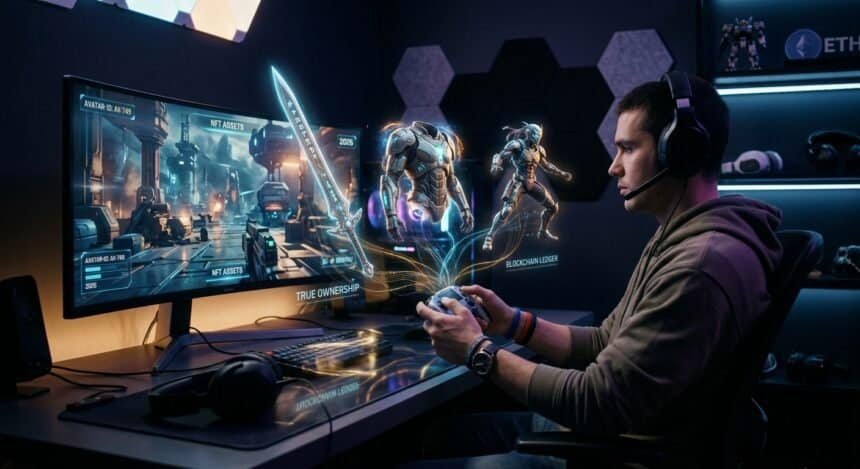
Web3 gaming refers to video games built on blockchain technology, where players can truly own their in-game assets — characters, items, currencies, and land — and take those assets outside the game. Unlike traditional games where everything you earn or buy lives on the developer’s servers, Web3 games store assets on a decentralized blockchain, giving players real ownership and the ability to trade, sell, or transfer items freely.
That definition fits in a paragraph, but the implications run much deeper. To understand why Web3 gaming is significant — and why it’s generating real debate — you need to understand what came before it.
Web1, Web2, Web3: A Quick History
The “Web3” in Web3 gaming refers to a broader evolution of the internet. Here’s the short version:
Web1 (roughly 1991–2004) was the read-only internet. Websites existed. People could visit them. There was no user interaction, no accounts, no posting. The internet was a library, not a conversation.
Web2 (roughly 2004–present) is the internet most people know today. Social media, streaming, cloud gaming, app stores. The key shift: users could create content, not just consume it. The catch: everything you create or buy lives on platforms owned by companies. Your Twitter account, your Spotify library, your World of Warcraft characters — none of it is truly yours. The platform can delete it, change it, or shut down, and it’s gone.
Web3 (emerging now) attempts to solve that ownership problem by moving data and assets onto blockchains — decentralized networks that no single company controls. The defining property: assets recorded on a blockchain exist independently of any company. If the company behind a Web3 game shuts down tomorrow, your assets still exist on the blockchain.
Web3 gaming is simply the application of Web3 principles to video games.
How Web3 Gaming Actually Works
Featured snippet: Web3 games run on blockchain networks — decentralized databases that record who owns what. When you earn or buy an in-game item in a Web3 game, that item is recorded as yours on the blockchain. You can hold it, sell it on a marketplace, or transfer it to another player without the game developer’s permission.
The mechanics are worth understanding in plain terms:
Blockchain as a ledger. A blockchain is a database that records transactions and ownership. Instead of a game company’s private server saying “player X owns this sword,” a public blockchain says it — and anyone can verify it. No single company can erase or modify it unilaterally.
Smart contracts as game rules. The economic rules of a Web3 game — how assets are minted, how they’re traded, what they’re worth — are often encoded in smart contracts: self-executing programs that run on the blockchain. A smart contract doesn’t need a human to enforce it. If the code says “the player who completes this quest receives this item,” that happens automatically.
Wallets as player identities. Instead of a username and password stored on a company’s server, Web3 players often use a crypto wallet as their identity. The wallet is software (or hardware) that holds your assets and proves ownership. Critically, the wallet belongs to you — not the game.
Tokens as in-game currencies and assets. Most Web3 games use tokens: either fungible tokens (interchangeable, like a currency) or non-fungible tokens (NFTs, which are unique, like a specific sword with specific stats). Both types are recorded on the blockchain and can be transferred.
None of this requires the average player to understand blockchain deeply. The best Web3 games abstract all of this behind familiar interfaces — login screens, inventory systems, marketplaces — so it feels like any other game. The blockchain is the backend. The game is still a game.
True Ownership: The Core Idea
The central promise of Web3 gaming is something that sounds obvious but has never existed in traditional gaming: you actually own what you earn.
Consider how traditional gaming works. You spend $70 on a game. You spend 200 hours building a character. You unlock rare skins, earn legendary weapons, and accumulate in-game currency. Then the game shuts down, or your account gets banned, or the developer decides to change the economy. Everything you built disappears. You have no legal claim to it, no way to transfer it, and no recourse. The terms of service made that clear from the start.
Web3 gaming challenges this model at a fundamental level. When a Web3 game issues a sword as an NFT on a blockchain, that sword is recorded as belonging to your wallet address. The developer cannot revoke it. You can sell it on a third-party marketplace, trade it to another player, or hold it. If the game shuts down, the NFT still exists — though its usefulness obviously depends on whether other games or platforms choose to recognize it.
This is a genuine philosophical shift in the relationship between players and games. For the first time, players can potentially accumulate value through gameplay and retain that value outside the game environment.
The caveat — and it’s an important one — is that ownership of an NFT doesn’t automatically translate to value. A sword in a dead game is still a sword in a dead game, even if you own it on the blockchain. The practical value of Web3 assets depends entirely on demand, liquidity, and ecosystem health. Ownership is the foundation; it’s not a guarantee.
NFTs in Gaming: What They Really Mean
NFT stands for Non-Fungible Token. “Non-fungible” simply means unique and non-interchangeable — unlike dollars, which are identical to each other, an NFT represents something specific.
In gaming, NFTs are used to represent items that have distinct identities: a specific character, a specific piece of land, a specific weapon with specific attributes. The NFT is a certificate of ownership recorded on a blockchain, verifiable by anyone, transferable to anyone without the original creator’s permission.
This has several practical implications that traditional gaming cannot replicate:
Scarcity that’s actually verifiable. When a game says “only 10,000 of this sword exist,” you can verify that claim directly on the blockchain. No server-side manipulation, no sudden inflation of supply. The code is public.
Cross-platform potential. In theory, an NFT item from one game could be recognized by another. In practice, this requires both games to agree on a shared standard — which is technically possible but commercially complicated. It exists today in limited forms and is an active area of development.
Secondary market access for players. In traditional games, if a weapon becomes extremely rare and desirable, the value accrues to the developer (who might sell it in a store) or to gray-market account sellers (who operate outside the rules). With NFTs, players can sell rare items on open markets, capturing value themselves.
Persistent digital assets. If a developer builds a sequel and chooses to honor original NFTs, players who held assets from the first game can carry them forward. This kind of backward compatibility has never been possible in traditional gaming, where progress resets with every new title.
The NFT discourse has been contentious — partly because early Web3 games issued NFTs primarily as financial instruments with thin game design underneath, creating speculative bubbles that collapsed. The games that have built lasting communities tend to be ones where the NFT exists to serve the gameplay, not the other way around.
Play-to-Earn vs. Play-and-Earn
Featured snippet: Play-to-earn (P2E) is a Web3 gaming model where players earn cryptocurrency or NFTs as rewards for gameplay, which can then be sold for real money. The newer “play-and-earn” model emphasizes fun-first design where earning is a byproduct, not the primary motivation — addressing the sustainability problems that collapsed early P2E economies.
The “play-to-earn” model became famous in 2021, primarily through Axie Infinity. The premise was simple: play the game, earn tokens, sell the tokens for real money. In some developing economies, players were earning more than local minimum wages. The model attracted millions of players and billions in investment.
Then the economy collapsed.
The problem was structural. Play-to-earn games often relied on a continuous influx of new players buying in to sustain the earnings of existing players. When new player growth slowed, token prices fell. When token prices fell, earnings dropped. When earnings dropped, players left. When players left, prices fell further. The feedback loop ran in both directions.
This wasn’t a one-time failure — it was a predictable outcome of designing a game economy around extraction rather than fun. If the primary reason to play is to earn, players leave the moment earning becomes unprofitable. A sustainable game needs players who would play for free.
The industry has largely absorbed this lesson. The language has shifted from “play-to-earn” to “play-and-earn” — a framing that puts gameplay first and treats earning as a secondary benefit. Games like Pixels on Ronin and Gods Unchained on Immutable retain players because they are genuinely fun and socially engaging; the blockchain layer adds asset ownership and earning potential without replacing the intrinsic motivation to play.
The distinction matters enormously for evaluating any Web3 game. The first question to ask is always: “Would people play this if there were no financial rewards?” If the honest answer is no, the economic model is unlikely to be sustainable long-term.
Web3 Gaming vs. Traditional Gaming
Featured snippet: The main difference between Web3 and traditional gaming is asset ownership. In traditional games, all items are owned by the developer and stored on their servers. In Web3 games, players own assets on a blockchain, can trade them freely, and retain them even if the game shuts down. Web3 games also often include token-based economies that let players earn real value.
| Feature | Traditional Gaming | Web3 Gaming |
|---|---|---|
| Asset ownership | Developer-owned; stored on company servers | Player-owned; stored on blockchain |
| Item trading | Restricted or prohibited (ToS) | Open; peer-to-peer or marketplace |
| Account portability | Locked to platform | Wallet-based; portable across platforms |
| Earning potential | None by design | Tokens and NFTs can have real market value |
| Transparency | Economy rules are private | Smart contract rules are publicly verifiable |
| Risk | Account ban or shutdown loses everything | Asset value depends on market demand |
| Onboarding friction | Instant (email + download) | Higher (wallet setup, crypto basics) |
| Game quality | Decades of design maturity | Still maturing; quality is improving |
Neither model is universally superior. Traditional games have decades of design maturity, frictionless onboarding, and massive production values. Web3 games have genuine ownership, open economies, and earning potential — but still face real challenges in onboarding and game quality that the industry is actively working to close.
The Biggest Benefits of Web3 Gaming
Real Asset Ownership
This is the foundational benefit, and it’s genuinely new. The ability to own a digital item in the same way you own a physical one — with the right to sell it, give it away, or hold it indefinitely — has never existed before in gaming. For players who invest significant time and money in games, this is a meaningful shift in the value proposition.
Open Economies
Traditional game economies are walled gardens. Developers decide what exists, what it costs, and who can trade. Web3 economies are open: players set prices, markets form organically, and rare items command whatever value the community assigns to them. This can be chaotic, but it can also create genuine economic opportunity for skilled or dedicated players.
Interoperability Potential
The long-term promise of Web3 is a gaming ecosystem where assets from one game can travel to another. Your character’s sword could be recognized by a different game’s universe, or your player avatar could appear across multiple titles. This is technically possible today in limited forms and represents a meaningful shift in how game ecosystems could be structured in the future.
Player Governance
Many Web3 games give token holders a vote in how the game develops — what features get built, how the economy is managed, where development resources go. This is imperfect in practice (whale dynamics, low participation rates), but it represents a genuine attempt to align player and developer incentives in a way that traditional gaming does not.
Transparent Rules
When a game’s economy runs on public smart contracts, players can verify the rules themselves. There is no hidden inflation of rare item supply, no undisclosed advantage for paying users, no opaque drop rates that nobody can audit. For players who have been burned by opaque traditional game economies, this transparency is a real benefit.
The Real Challenges (Honest Assessment)
Web3 gaming’s promise is genuine, but so are its problems. Understanding both sides is essential for anyone evaluating the space.
Onboarding Friction
Setting up a crypto wallet, acquiring tokens for gas fees, and understanding the difference between chains and bridges is not a natural part of the gaming experience. Every step of friction is a player who churns before seeing the game. The best Web3 games in 2026 are aggressively working to abstract this complexity — embedded wallets, sponsored gas, email login — but the gap with traditional gaming’s instant onboarding hasn’t fully closed.
Game Quality
The honest truth is that the average Web3 game today is not as polished as the average traditional game at a comparable budget. The industry is young, development resources have often gone into tokenomics rather than game design, and the speculative atmosphere of early cycles attracted developers chasing financial returns rather than player experiences. This is changing — studios like Gunzilla (Off The Grid) and Neon Machine (Shrapnel) are bringing AAA-caliber ambition to the space — but the quality gap is real.
Economic Sustainability
Designing a game economy that is both fun and financially sustainable is genuinely hard. The play-to-earn collapse demonstrated what happens when financial incentives dominate design decisions. Sustainable Web3 game economies need to be fun first, with earning as a reward rather than the purpose.
Regulatory Uncertainty
Depending on jurisdiction, in-game tokens may be classified as securities, NFT sales may trigger tax obligations, and the entire legal framework for digital asset ownership in games is still being written. Studios operating in this space face genuine regulatory risk that traditional game developers do not.
Bridge Security
For players moving assets across different blockchain networks, bridge contracts have historically been a major vulnerability. The largest individual crypto thefts have involved bridge exploits — the Ronin bridge ($600M) and Wormhole ($320M) are canonical examples. Players who hold high-value Web3 game assets need to understand this risk.
Popular Web3 Games Worth Knowing {#popular-games}
The following games represent the current state of the art in Web3 gaming — titles that have built real player bases and meaningful economies:
Gods Unchained (Immutable X) — A trading card game with deep competitive mechanics and a gasless trading economy. One of the most enduring examples of a Web3 game that people play because it’s genuinely good, not just because it pays.
Axie Infinity Origins (Ronin) — The game that introduced millions of people to Web3 gaming, now in a revised form that addresses the economic problems of its original incarnation. Still one of the largest daily active player bases in the space.
Pixels (Ronin) — A social farming MMO with simple mechanics and extremely high daily engagement. Demonstrates that casual, social games can sustain large Web3 communities without requiring complex tokenomics.
Shrapnel (Avalanche) — An extraction shooter built on a dedicated Avalanche subnet, available through Epic Games. One of the clearest current examples of AAA-quality production values being applied to a Web3 game.
Star Atlas (Solana) — An extraordinarily ambitious space MMO, still in development, that aims to be one of the most complex player-driven economies ever built in a game. High ambition, long timeline.
Illuvium (Immutable zkEVM) — An open-world RPG with auto-battler combat and high-fidelity visuals. One of the strongest current arguments that Web3 games can match traditional games on production quality.
Night Crows (WEMIX) — A full-scale MMORPG that generated over $10 million in revenue within three days of launch, demonstrating that Web3 game economies can produce mainstream commercial results.
Is Web3 Gaming the Future?
Featured snippet: Web3 gaming is likely to become a permanent part of the gaming industry, but not a replacement for traditional gaming. The asset ownership model it introduces is genuinely new and valuable — but widespread adoption depends on solving onboarding friction, improving game quality, and building sustainable economies. The best prediction is that blockchain becomes invisible infrastructure powering real games.
The honest answer is: parts of it almost certainly are, and parts of it were always hype.
The parts that are almost certainly permanent: true digital ownership is a concept that, once understood, is difficult to walk back from. Players who have owned and sold in-game assets on open markets will not easily return to a model where everything they earn is owned by a developer. The ownership model has been proven to work in production.
The parts that were always hype: the idea that every game should be a financial instrument. The games that built lasting communities did so by being fun — the blockchain was the backend, not the product. The games that treated tokens as the product and game design as the afterthought are mostly gone.
The trajectory that seems most likely: blockchain becomes infrastructure that powers games the way servers and databases do today — invisible to the player, functional in the background. The player logs in, plays, earns, trades. They might not know or care which blockchain their assets live on. The gaming experience is primary; the ownership layer is a feature.
Several trends are accelerating this direction. Embedded wallets and sponsored gas are eliminating onboarding friction. AAA studios are bringing production-quality game design to Web3. Regulatory frameworks are slowly being established. And the speculative froth of early P2E cycles has largely cleared, leaving behind teams that are building for the long term.
Web3 gaming in 2026 is not the speculative mania of 2021 — and that’s a good thing. It’s smaller, more serious, and more focused on the fundamentals. The games being built now are being designed to be played, not just traded. That’s what sustainable looks like.
FAQ
What is Web3 gaming in simple terms? Web3 gaming is video gaming where players truly own their in-game items. Instead of a company holding your assets on its servers, a blockchain records them as yours. You can sell them, trade them, or keep them — without the game developer’s permission.
Is Web3 gaming the same as crypto gaming? They’re closely related but not identical. Crypto gaming is a broader term for games involving cryptocurrency. Web3 gaming specifically refers to games built on decentralized blockchain infrastructure, emphasizing ownership and open economies rather than just payment in crypto.
Do you need cryptocurrency to play Web3 games? Not always. Many Web3 games now offer free-to-play entry points, and the best ones absorb transaction fees on behalf of players. You may need a crypto wallet to hold assets, but the better games today are designed so that setting one up takes minutes and doesn’t require purchasing cryptocurrency upfront.
Are Web3 games safe? The games themselves generally are, but the broader ecosystem carries risks. Bridge contracts — used to move assets between blockchains — have been exploited for hundreds of millions of dollars. Holding high-value assets across chains requires understanding these risks. As a casual player, the main practical risks are scam projects and volatile token prices.
What is the difference between Web3 and Web2 gaming? Web2 games store everything on the developer’s servers — you don’t own your account or items. Web3 games store assets on a blockchain — you own them independently of the developer. Web2 onboarding is frictionless. Web3 onboarding has historically required crypto knowledge, though this gap is narrowing rapidly.
Can you make money playing Web3 games? Potentially, but treat it as a byproduct rather than a business plan. Some players earn meaningful income through skilled play, early participation in growing ecosystems, or trading rare assets. But early play-to-earn models showed clearly that economies built on financial extraction aren’t sustainable. Play games you enjoy; earning is a bonus.
What blockchain are Web3 games built on? There is no single answer. Major gaming blockchains include Immutable X, Ronin, Polygon, Arbitrum, Avalanche, Solana, and Base. Each has different strengths — see our full breakdown of the top gaming blockchains in 2026 for a detailed comparison.
Is Web3 gaming dying? No — though the speculative wave of 2021–2022 has definitively passed. What’s emerged is a smaller, more serious industry building games designed for long-term play rather than short-term speculation. Daily active users on Ronin, Immutable, and other chains remain substantial, and new AAA titles are in active development.
What are NFTs in gaming? In gaming, NFTs (Non-Fungible Tokens) are unique digital items stored on a blockchain — a sword, a character, a piece of land. Owning the NFT means owning the item in a way that’s verifiable, transferable, and not dependent on the game company continuing to operate. See our NFT gaming platforms guide for a deeper look.
This article is updated periodically to reflect the evolving Web3 gaming landscape. Information is current as of early 2026.








[…] new web3 adaptation retains the core mechanics of the original game, allowing players to summon demon squads with […]