

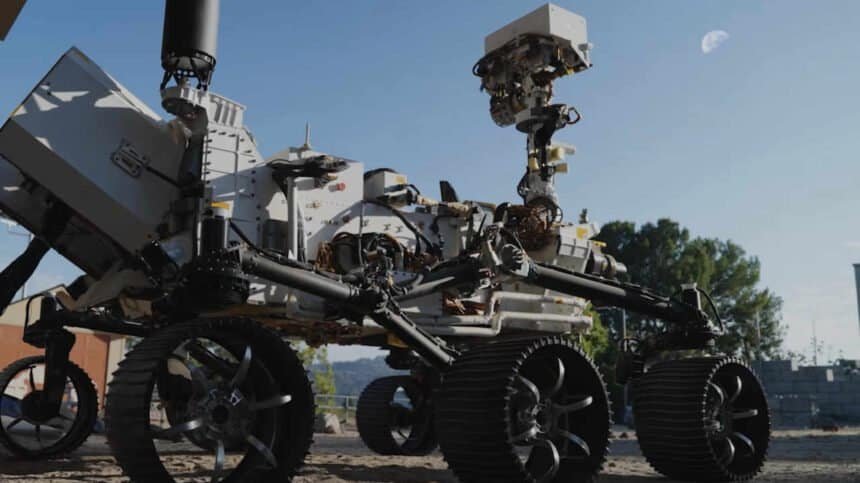
The rover NASA wants to drive across the lunar south pole is already built. It’s sitting on Earth, and it has been the whole time.
Curiosity and Perseverance both have full-scale replicas here on the ground, which scientists use to test features and updates before beaming them up to the actual vehicles on Mars. They were built to stay put. Now NASA is planning to send one of them, or a hybrid of the two, to the moon.
In late June, the agency announced a proposal for a rover called PROMISE, short for Polar Rover for Observation, Mapping and In-Situ Exploration. It would be the repurposed version of Perseverance’s engineering test model.

NASA’s own announcement hedges on the parentage. It calls the new vehicle a “hybrid” of the engineering versions of Perseverance and Curiosity, so it will possibly carry traits from both. The video the agency released about the project shows Perseverance’s landing on Mars before cutting to the replica back on Earth.
The rover already has a name, and it’s a worse acronym
Before the rename, Perseverance’s test model went by Operational Perseverance Twin for Integration of Mechanisms and Instruments Sent to Mars. OPTIMISM, for short.
“We’ve had years now of experience operating the two rovers on the surface of Mars, and we’ve got this hardware that the taxpayers have invested a lot in,” NASA administrator Jared Isaacman said during an update about the agency’s moon base plans. “So the question was posed: ‘What if we send it to the moon?’ … It’s going to bring an immense capability to the lunar south pole in short order.”
Read that as what it is: a budget argument dressed as an engineering one. The hardware’s paid for. The question is what it costs to finish.
Plutonium is the part that actually matters
PROMISE would scout the lunar south pole, a candidate site for future bases because of the abundant water ice there, and characterize the surface and subsurface.
It would carry a multi-mission radioisotope thermoelectric generator, an MMRTG, fueled by plutonium. The generator converts heat from the natural decay of the plutonium into electricity. No sunlight required, anywhere, ever.
That’s the difference between this and a solar rover, and it isn’t subtle. Lunar night at the poles kills hardware that can’t keep itself warm.
“For moon-based objectives, having a nuclear RTG on it allows us to go anywhere we want, regardless of the illumination,” said Carlos García-Galán, the program manager for the Moon Base project. “Surviving the lunar night is going to be one of the bigger challenges with this capability; we wouldn’t have to worry about that.”
The parts list is mostly missing parts
PROMISE is a concept. OPTIMISM is not ready for flight and has to undergo numerous tweaks and upgrades before it becomes a functional lunar rover.
NASA hasn’t said what that work involves. But the vehicle currently has no sensors to control onboard temperature, no flight-ready scientific instruments, no communications system and no generator. Its components aren’t rated to survive abrasive, razor-sharp lunar dust either.
Strip that down and the reused hardware is a chassis, a mobility system and years of operational experience. The instruments, the power, the thermal control and the radio all still have to be built.
What the savings look like on paper
The Planetary Society, the NGO founded by Carl Sagan, estimates PROMISE would cost NASA between $700 million and $1.3 billion, and wouldn’t launch until sometime in the early 2030s.
That’s a wide spread for a rover whose main selling point is that it already exists. Judge this one by whether the MMRTG gets allocated and the dust rating gets solved, because those are the two line items that turn a testbed into a spacecraft.