
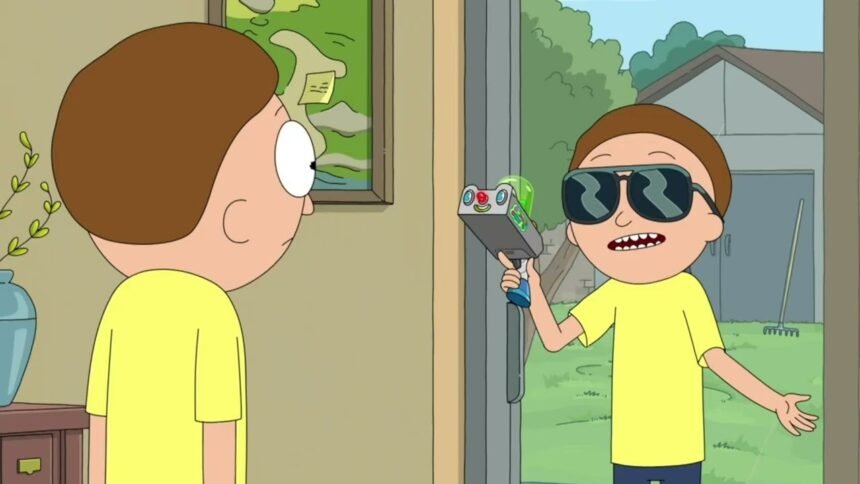
Morty crashes his own funeral. Then he does it again. And again.
That’s the engine of “Field of Dreams,” the Season 9 finale, and it’s the reason the episode lands as the second-best thing this season produced. “Ricks Days, Seven Nights” is still the high-water mark. But this one gets close, and it gets there by doing something the show doesn’t always bother with: making the joke and the wound the same object.
Full spoilers ahead for Rick and Morty Season 9, Episode 10.

The estate sale is the setup, not the story
Rick (Ian Cardoni) dies, and his multiversal counterparts descend to pick over his belongings like opportunistic vultures. That’s a Rick estate sale, a new bit of world-building the episode introduces and then mostly uses as a doorway.
Seeing alternate Ricks and Mortys (Harry Belden) is reliably fun, especially in this post-Citadel stretch of the show. But the estate sale is scaffolding. The real material is what Morty decides to do with it.
He goes funeral-hopping.
Why the premise curdles so fast
You get why he’s curious. How are all these other families handling his death? Do they miss him? And you get why the voyeurism becomes a habit almost immediately, because grief performed for an audience of one is the most flattering thing a person can watch.
Then he gets caught, which was always going to happen. And you get that part too, because the family that catches him gives him something that looks like love and appreciation. Toxic and destructive for everyone involved, sure. But legible.
Morty’s fairly harmless craving for affection turns into a weight that pulls every person near him underwater. That’s the whole design of the episode, and it holds.
The Jerry problem
This alternate Jerry (Chris Parnell) is a borderline abusive parent under a pleasant facade, and the possibility of getting his son back is what finally snaps him loose from reality.
Parnell deserves specific credit here. The various Jerrys register as genuinely distinct characters in a way the rest of the Smith family doesn’t across these alternate-universe episodes. Some of that’s the writing. A lot of it isn’t.
Compare this Jerry, or the late Jerry Prime, to the usual sad sack, who shows up here in a couple of scenes singing about his stupid fedora. Same actor. Different species.
Rick throws it away on purpose
Watching Rick dismantle his own life is grim and weirdly magnetic. He’s not doing it to help Morty. He’s doing it because the man he used to be is more appealing than the man he became, and that’s a much uglier motive.
He starts as a recovering addict with a home life that works. He ends as the drunken, spiralling mess we know by heart. The Russian janitor becomes a dog with an impossibly long neck. Everyone loses.
Malin Ackerman’s character gets used sparingly and well, functioning as a running reminder of exactly what Rick is torching in the name of science. The finale circles the same idea as “Ricks Days, Seven Nights” — Rick fleeing the emptiness of his life and then sprinting straight back into it — but the approach differs enough that it doesn’t feel like a rerun.
Nothing mattered, and that’s the punchline
Episode 10 ends bleak. Rick dies. Jerry dies. Everyone in Morty’s fake family dies. Rick’s entire quest to build a portal gun was a massive failure.
But it’s fine, because another Rick estate sale means Morty has an easy ticket home.
The season closes on existential angst, as it should. The difference is whose it is. For once the grandfather isn’t the one carrying it.