

Solana validators serving regulated institutions now have a path to compliance that doesn’t require bolting checks on after the fact. Flowra, the open orderflow auction platform for Solana, has partnered with Honeypot to wire sanctions and risk screening directly into the block construction layer.
In Brief
- Flowra’s Programmable Block Policy (PBP) system will use Honeypot’s compliance intelligence to let validators filter transactions against sanctions criteria before they’re included on-chain
- Screening covers wallet addresses linked to sanctioned entities and network-level obfuscation including VPNs, proxies and Tor exit nodes, which account for an estimated 31-61% of traffic reaching blockchain platforms
- Each validator defines its own compliance policy, preserving operator autonomy across the network
The integration targets a gap that has widened as institutional capital moves onto Solana. Regulated validators need to meet OFAC and equivalent sanctions obligations, but until now those controls existed primarily at the application layer, on exchanges and DeFi front-ends, not at the point where blocks are built.

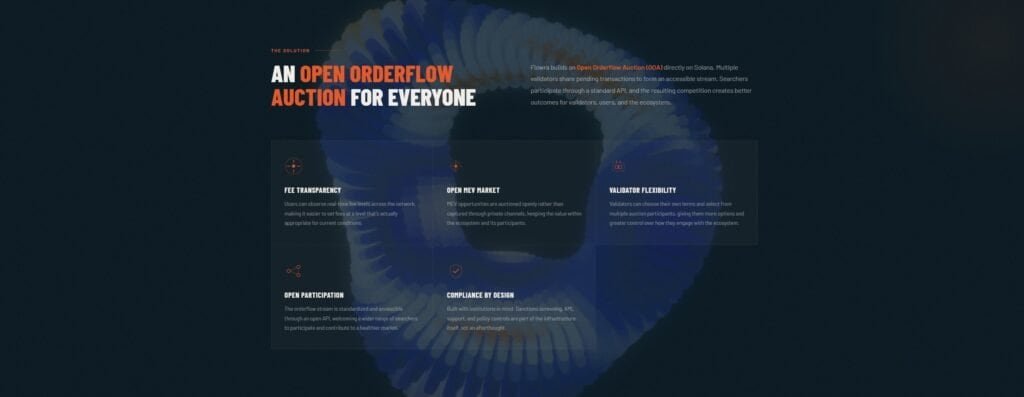
Flowra’s PBP framework changes where compliance decisions happen. Instead of screening transactions after they’ve been confirmed, validators can set rules that determine which transactions and bundles qualify for inclusion during construction. Honeypot’s detection engine, which processes over 14 billion events annually, provides the intelligence layer that powers those rules.
“We’re working with Honeypot to bring compliance into the block-building process itself, allowing validators to define and enforce their own policies before transactions are included on-chain,” Harry Hwang, CEO of Flowra, said. “The goal isn’t to make the network less open, it’s to give individual validators the flexibility to operate in a way that reflects their own requirements.”
The partnership fits into Flowra’s wider strategy of building an open alternative to Jito’s dominant validator infrastructure on Solana. While Jito’s block engine runs under more than 95% of active stake, Flowra has attracted approximately 60 million SOL in migration commitments by offering transparent orderflow auctions and customizable block-building policies. Adding compliance tooling strengthens the case for institutional validators weighing the switch.
Honeypot’s screening goes beyond static wallet list matching. The platform detects network-level evasion techniques, including VPN usage, residential proxies and Tor exit nodes, that sanctioned actors use to mask their jurisdiction. OFAC guidance explicitly recommends this type of screening, including flagging improbable login patterns such as the same user appearing from two countries within minutes.
The compliance framework is designed to accommodate additional enterprise providers over time. Honeypot is the first data source integrated into PBP, but the architecture is built to support multiple compliance feeds, giving validators options as the regulatory environment evolves.
The collaboration will initially focus on sanctions screening, wallet screening and audit trail generation for regulated operators. Technical implementation details will be shared as the rollout progresses.
Flowra is a blockchain infrastructure company building validator and orderflow solutions for the Solana ecosystem, focused on transaction transparency, value distribution and incentive alignment. Honeypot provides compliance intelligence for platforms operating under sanctions and geo-restriction requirements, processing over 14 billion events annually to detect location obfuscation across exchanges, DeFi protocols and financial institutions.