


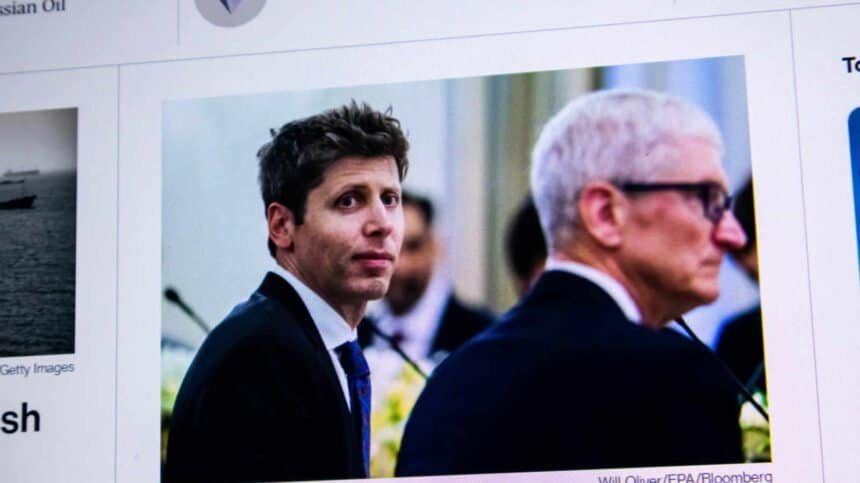
Apple’s lawsuit against OpenAI just grew by 11 names. In a fresh court filing, the company said an internal investigation turned up 11 other former employees who may have witnessed or taken part in the suspected leaking of trade secrets, on top of the two it had already accused.
That’s a different kind of claim than the one Apple started with. Two named engineers is a personnel problem. Thirteen people is a pattern, or at least Apple wants a judge to see it that way.
What Apple wants from the court
Apple is seeking a preliminary injunction that would stop OpenAI from moving forward with development of any device suspected of being based on Apple’s technology. It’s also asking for expedited discovery, which is the legal equivalent of saying the normal timeline is too slow because something is happening right now.

Companies don’t usually ask to speed up discovery unless they think they’ll find something. Pair that request with the 11 new names and the filing reads like Apple believes it has new evidence of misconduct rather than a hunch it wants to go fishing for.
The two engineers already named
Apple had previously accused Chang Liu, a former senior system electrical engineer, and Tang Yew Tan, a former VP, of sharing trade secrets with OpenAI. Those two remain at the center of it.
The new filing puts other people around them. Apple says one former employee met with Chang Liu ahead of an interview at OpenAI “and discussed with them during that meeting Apple proprietary information relating to unannounced products.”
Another allegation is more specific about the mechanics. The filing states that “yet another former Apple employee took screenshots of confidential Apple documents relating to an unannounced Apple Product before an interview at OpenAI.”
The detail about the work devices
Then there’s the line that’s hardest to explain away. Apple said in the filing that “multiple former Apple employees now working at OpenAI reached out to discuss returning Apple-issued work devices they kept when they left Apple.”
Read that twice. People who had already left Apple, and were already at OpenAI, still had Apple hardware, and they’re the ones who brought it up. Whether that’s evidence of theft or evidence of a sloppy offboarding process depends entirely on which side you ask.
OpenAI’s answer, filed the day before
OpenAI got its response in first, one day ahead of Apple’s latest filing. It wrote that Apple’s request for a preliminary injunction is “both based on false information and completely unnecessary because we do not have, nor want, any of their trade secrets.”
It also published text messages involving Chang Liu that appear to show Apple employees contacting him after he left the company, asking where certain files were. OpenAI called that an example of Apple “failing to properly manage system access when people leave.”
That’s a sharp counterpunch, and it lands on the same weak spot as the work-device detail. If Apple’s own staff were texting a departed engineer for file locations, the story about who lost control of what gets complicated. OpenAI hasn’t yet responded to the newest filing and its expedited discovery request.
Why a smart speaker is sitting under all of this
The device language in Apple’s injunction request isn’t abstract. Rumors have been swirling that OpenAI is working on some kind of AI-enabled smart speaker with former Apple design luminary Jony Ives, whose startup io Products OpenAI recently bought for $6.5 billion.
io Products is named as a co-defendant. So the injunction Apple is asking for wouldn’t just restrict a hypothetical product, it would land squarely on the hardware effort Apple’s own former design lead is attached to, at a company that just spent $6.5 billion to bring him in.
Watch the expedited discovery ruling before anything else. If a judge grants it, Apple gets to look at OpenAI’s internal material on an accelerated clock, and the 11 unnamed former employees stop being a number in a filing and start being depositions.











[…] hardware push has also collected a lawsuit. Apple, the current king of hardware, has accused the AI lab of stealing trade secrets. OpenAI has denied […]