
Half of everything uploaded to Deezer in a day is now AI-generated. That’s the number sitting underneath Spotify’s announcement, and it explains why the company is doing something it clearly didn’t want to do: putting a label on the artists themselves.
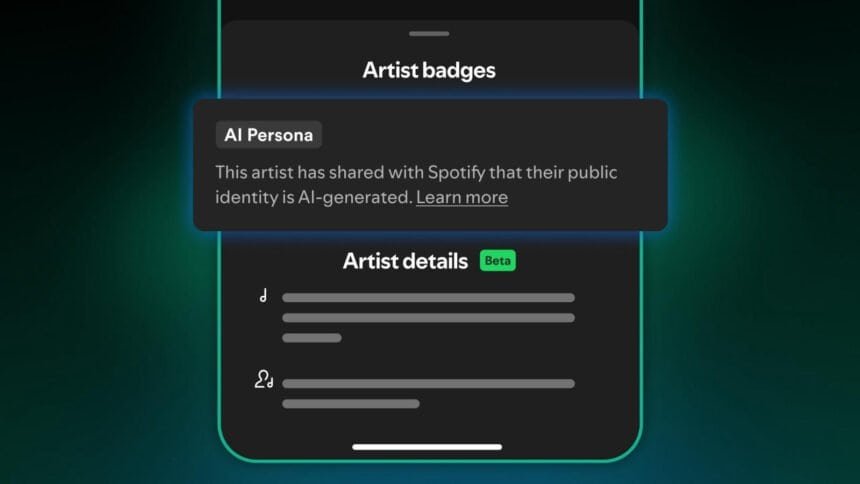
Starting in mid-September, artist profiles that do “not represent a real person” will carry an “AI Persona” badge across the app. Music from those profiles won’t show up in editorial suggestions or personal recommendations by default.
Not demoted. Not ranked lower. Excluded from the surfaces where most listening actually starts.

Spotify isn’t waiting for artists to raise their hands
Artists can disclose that they’re an AI persona starting today. The obvious problem with self-identification is that the people running slop farms have no incentive to self-identify, and Spotify seems to know it.
So the company says it will use human review alongside AI tools to work out whether a profile, including its name and image, “appears to represent photorealistic AI-generated identities.” When it decides an identity may be AI-generated without a disclosure, it applies a softer label: “Likely AI Persona.”
That hedge matters. One badge is a fact the artist admitted. The other is Spotify’s guess, and Spotify is publicly marking it as a guess.
The big accounts get checked first
Spotify says it will review artists who meet “defined audience thresholds” first, to cover the profiles people listen to the most. Which is a sensible triage and also an admission of scale. Nobody is hand-reviewing the entire catalog.
The company’s framing is blunter than usual. “Listeners have been clear in telling us that they don’t like seeing an artist profile that seems human, only to find out that the persona is AI-generated,” Spotify says. “We tune our algorithms to highlight authentic human artists and, based on available signals, strive to not include spam, slop, or low-effort content in our recommendations.”
Spam, slop, low-effort content. That’s a streaming service describing a chunk of its own uploads.
The label is about who, not how
Here’s the limit you should hold onto: the new labels only pertain to an artist’s identity, not how they created their music. A real person who ran their whole record through generative tools gets no badge. A fictional persona releasing entirely human-played material does.
Spotify doesn’t currently have a system to identify AI-generated music the way Deezer does. It lets artists disclose AI use, and it launched a “Verified by Spotify” badge to indicate that they’re a real person. That’s a disclosure regime, not a detector.
Which means the badge answers a question about authorship identity while leaving the one most listeners are asking, did a machine make this, largely untouched.
There’s an appeals process, and there needs to be
Spotify will notify artists if it puts a “Likely AI Persona” badge on their profile, and gives them the ability to appeal. Good, because a false positive here isn’t cosmetic. Getting pulled out of default recommendations is a revenue event for a working musician, and “photorealistic” is doing a lot of load-bearing work in a system that has to judge press photos.
Spotify also plans on adding a feature that will let listeners flag artists with potential AI-generated identities. Crowd-sourced reporting on artist authenticity has an obvious failure mode, and how that queue gets triaged will tell you more about the policy than the badge design does.
Watch the mid-September rollout for one thing specifically: whether any artist you already listen to picks up a “Likely AI Persona” badge. That’s the test of whether Spotify’s human-plus-AI review is calibrated, and unlike the badge itself, it’s something you can check yourself.