
Jesus saves in Anywhere City. For a fee.
That’s the joke sitting at the center of Grand Theft Auto 2’s biggest quality-of-life upgrade: you drive to the nearest church, hand over in-game currency, and the good lord above remembers your progress. Crude, funny, and a genuine improvement over the original, which asked you to start over every single time.
This is the second entry in a run back through the core Grand Theft Auto games ahead of Grand Theft Auto 6. These aren’t traditional re-reviews and they don’t carry a score out of 10, because holding games published multiple hardware generations ago to 2026 standards would be a rigged fight. The point is to re-examine what made each GTA remarkable when it landed, what it achieved, what legacy it left behind, and how much fun it still is. By the end, using GTA’s old six-star wanted level, you should have a rough sense of where each game sits in my long-term affection for the series.
A sequel that argues with its own box art
GTA 2 showed up at the tail end of the 20th century with the same top-down turmoil that made its predecessor a hit. What it dropped was the original’s recognisable, contemporary setting, swapping it for an unspecified point in the near future: a stylised, retro-futuristic place called Anywhere City, USA, overrun by gangs, ruled by a megacorporation, and boasting the highest rate of Elvis Presley’s per capita this side of Graceland.
Did it work? The answer, unlike Anywhere City’s proliferation of Elvis impersonators, requires a little more conversation.
Because the game has an identity crisis. Forget for a second that it looks and feels nothing like the original. It also clashes with its own box art and its own intro movie, which features contemporaneous ’90s cars and an obvious New York setting. I bounced off GTA 2 fast in 1999, and that was absolutely a big reason why. It felt like an entirely unrelated product to everything before it, up to and including the tone-setting FMV intro it had just shown me. Which is a genuinely weird problem for a game to have. I never stuck around long enough back then to notice how much slicker it is to play.
The fixes that actually matter
Saving is the headline, and it signals something: GTA 2 is a little more aware it’s a PC and home console product. By the late ’90s, hefty mission-oriented action games had largely moved on from the ruthless arcade philosophy of starting from scratch every session with a tiny set of lives. Developer DMA Design adjusted, but only slightly. Score-based progression stays. Strictly limited lives stay. The game is still hard as hell. Saving is just a crutch the original didn’t offer.
The health bar might be the bigger deal. If you’re trying to get through missions without cheating, that padding helps more than saving does. Health works on a 10-point scale, five hearts that can be halved, which is a stark contrast to the first GTA, where your character is essentially on their final sliver of life at all times and gets wasted after a single hit. The tank controls make dodging incoming fire hideously difficult in both games. Here, at least, you survive the mistake.
The camera is considerably less janky too. It still shimmies as you drive, but it tracks cars far more smoothly. Cars self-straighten at speed, so lining up in a lane or changing lanes doesn’t demand furious d-pad tapping.
And there’s less junk to snag on. From directly above, depth is a hard thing to communicate, so it’s tough to tell what’s rooted into the ground and what isn’t. GTA 2 sidesteps the problem by having skinny objects like light poles not register to cars at all. Not realistic. But it kills the constant collisions that bogged down the original’s pace.
Molotovs, dual pistols and a gun that makes skeletons
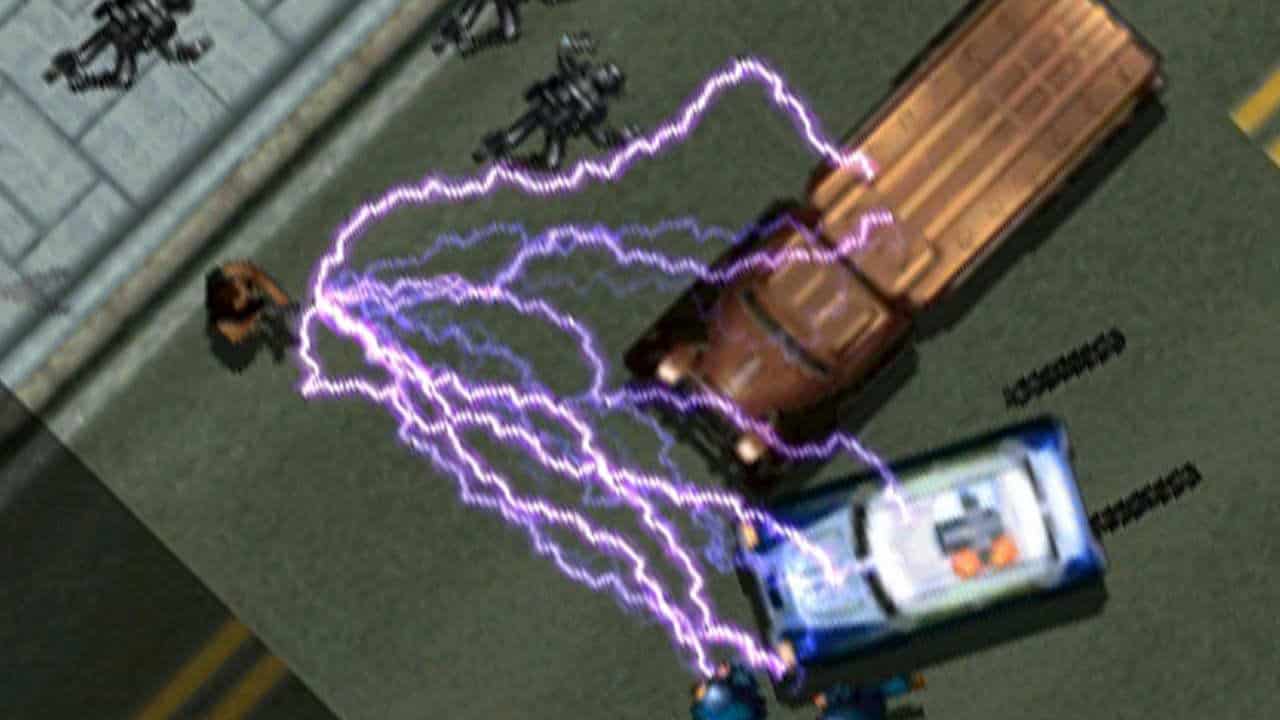
Cars can be fitted with weapons and gadgets now: machine guns, mines, oil slick traps. The handheld arsenal has more than doubled. You get tossable explosives like grenades and Molotovs, a suppressed SMG that won’t alert nearby NPCs, a shotgun for close quarters, dual pistols to dial up the John Woo factor, and a futuristic electro gun that will saute suckers into skeletons.
That electro gun locks onto multiple targets at once, which is a nice trick. But the quieter win is a mild auto-aim function, an assist sorely missed in GTA 1, which makes combat less frustrating no matter what you’re holding.
Where it loses me
The polish is real. The vibe still doesn’t land.
Merging ’40s and ’50s vehicles with a crime-ridden, near-future corporate dystopia is a stylistic choice, and I understand it’s deliberate. It just doesn’t grab me. I love that era of automotive history, I love skidding around in Mafia and LA Noire, but the cars look silly here and don’t sync with the setting at all.
In the original GTA you can tell cars apart instantly because they resemble real cars and look distinct. GTA 2 has more than 60 vehicles and far too many of them look like each other, with none resembling anything iconic. They’re caricatures of cars. Give me the original’s realism.
Same story with the maps. Anywhere City splits into three districts: the Downtown Sector, the Residential Sector and the Industrial Sector. GTA 2 has sharper graphics than its murkier predecessor, and the cleaner image arguably makes it the more timeless-looking of the two. The PC version even includes day and night versions of each area. But with the possible exception of the Residential Sector, the most varied of the three, there’s a plainness to Anywhere City that the original’s cities didn’t have.
What I do enjoy is how alive and dangerous it feels, muggers and carjackers and gang members scurrying the sidewalks as a constant threat. It still doesn’t have the charm of Liberty City, San Andreas or Vice City, primitive as those early renditions were.
The 350-horsepower elephant in the room
Maybe I’m biased because the hours I’ve sunk into those maps dwarf my time in Anywhere City. But something bigger was going on in 1999, and it weighs 3,500 pounds and makes 350 horsepower.
Driver launched on PlayStation in European territories in June 1999, about five months before GTA 2. It has no on-foot component, so it isn’t a like-for-like comparison, but it’s a fully 3D, open-world car chase classic that immediately became more or less my favourite game of all time. I’d seen the future. GTA 2 couldn’t lure me back.
The 3D action-driving wave was already forming. Midtown Madness had arrived on PC from Angel Studios, the future developers of Midnight Club, Smuggler’s Run and Red Dead Redemption. After Driver came Mucky Foot’s ambitious but janky Urban Chaos, late 1999 on PC and early 2000 on PlayStation, with primitive driving and third-person action. A PlayStation-exclusive Driver sequel followed in late 2000, this time letting you exit cars to steal another. June 2001’s World’s Scariest Police Chases sank with little trace, arriving on PS1 after the PS2 had launched, though it was a surprisingly decent open-world driving game given the outmoded hardware.
Any way you slice it, GTA 2 was a buck late and a dimension short to join the first wave.
The series wouldn’t be the bridesmaid for long. That’s a discussion for next time.
The verdict from 2026
Replaying it now, I have a stronger appreciation for what GTA 2 fixed than I ever gave it credit for as a teenager in 1999. The driving is better. The shooting is better. Those gains are real and welcome.
I just can’t muster any enthusiasm for the retro-futuristic setting. I wouldn’t call it aggravating, exactly, but in the words of the king of rock and roll, it just ain’t satisfactioning me.