

In Brief:
- Matt Wong launched BaseBuilderCodes.com, a free site that charts on-chain activity attributed to any app’s Base Builder Code, built on Coinbase Developer Platform’s SQL API.
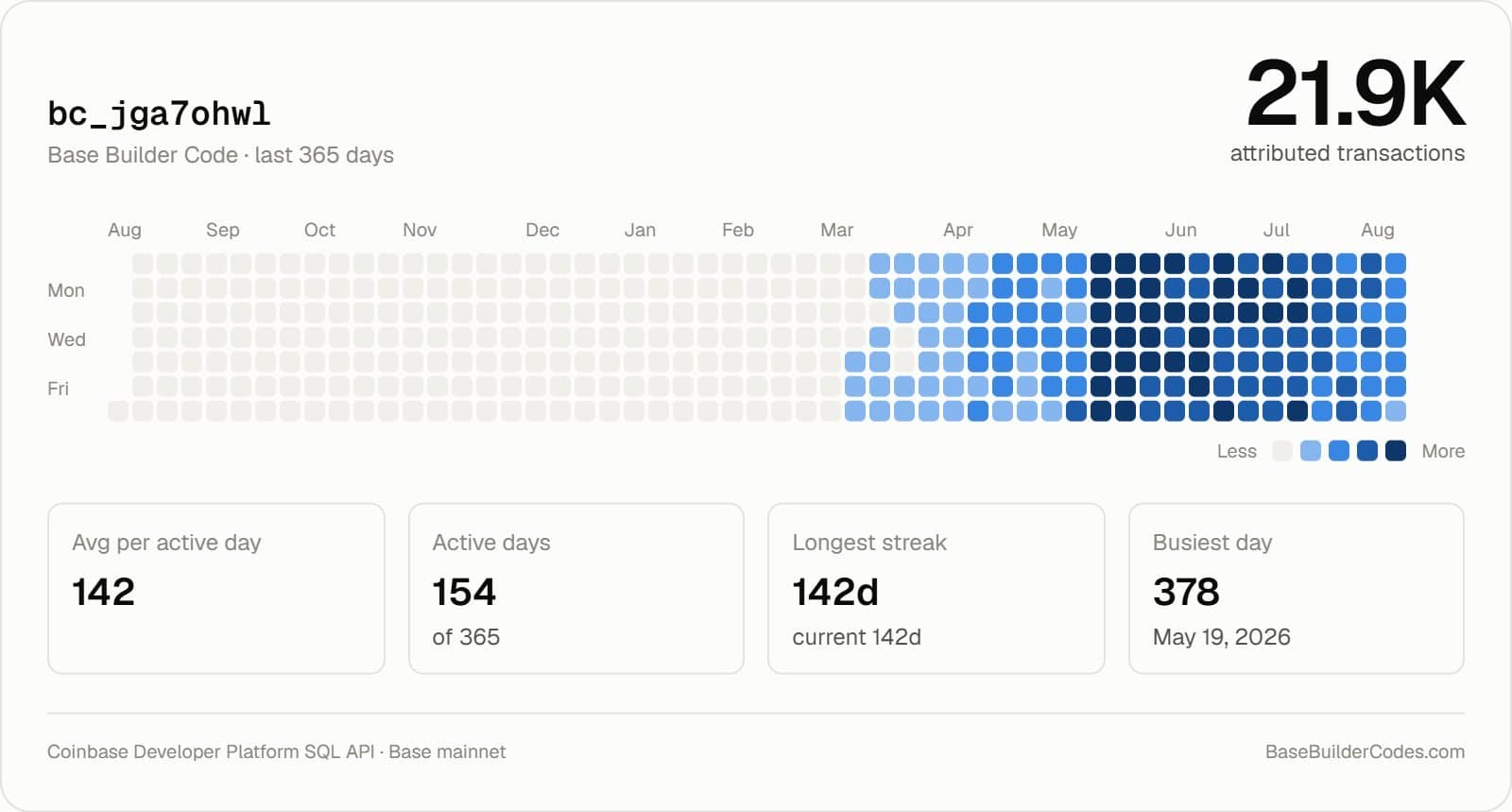
- Champz ran both of its Base apps through the tool and published the output: about 40,000 transactions over six months, split 21,900 for Legends of Champz and 17,900 for its miniapp.
- Builder Codes feed Base’s ERC-8021 attribution layer, which Base has said is an input for future rewards programs and leaderboard placement.
Matt Wong released BaseBuilderCodes.com, a site that turns an app’s Base Builder Code into a public activity readout.
“Visualize your @Base Builder Code activity,” Wong said in the post announcing it. The tool is “Powered by the @CoinbaseDev SQL API!” he said.
~40K onchain transactions across our two apps on @base in the last 6 months
Legends of Champz: 21.9K txns · 154 active days · current streak 142d
Champz miniapp: 17.9K txns · 185 active days · current streak 185d
Builder Codes don't lie.
Nice tool, @mattwong_ca — thanks
Wong’s GitHub profile lists him as an engineering student at the University of Waterloo and an incoming Coinbase employee.
The SQL API it runs on is Coinbase Developer Platform’s indexing endpoint for Base. It serves custom queries against blocks, transactions, token transfers and decoded events, with sub-500ms query latency and under 250ms freshness from the tip of chain, according to CDP documentation. A playground in the CDP portal runs queries without API keys.
Champz publishes its numbers
Champz was among the first to post results. The studio said its two Base apps recorded roughly 40,000 on-chain transactions over the past six months.
Legends of Champz accounted for 21,900 of them across 154 active days, with a current streak of 142 days. The Champz miniapp logged 17,900 transactions across 185 active days and a 185-day streak, meaning it hasn’t missed a day in the window measured.
“Builder Codes don’t lie,” the studio said.
What a Builder Code counts
ERC-8021 appends a byte suffix to transaction calldata identifying the app that facilitated the transaction. Indexers parse it backwards: first a 16-byte marker, then the schema ID, then schema-specific data. Contracts ignore bytes appended past their expected arguments, so the suffix passes through execution without touching contract behavior. Overhead is 16 gas per non-zero byte.
The codes themselves are an ERC-721 collection. On-chain metadata carries a payout address declaring where any rewards should be sent. Off-chain metadata carries the app name and site. Developers register on base.dev and find the code under Settings, then Builder Code.
The standard accepts multiple comma-separated codes in a single suffix, which covers transactions facilitated by both a frontend app and a backend relay.
Why Base wants the data
The gap the codes address is attribution. Linking a transaction to a protocol is trivial because the contract is on-chain. Linking it to the app that produced it isn’t, because apps are off-chain interfaces, bots and backend jobs with no native tie to the transactions they generate.
Builder Codes went live for all apps on Base in early March 2026. Antonio García Martínez, Head of Growth at Base, said the codes provide chain-level attribution for all activity on Base.
“Builder Codes help apps and protocols get recognized for value created,” Base’s builder account said.
Base has pitched three things to developers who adopt them: an analytics suite, placement on leaderboards and in the Base App, and eligibility for potential rewards as the data is measured.
In June 2026 Base extended the system to x402, appending schema 2 codes to settlement transaction calldata so it can attribute x402 payments to the apps that drive or serve them.
Hyperliquid coined the term, letting apps annotate transactions to claim a cut of swap fees. Polymarket shipped a version of its own. Both were scoped to their own venues. ERC-8021 works on any EVM chain and is supported on Ethereum L1, Optimism and Arbitrum alongside Base.
Background
Champz calls itself an indie gaming studio on Base L2, running skill-based strategy games where players collect NFTs and compete for rewards. Legends of $CHAMPZ opened to all users through base.app, with free packs, ranked battles, a Guardian throne mechanic and USDC and $CHAMPZ payouts.
The economics have gates. Players need to hold at least 25,000 $CHAMPZ to withdraw truffles as USDC, per the project’s documentation. Free-to-play players can earn truffles in-game but have no way to exchange them. Holding more than 50,000 $CHAMPZ removes the character cap on a wallet.
The Base CHAMPZ contract sits at 0xd4f00B4972eF5e88D667e1f9CB593fB6DbDdd180. An older Ethereum deployment traded near $0.0002 with about 588 holders as of Aug. 15.
In a separate post, the studio said it had “officially hit the 100 ETH mark distributed to our players.”


[…] studio bundled the work into its weekly stats post and listed three items: a “Mobile performance overhaul,” “Gameplay changes – Greed is […]