
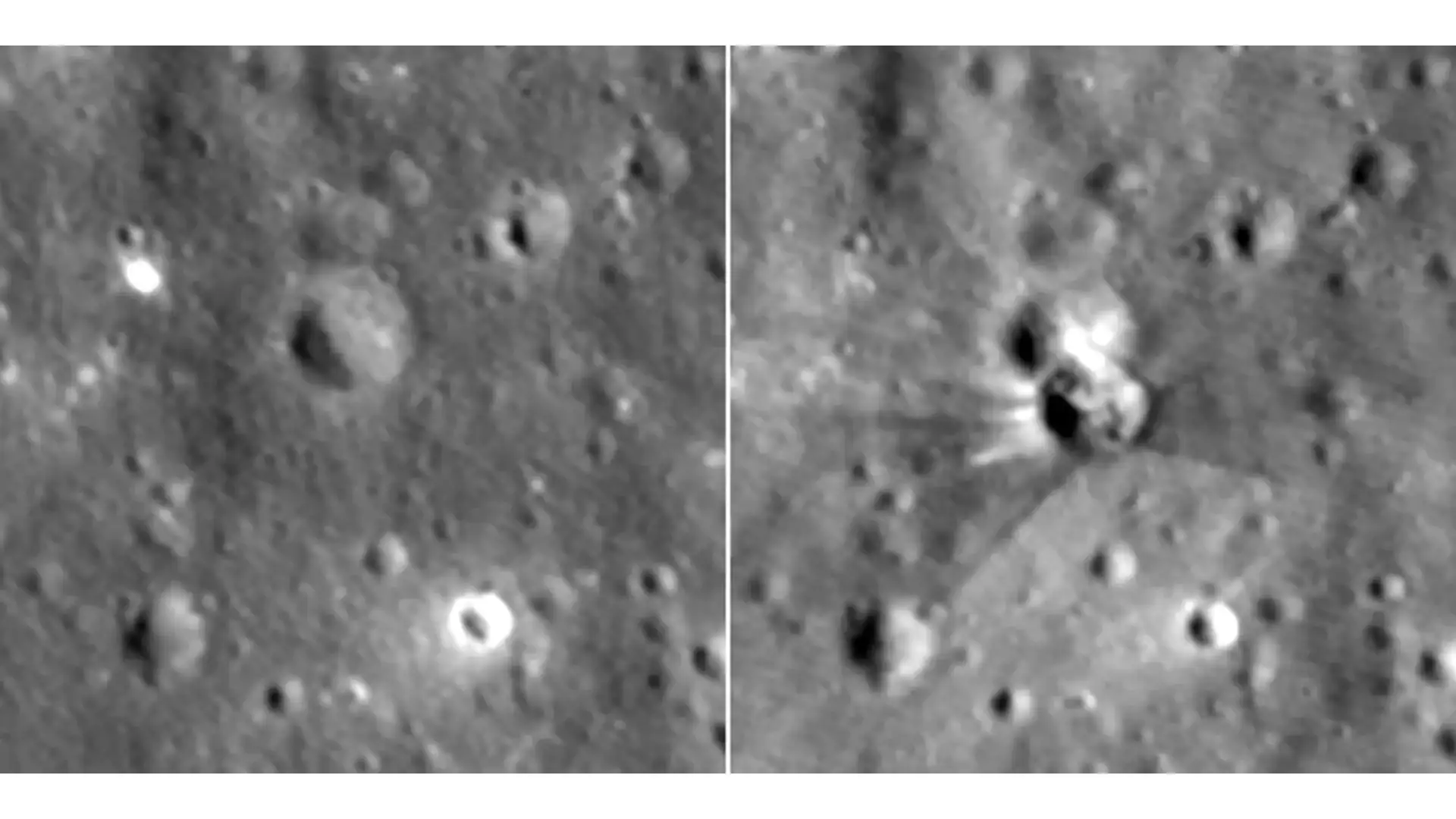

A rocket stage that left Earth in January 2025 hit the Moon on Aug. 5, and it took NASA six days of orbital patience to get a clean look at the hole it made.
The hole is about 60 feet wide and less than 10 feet deep. That’s it. A Falcon 9 upper stage, the same hardware that lofted the Firefly Blue Ghost 1 mission, came down on the lunar surface and left something you could park a couple of cars in.
Between Aug. 11 and 12, NASA’s Lunar Reconnaissance Orbiter caught it.
Getting the shot meant tilting an entire spacecraft
LRO doesn’t have a swivel mount for its cameras. To point at the impact site, engineers tilted the whole orbiter while it was moving about 1 mile per second, roughly 60 miles above the ground.
Then there’s the timing problem, which is the part that gets undersold. Shoot 10 seconds early or 10 seconds late and your target sits about 10 miles off the center of the frame.
The orbiter loops pole to pole every two hours while the Moon turns underneath it. You don’t fly to a target. You wait for the target to rotate into view. Six days of waiting for one usable pass.
The measurements came from a shadow
Researchers photographed the crater from several angles under different lighting, because different light brings out different features. Frames that showed the rim clearly gave them the 60-foot width.
Depth was trickier. They measured the length of the crater’s shadow and worked backward to get the sub-10-foot figure. Low-tech in principle, and it works.
The Narrow Angle Camera doing the work can resolve features as small as 3 feet across, which is why a 60-foot scar is legible at all from 60 miles up.
The dark streaks are the interesting part
Look at the rays spreading out from the impact and you’ll see both bright and dark material. The dark streaks are dust and rock that spent a long time getting cooked by solar wind, galactic cosmic rays and micrometeorite hits.
The collision threw that weathered material up from as deep as 1.5 feet down. Closer to the rim, the brighter streaks are fresher stuff, dug out from deeper underground.
So the crater is a cross-section. A free excavation of the top layers of the Moon, courtesy of a spent rocket.
Amateurs found it first
Independent astronomers worked out the rocket’s trajectory using publicly available information. Not classified tracking data. Public information.
NASA’s Center for Near Earth Object Studies, which normally watches for natural objects that could threaten Earth as part of the agency’s Planetary Defense program, treated the whole thing as a live test. Predicting where a known object will hit is exactly the skill you want to have verified before it matters.
The center, based at NASA’s Jet Propulsion Laboratory in Southern California, kept refining its numbers until it had an expected impact location. That prediction went to the Republic of Korea and the team running its Korea Pathfinder Lunar Orbiter, Danuri.
The prediction was off by about 0.6 miles
A few hours later, the Danuri team pointed the spacecraft’s high-resolution LUTI camera at the site and got the crater. NASA’s predicted location turned out to be accurate to within about 0.6 miles.
Then Danuri handed the coordinates back to the LRO team, which used them to aim its own observations better. Korea found it, NASA refined it, and both sides got something out of the exchange.
The LRO team compared the new frames against pre-impact photographs of the same ground and pinned the crater’s center to 19.4759°N, 266.7138°E, at an elevation of 511 meters.
Write those coordinates down. There’s a new 60-foot dent in the Moon and we know exactly where it is, which is more than could be said for most of the hardware humans have left up there.



[…] launches on a Falcon 9 from Space Launch Complex 40 at Cape Canaveral Space Force Station in […]