

In Brief:
- Song Jae-kyung, an adviser at NEXUS and the developer behind Lineage, gave the opening keynote at OpenAI Game Builders Seoul on Aug. 31, arguing AI’s next role in games is as a participant rather than a development tool.
- He said Codex pushed him to 160,000 lines of code in eight months on his solo MMORPG, against the 30,000 lines he wrote in a year building The Kingdom of the Winds three decades ago.
- The project, Open MMO, gives AI agents no privileged API. They connect over the same WebSocket protocol as human players, and the game is expected to be distributed through NEXUS’s chain once the gameplay is tightened up.
Song Jae-kyung told OpenAI's first game development hackathon that AI agents should be designed to perceive, judge and act inside a game world on their own terms, as a new class of participant rather than a smarter NPC or a faster compiler.
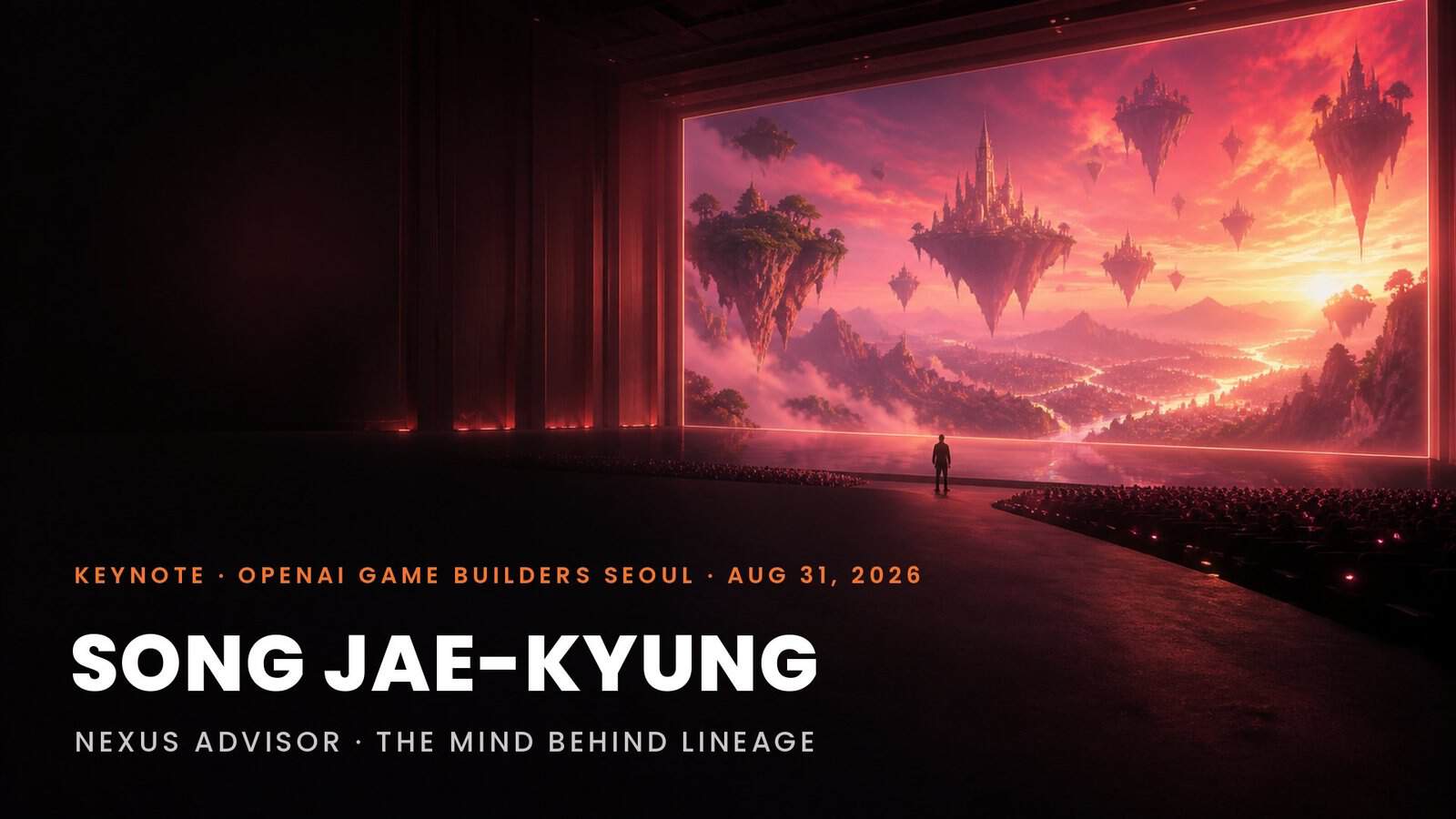
The adviser at NEXUS and former XL Games CEO delivered the opening keynote at OpenAI Game Builders Seoul on Aug. 31, alongside Com2uS Chairman Song Byung-jun. The event ran at Graphic by Daeshin in Seoul and was OpenAI’s first global gathering built around game development with Codex.
𝗔𝗜 𝗷𝗼𝗶𝗻𝘀 𝘁𝗵𝗲 𝗴𝗮𝗺𝗲.
NEXUS advisor Song Jae-kyung (@appledelhi) — the mind behind Lineage — gave the opening keynote at @OpenAI Game Builders Seoul today: AI won't be just a development tool. It will be a participant in the game.
His open-source, one-man MMORPG
Song brought numbers. Thirty years ago, building The Kingdom of the Winds, he wrote about 30,000 lines of code in a year. Working alone on Open MMO over eight months, he wrote 160,000. That’s roughly eight times the throughput, he said.
No special API for the bots
Open MMO is the argument in code. Song put the source and the development documentation on GitHub on July 20. It runs in a browser through a Google account login with no install.
The design premise is equivalence between agents and humans. Agents get no privileged endpoints. They speak the same WebSocket protocol as players, and the server can’t tell which kind of client is on the other end. Anything a human can do, an agent can do.
The agent-side client is implemented as an MCP server. An LLM picks the goal and the action, the agent client handles pathfinding, movement and attack commands, and the game server rules on whether any of it worked. Judgment, input and adjudication sit in separate layers.
The world runs 32 kilometers by 32 kilometers, procedurally generated with terrain, rivers, coastlines and biomes, plus road networks and bridges placed automatically. Day and night lengths shift with the planet’s orbital position. Two moons run on different orbits.
The rest is deliberately old. Seven classes, six stats rolled with dice, ability-based combat drawn from Dungeons & Dragons and NetHack, all hit and damage math resolved server-side. Housing goes up to four stories in wood. Inventory is weight-limited across 11 equipment slots, and anything dropped is free for anyone to pick up.
Song built it by vibe coding, handing the work to the model instead of typing it.
Where NEXUS fits
NEXUS has been pushing agent gaming, in which AI agents act as players and as economic participants, as a core business line. Open MMO is expected to reach players through the company’s blockchain game platform after the gameplay is refined.
That platform is mid-rename. The CROSS mainnet is becoming OneChain, $CROSS CROSS $0.09931 ▼ -23.2% is becoming $ONE and $ONEUSD serves as the ecosystem’s transaction medium, tying the token to the ONE store brand.
NEXUS agreed in June to buy 20,247,990 shares of ONE store, an 89.03% stake, for about 62.6 billion won, or $45.3 million. Sellers were SK Square at 45.78%, Naver at 24.06%, Steel Number One First at 17.02% and KRAFTON at 2.17%. ONE store is installed on more than 38 million devices in Korea.
Nine titles are being onboarded to ONE across MMORPG, SLG, collectible RPG and TCG, for sequential release this year. Frost Kingdom went out in July as a multiplatform launch.
First-half revenue was 17.42 billion won, up 9.4% year on year, with 5 billion won in net profit.
Forty teams and a five-hour build
Com2uS backed the Seoul event under the slogan “Build with Codex, Play with Hive.” AI curation platform Artue handled planning.
Forty teams cleared an online preliminary round. In Track 1 they gave three-minute talks on the AI architecture behind games they had already built with Codex. Track 2 was a five-hour live hackathon on a theme revealed on site. Teams wired Com2uS Holdings’ Hive backend in for login, payments, user analytics and security.
The Track 1 winner, chosen by popular vote, took $50,000 in OpenAI API credits and a year of ChatGPT Pro. Track 2’s top team got the subscription. Every finalist got $100 in credits.
Oliver Jay, managing director of OpenAI International, opened the day. He said he expects Korean developers to make active use of AI and take bold swings at new kinds of gameplay. Song Bo-young, CEO of Artue and an OpenAI adviser who led planning, said Game Builders will expand to Japan, the United States and Europe from here.
Background
Song co-founded Nexon with the late Kim Jung-ju in 1994 and built Nexus: The Kingdom of the Winds. He shipped Lineage at NC in 1998 and founded XLGAMES in 2003 to make ArcheAge. He left in January 2025 and joined the Open Game Foundation, set up in Switzerland by NEXUS CEO Jang Hyun-guk, as senior adviser and board member.
When Open MMO surfaced in July, Jang called it the world’s first open-source MMORPG where humans and AI agent players play together, player characters and NPCs alike. “A completely new game,” he said.