

Two exchanges restored trading for the same token on the same day, under two different sets of rules. Neither one covers the tokens sitting in your own wallet.
Nesa’s NES token came back to trading on Binance Alpha and regained Ethereum funding on Kraken on Sept. 10, after venue-specific interruptions tied to an Aug. 24 token-contract security incident.
That’s the good news. The rest of it depends entirely on where your NES was sitting, and when.

Two snapshots, and the second one is the one that bites
Binance said users who held NES before Aug. 24 at 14:51 UTC must also have held an eligible portion when trading was suspended on Sept. 5 at 04:00 UTC to receive the 1:1 swap for that portion.
Read that twice. Holding through the first cutoff isn’t enough. You had to still be holding at the second one.
Sell into the gap between Aug. 24 and Sept. 5, and the portion you sold falls outside the 1:1 swap. That’s a two-week window in which a perfectly ordinary decision, trimming a position after a security incident, changes what you get back.
NES bought after the Aug. 24 cutoff is excluded from the 1:1 swap entirely. It falls under separate refund treatment instead.
The refund math isn’t public
Binance said users with eligible net purchases during the specified window would receive an email with refund details within seven business days.
What the announcement doesn’t do is disclose the complete refund formula. And nothing in it supports the idea that every affected holder will be made whole.
That gap matters. “Refund details to follow” is not the same promise as “you’ll get your money back,” and the distance between those two readings is where most of the frustration in this episode is going to live.
Trading reopened at 08:00 UTC on Sept. 10. If you’re affected, the practical move is to work out which snapshot category your balance falls into, then watch the email address tied to your account.
Kraken picked a chain and dropped the other one
Kraken’s incident page said NES would be migrated 1:1 to a new Ethereum contract. Deposits and withdrawals on Ethereum were scheduled to return at 14:00 UTC on Sept. 10, and the exchange marked the funding incident resolved 12 minutes later.
No snapshots, no eligibility windows, no refund formula. Just a migration.
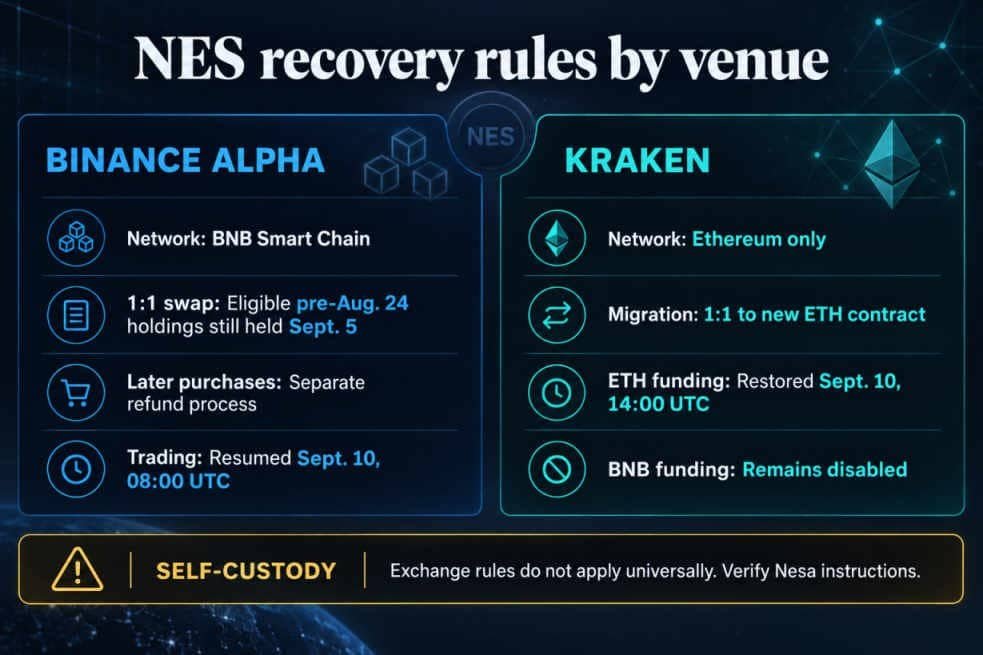
But NES funding on BNB Chain stays disabled. Only Ethereum-based NES will be supported going forward, Kraken said.
If you’re moving NES to or from Kraken, select Ethereum and check the new contract details against Kraken’s official notice before you send anything. A BNB Chain transfer to an exchange that no longer supports BNB Chain funding is the kind of mistake that doesn’t have an undo button.
Self-custody holders get nothing from either notice
Here’s the part that’s easy to miss in the relief of seeing trading resume. Both of these are exchange-managed actions, and exchange-managed actions stop at the exchange.
Binance’s snapshot windows don’t reach your wallet. Kraken’s automatic migration doesn’t either. If you held NES in private custody through Aug. 24, neither notice tells you what happens to those tokens.

As of press time, Nesa’s public official site and its general wallet documentation didn’t provide incident-specific self-custody migration steps.
So the answer for now is to wait rather than improvise. Until Nesa publishes a route or directly verifies one, don’t approve a contract interaction or move old-contract tokens on the strength of an address you found somewhere other than Nesa’s official channels. Post-incident migrations are prime hunting ground for fake migration contracts, and an approval you sign yourself isn’t something any exchange can reverse.
The $286M exploit fallout produced two recovery frameworks that disagree with each other on almost every detail, and a third group of holders who aren’t covered by either. If you’re in that third group, the only thing worth doing today is verifying the contract address through Nesa directly, and doing nothing until it exists.