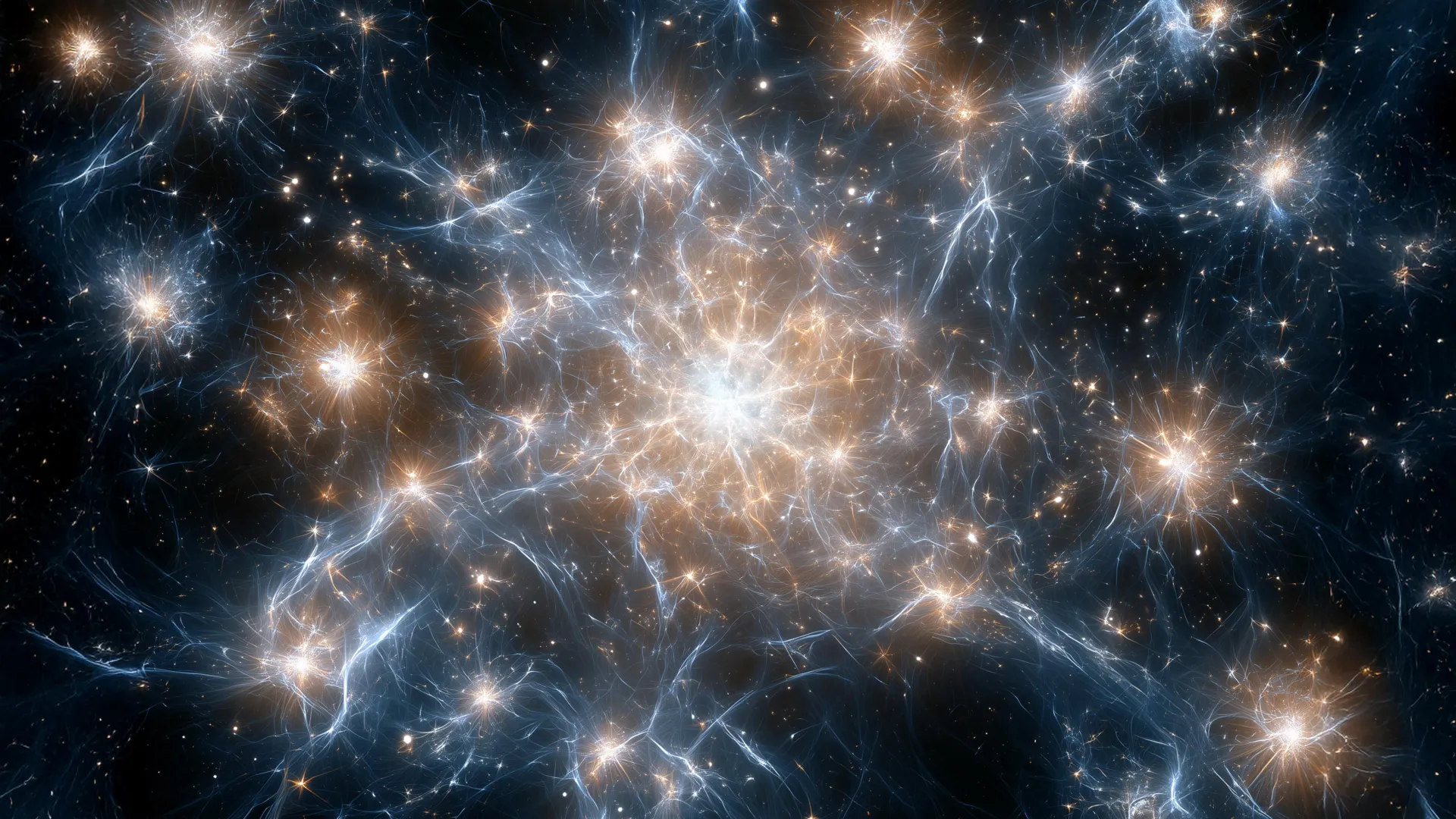

Cosmology’s standard model treats dark energy as a fixed setting, a constant that has pushed the Universe apart at the same strength since the beginning. A new catalog of 2,884 exploding stars suggests that assumption may be wrong.
The catalog is the largest collection of Type Ia supernovae ever assembled, and the people who built it said it adds fresh evidence that dark energy, the force behind the Universe’s accelerating expansion, may change over time.
Two separate projects, the same hint
One odd result can be a fluke. This is now the second.
Professor Tamara Davis, an astrophysicist on the team, said the warning signs first showed up in the team’s own earlier work. “Our supernova data from DES in 2024 first showed hints that dark energy may be time varying, and this new compilation also sees a deviation from the standard model although in a slightly different direction,” Davis said.
A separate instrument with a different method is pointing the same way. “Similarly results from the Dark Energy Spectroscopic Instrument (DESI) found hints of variations in dark energy in its surveys of relic sound waves from the early Universe,” Davis said.
“So, 2 completely independent measurements have found hints of time variation in dark energy, challenging the standard model that dark energy doesn’t change.”
Read that carefully, though. The two measurements don’t agree on exactly how the Universe departs from the standard model. Nobody is claiming a confirmed discovery. The researchers are saying the question deserves a harder look, and that’s a more modest claim than the headlines this kind of work tends to attract.
Why white dwarf explosions make good rulers
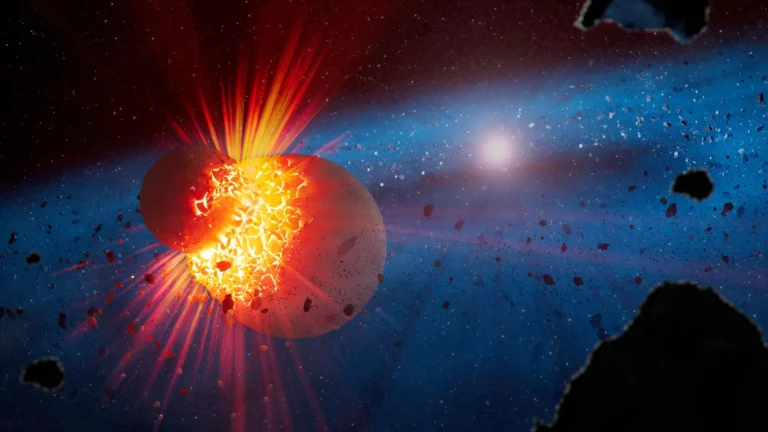
Type Ia supernovae happen when white dwarf stars explode. Astronomers use them to measure distances across the Universe, and stacking up enough of those distances lets them trace how expansion has played out over cosmic history.
The international team, led by scientists at the University of Queensland’s School of Mathematics and Physics, combined historical supernova measurements with results from the Dark Energy Survey (DES) published in 2024.
PhD candidate Ryan Camilleri said the project sets a new international standard for supernova cosmology. “We’ve rebuilt 3 decades of astronomical observations into a single, consistent framework,” Camilleri said.
“We combined our data with other cosmic measurements including relic light from the Big Bang and maps of how galaxies are distributed through space.
“Instead of confirming the standard model of cosmology which assumes dark energy is fixed and unchanging, we have more evidence that dark energy may change over time.”
Fixing 30 years of mismatched data
Pooling decades of observations is messier than it sounds. Old measurements came from different telescopes, processed with older assumptions about how supernovae behave.
So the team went back and reworked them. “Over the years we’ve learned a lot more about how supernovae behave so we’ve been able to go back and apply that improved understanding to older data,” Camilleri said.
Cosmic dust and the masses of host galaxies can both change the light that reaches Earth from a distant explosion, which skews the distance you calculate from it. The team corrected for those, along with differences between instruments.
“Extensive work has been done to link observations from different telescopes with different capacities and take into account issues such as cosmic dust and galaxy mass which can affect the light coming from a supernova,” Camilleri said.
“We also incorporated more subtle effects such as gravitational lensing, which is the bending and magnification of light around large objects as it travels from a supernova to Earth.”
The cosmology results and a companion set of host galaxy mass measurements are both posted on arXiv. The dataset draws on the Dark Energy Survey, Foundation Supernova Survey, PanStarrs I, Sloan Digital Sky Survey, Supernova Legacy Survey, Carnegie Supernova Project and the Center for Astrophysics supernova survey, built up over decades by hundreds of astronomers.
The bigger bet: gravity and quantum physics
Davis said the stakes go beyond how fast the Universe is expanding. Working out how dark energy behaves might help with one of theoretical physics’ oldest unsolved problems.
“All of this research may also hold the clue to explain how gravity and quantum physics fit together,” Davis said.
“We know these 2 theories are each immensely successful in their own realms, so if we can figure out how to put them together that would be a huge step in theoretical physics.”
That’s a long way off. The closer test is more data. The team plans to add supernovae from the Dark Energy Bedrock All-Sky Supernova program (DEBASS), which is finding hundreds of explosions closer to Earth than the ones DES surveyed. Those nearby events will give the researchers another set of measurements for checking whether dark energy really changes over time.