
Moonshot’s pitch for Kimi in finance isn’t a model benchmark. It’s a list of data vendors.
The Beijing startup said Thursday that investment banks, funds and venture capital firms are running its Kimi models inside AI tools, and it named names: investment bank CICC, and venture capital firms including Sequoia China, now rebranded as Hong Shan. The announcement came alongside the launch of Kimi for financial services.
That’s the part worth paying attention to. Not the model. The wiring.

The partner list is the product
Kimi users can pull information commonly used for analysis and reports directly, through industry data partners that include S&P Global Market Intelligence, Crunchbase, Wind, local financial news leaders and business database Tianyancha, according to Moonshot.
The startup said Kimi can also reach the U.S. Securities and Exchange Commission’s EDGAR system for public companies’ financial filings, plus the IMF, the World Bank and the Federal Reserve Economic Data site, better known as FRED.
Three of those are free public sources anyone can query without an AI subscription. The paid vendors are the interesting half, because licensing S&P Global and Wind data into a consumer-facing chat product is a contract problem, not an engineering one.
What the mobile app actually showed
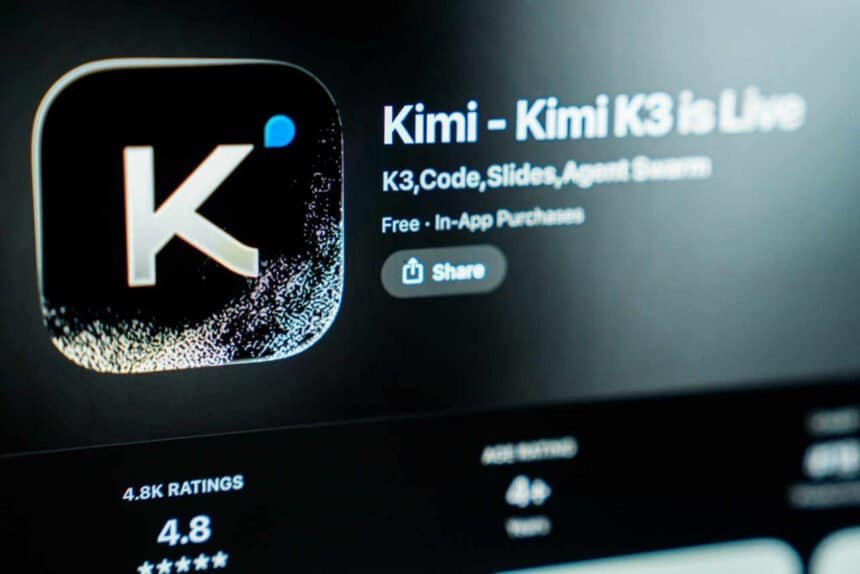
There’s no separate interface to download. A test on Kimi’s mobile app indicated different kinds of data were available to different users depending on subscription tier.
So the data access is gated, and the gate is your plan. Subscriptions start at 49 yuan ($7.31) a month and run up to 699 yuan ($104.23). The top tier costs roughly 14 times the entry tier, and Moonshot hasn’t spelled out where the vendor feeds sit on that ladder.
For context on what $104.23 a month buys elsewhere: a Bloomberg terminal seat it is not. But neither does it pretend to be.
A Deutsche Bank manager shows up in the promo video
Moonshot published a promotional video Thursday featuring Samuel Fischer, Beijing branch manager at Deutsche Bank.
“The real inflection point really is the combination of stronger AI capabilities with professional expertise,” Fischer said. “AI companies that understand real financial workflows and can deliver reliability and data security will be particularly well positioned to contribute to this transformation.”
“AI can now organize and compare this kind of information, identify inconsistencies, and support initial analysis,” he added.
Read that second quote carefully. Organize, compare, flag inconsistencies, support initial analysis. Every verb there is an assistant’s verb. None of them is a decision.
It was not immediately clear whether Deutsche Bank was a client. The bank declined to comment. A branch manager appearing in a vendor’s launch video isn’t a procurement contract, and the silence is doing some work here.
The IPO question hanging over all of it
Moonshot has reportedly filed confidentially for a Hong Kong IPO. The company said it does not comment on market rumors or speculation.
A named client roster and a wall of licensed data partners is exactly the kind of material that makes a revenue story legible to bankers. Whether that timing is coincidence, nobody at Moonshot is saying.
The model underneath
Kimi K3, released in July, competes with models from leading U.S. companies. That’s the backdrop, not the news.
The news is that a Chinese AI company decided the way to sell to finance isn’t a smarter model. It’s proving you can hand an analyst a Tianyancha record and an EDGAR filing in the same reply without them opening a second tab.
If you’re evaluating this, the question to ask Moonshot isn’t how Kimi reasons. It’s which of those data partners is on the 49 yuan tier, and which one costs you 699.