
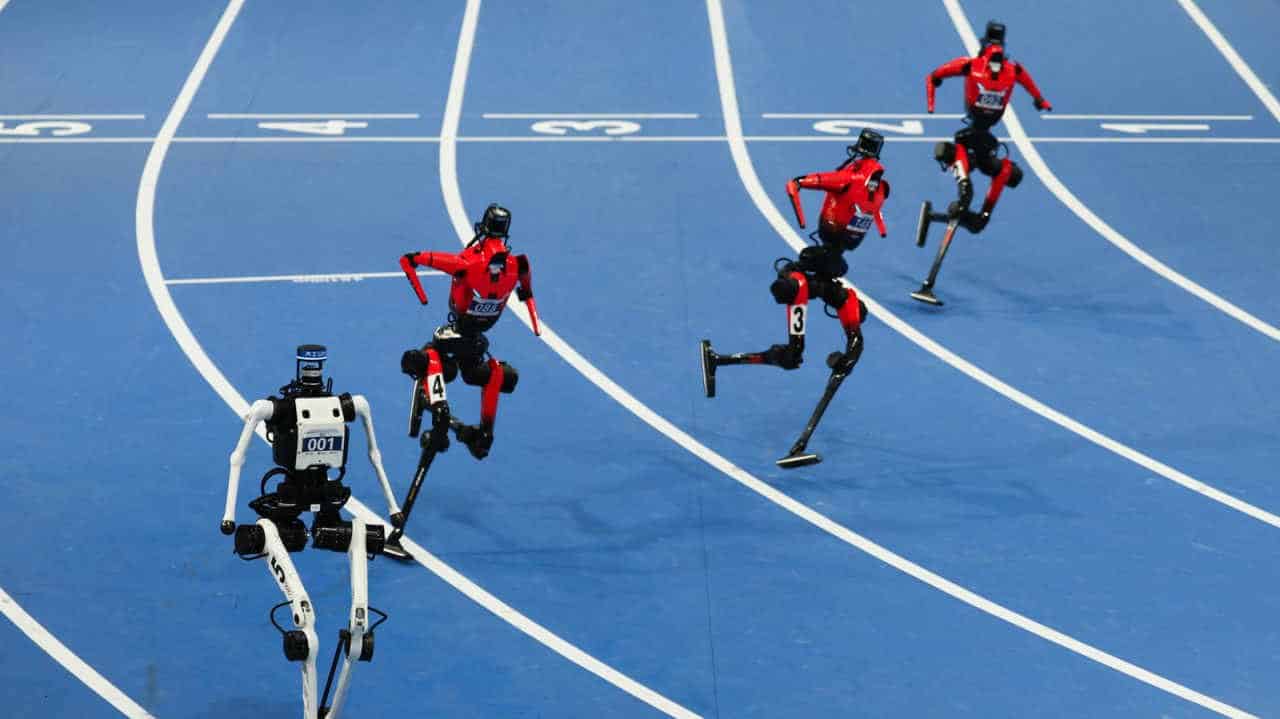

Usain Bolt’s 100-meter world record from 2009 still stands at 9.58 seconds. With an asterisk that didn’t exist a week ago: that’s the human record.
At the second annual World Humanoid Robot Games in Beijing, a machine called Tiangong Ultra covered the same 100 meters in 9.39 seconds during a preliminary heat. Not a final. A heat.
The finish line is where it gets stupid
Watching the sprints, the times aren’t the part that sticks with you. The stopping is.
These robots crossed the line and slammed straight into pads. Some of them needed human handlers to stretcher them off the course. A sub-9.4 sprint followed by an undignified faceplant into foam, over and over.
So no, don’t read this as a sign that humanoid robots are ready for commercial work. A machine that can run faster than any person alive but can’t decelerate without a crash mat isn’t solving anyone’s labor problem yet.
Nine point three nine, from 21.5
Here’s the number that actually matters, and it isn’t Bolt’s.
At last year’s inaugural World Humanoid Robot Games, Tiangong Ultra won the 100-meter dash in 21.5 seconds. Same robot family, same event, one year later: 9.39 seconds. That’s the improvement curve worth paying attention to, and it’s steeper than anything the human record book has ever produced.
The robot was developed by Beijing Humanoid Robot Innovation Center. It beat out Honor’s Lightning robot, which finished the sprint in 9.47 seconds. Eight hundredths of a second between first and second, which is a tighter margin than you’d expect from a field of machines that can’t reliably stop running.
Lightning got its own back over 13 miles
Beijing also hosted a half-marathon for Chinese companies to show what their humanoids can do over distance, and the crashes carried over from the sprints.
Honor’s Lightning robot took gold there with a finish time of 50 minutes and 26 seconds. That one also surpassed a human record.
Distance is the harder problem. A 100-meter sprint is roughly nine seconds of not falling over. Fifty minutes of continuous locomotion means thermal management, battery draw and joint wear all have time to go wrong. Lightning losing the sprint by 0.08 seconds and then winning the long event tells you these machines are being tuned for different things.
Soccer, table tennis and boxing are also on the schedule
The Games opened August 22 and run through the 26, with thousands of robot participants. Track and field is only part of it. There’s soccer, table tennis and boxing on the program too.
Table tennis is the one I’d watch. Sprinting rewards raw actuator speed in a straight line; returning a ping-pong serve demands perception, prediction and fine motor control in the same tenth of a second, and that’s a category of problem these robots haven’t shown they’ve solved.
If you want a benchmark for next year’s event, don’t track the sprint time. Track whether any of these things can cross the finish line and slow down on its own.



[…] product is Iron, a humanoid with a realistic human shape built for commercial deployment. Not a research platform. Not a stage […]