



























 George Tsagkarakis


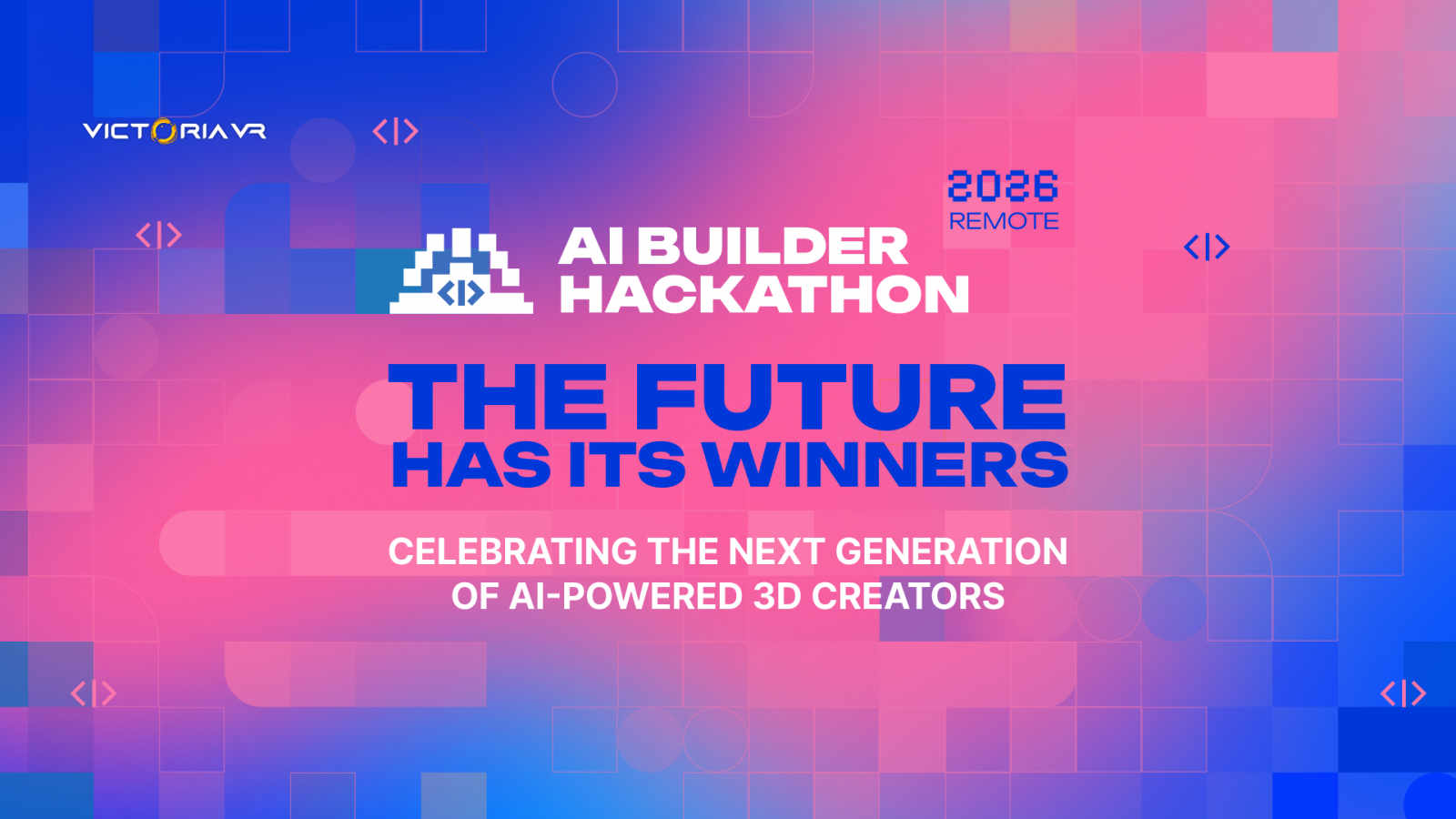
The winners of the AI Builder Hackathon 2026 have been announced. The event, run by Victoria VR (official site), asked developers and teams from around the world to build browser-native AI tools for creating and interacting with 3D experiences. Five projects split a €20,000 prize pool, and first place went to Theras AI, a browser-based 3D world editor that builds interactive environments from natural-language descriptions.
The organizers say the projects were scored against four criteria, each marked out of 10 and weighted toward a final score. One of those criteria was Impact. The results were announced on November 25, 2026, after months of development.
Theras AI takes first place
Theras AI scored 9.25/10 and won €10,000. Users type or speak a description of what they want, for example an island with a windmill, a golden-hour sky and lanterns, and the editor builds terrain, buildings, lighting, characters and game logic into a live scene. That scene stays fully editable.
The tool has an AI assistant that accepts text, voice and file inputs. It also has a library of more than 700 models, terrain sculpting tools and reusable building components. A Play mode lets creators walk around their worlds as characters. The organizers credited the mix of AI creation tools and traditional editing, along with a strong demonstration, for the win.
Sayplay turns one sentence into a playable game
Second place and €5,000 went to Sayplay, with a score of 7.10/10. It generates short, playable 3D games in the browser from a text prompt. Each game has its own objectives, controls and rules. A quick playable version appears first while an AI director works on a more tailored version.
Sayplay doesn’t let the AI write unrestricted game code. It uses predefined components, deterministic game logic and automated checks so that the games work and can be won. Players can share games through links, replay them and remix them with new prompts. Sayplay received a perfect score in Impact.
Aether, Refloor and Draw3D round out the top five
Aether came third with 6.95/10 and won €3,000. It is a browser-based AI world studio built on its own open-source TypeScript framework. Users describe a world or upload a reference image, such as a photo of a room, and the AI builds terrain, buildings, interiors, characters and gameplay rules. Creators can change scenes through conversation or move objects directly. An automated playtesting bot checks whether a generated game can be completed. The framework underneath combines rendering, physics, game logic, procedural architecture and validation systems.
Refloor placed fourth with 6.35/10 and €1,500. It turns a plain-language description of a home into a furnished, editable 3D space that users can walk through in a browser. Doors, cupboards, lighting and appliances are interactive, and furniture, materials and finishes can be changed by asking the AI. It supports saved design versions, undo, project exports and live collaboration.
Draw3D finished fifth with 6.30/10 and €500. It is a human-AI collaborative CAD tool where users refine 3D designs step by step through sketches, voice commands and text. It pairs a browser-based Three.js interface with native FreeCAD and Blender tools, and it supports desktop use and optional WebXR.
Final standings
- 1st: Theras AI, 9.25/10, €10,000
- 2nd: Sayplay, 7.10/10, €5,000
- 3rd: Aether, 6.95/10, €3,000
- 4th: Refloor, 6.35/10, €1,500
- 5th: Draw3D, 6.30/10, €500
Two of the five winners, Sayplay and Aether, generate games that can be played straight away in a browser. Theras AI includes a Play mode for exploring the worlds it builds. Refloor and Draw3D are aimed at home design and 3D object design. Victoria VR VR $0.001661 0% says the goal of the hackathon was to make 3D creation open to people who don’t know how to use complex software.