

AMD’s gaming business lost 31 percent of its revenue year-over-year, falling to $779 million. Its data center business more than doubled in the same period, hitting $6.7 billion. Both numbers came out of the same earnings report, and only one of them is getting talked about on the call.
That $6.7 billion figure is up from $5.8 billion in Q1, and up 107 percent from the $3.2 billion AMD reported for the same period a year ago. Demand for AI capacity is doing the work.
And AMD doesn’t expect it to stop. On Tuesday’s earnings call, CEO Lisa Su said the company expects “data center segment revenue to more than double year-over-year in 2027.”

The gaming decline has a supply-chain explanation
Price hikes and component shortages slowed sales for the Xbox Series X / S, PS5 and Valve’s Steam Deck. That’s three of the biggest consoles and handhelds AMD silicon shows up in, all pushing against the same wall.
Graphics cards got hit for the same reason. “Gaming graphics revenue also declined year-over-year, as higher industry-wide component costs contributed to higher graphics card prices and weighed on overall demand,” Su told analysts on a call after the earnings were released.
Anyone who has shopped for a GPU lately already knew the price part. Now there’s a revenue line confirming buyers walked away.
Where the growth actually sits
Data center made up 58 percent of company revenue in the quarter. That’s the number worth sitting with, because it reframes what AMD is now.
“Revenue increased 50 percent year-over-year to a record $11.5 billion, driven by continued strength in our Data Center business, which represented 58% of company revenue in the quarter,” wrote AMD CFO Jean Hu.
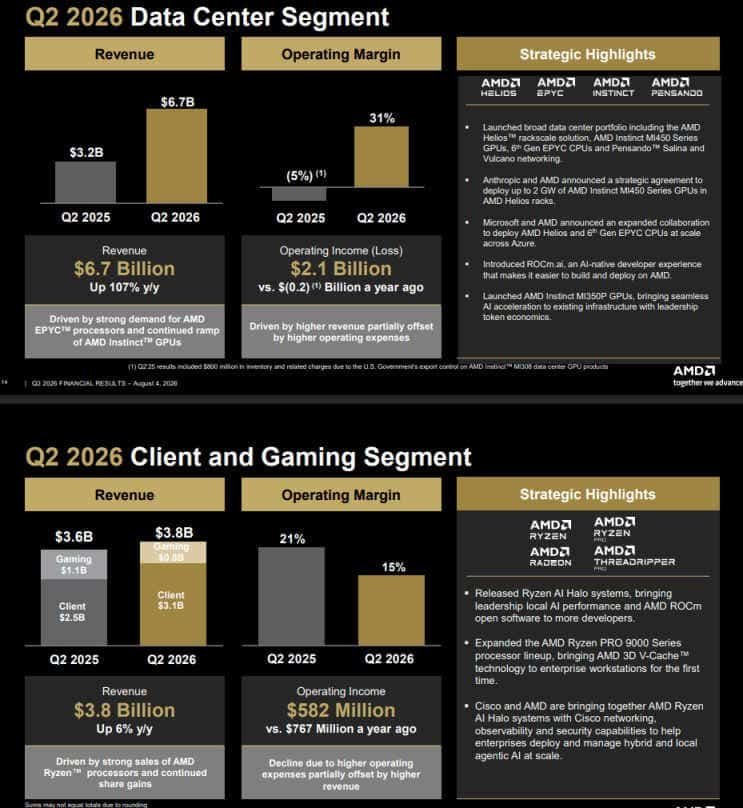
The PC and gaming business overall grew six percent compared to last year. Client revenue was up 23 percent on Ryzen processor sales, which is the part of the consumer story that’s still working.
Su’s framing puts AI in every column
“AI is driving a significant expansion in demand for compute across all of our markets, and our leadership portfolio and growing customer visibility position us exceptionally well to capture this expanding opportunity and deliver substantial revenue and earnings growth in the years ahead,” said Su.
All of our markets is doing a lot of work in that sentence. The gaming line fell 31 percent this quarter, and the explanation offered for it was component costs, not AI demand.
If you build gaming PCs or you’re waiting on a graphics card price to come back down, the number to watch isn’t the 107 percent data center jump. It’s whether those industry-wide component costs Su described ease up before AMD’s next report.