

In Brief:
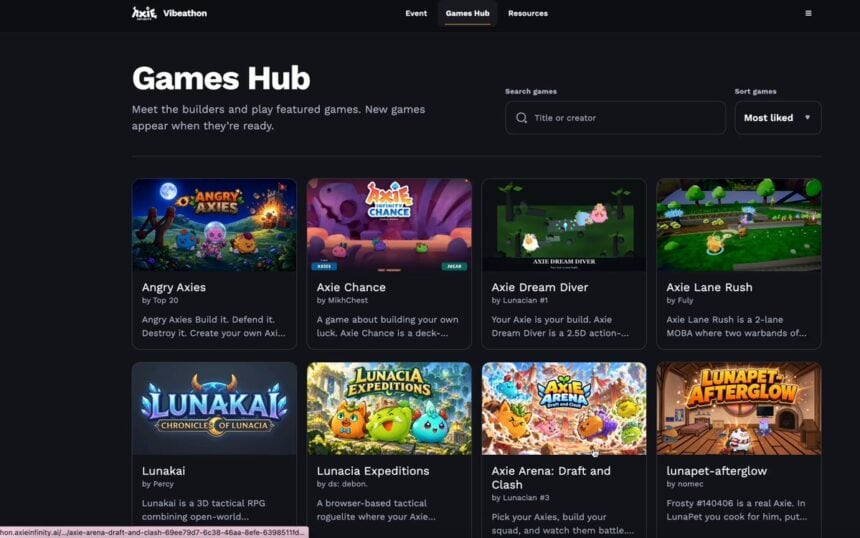
- Axie Infinity published the first batch of Axie Vibeathon games in the Games Hub on Sept. 22, most of them playable in the browser.
- Sky Mavis co-founder Jeffrey “Jiho” Zirlin said the two-week build round drew 70 submissions.
- Signed-in users can like games and leave feedback for builders, but likes and comments don’t affect judging; up to eight finalists advance to Round 2 in October for a share of a 20,000 bAXS prize pool.
Axie Infinity (official site) opened the Games Hub to the public on Sept. 22 with the first batch of Axie Vibeathon entries, games the community built with AI coding tools over a two-week sprint.
“The first batch of Axie Vibeathon games is live!” the Axie Infinity account said on X. “Jump into the Games Hub and discover what the Axie community built with AI. Most games play right in your browser!”

This is a thing of beauty!
Page after page of new axie experiences, built by YOU.
We had 70 submission to the vibeathon, unlocking the creative potential in Lunacians across the globe.
This is something unique that I haven't seen anywhere else.
cc: @claudeai @OpenAIJihoz.ronView on X ↗
Sky Mavis co-founder Jeffrey Zirlin, who posts as Jihoz, put the submission count at 70. “Page after page of new axie experiences, built by YOU,” he said, tagging Anthropic’s Claude and OpenAI in the post.
Likes don’t count
Players can sign in to like their favourite entries and leave comments for the builders. The company said likes and comments don’t affect judging.
Round 1 scoring instead rests on five weighted criteria: Axie Core at 35%, gameplay at 25%, product vision at 20%, feasibility at 10% and prototype and documentation quality at 10%. Every entry passes an eligibility and safety screen before receiving three independent judge scores.
The games went live at 11 a.m. Philippine time, the slot Axie Infinity gave when it announced submissions had closed. Only entries that cleared review appear in the hub.
What builders had to ship
Each entrant competed as an individual and submitted one game, hosted on a server they control. The Vibeathon platform links out to the game rather than running it.
Submissions had to be browser-playable and include a title, pitch, thumbnail, control instructions, a code repository link, a fallback demo video, documentation of which AI tools were used and a statement on how the game fits Axie Core. Sky Mavis didn’t mandate an engine, and use of Axie art, NFTs, on-chain data or the API was optional at the prototype stage.
Several builders have already published their entries publicly, including Lunacia Rift, a 1v1 three-lane micro-MOBA, and Axie Lost & Found, a first-person browser game.
Prize pool and next steps
The community prize pool is 20,000 bAXS, the locked form of AXS, worth roughly $18,000 when the event was announced. It’s split among winners, finalists and standout prototypes.
Up to eight finalists are due to be named on Sept. 29 and advance to Round 2, which runs Oct. 4 to Oct. 31. Each finalist receives 250 USDC toward AI tooling. Round 2 is where a complete game loop and any Axie asset or blockchain hooks must be built and cleared by Sky Mavis. Winners are due on Nov. 5.
A separate 500 bAXS “Promising Prototype” bonus goes to a strong Round 1 entry that doesn’t reach the final. Sky Mavis said the award is recognition only, and no winner, finalist or recognised prototype is automatically entitled to a production pathway. The company has said winning ideas can become ecosystem integrations or standalone games.
Background
Sky Mavis opened Vibeathon registration on Sept. 1 and closed it on Sept. 7. Round 1 ran Sept. 8 to Sept. 21. The company pitched the event at non-programmers as much as developers, saying a clear idea and AI tools were enough to produce something playable.
Builders got a resource kit with Axie art assets, engine guides, API setup instructions and an Origins Battle Kit drawn from Axie Origins, plus a beta Three.js Axie Mixer for 3D work, along with Discord support.
Sky Mavis described this run as the first iteration, starting with the Lunacian community to settle the tools, the format and the path from an idea to a published Axie game.
“This is something unique that I haven’t seen anywhere else,” Zirlin said.