
Bitwise built the cheapest Dogecoin ETF on the market. Investors put roughly $700,000 in it. Then they took more out than they ever put in.
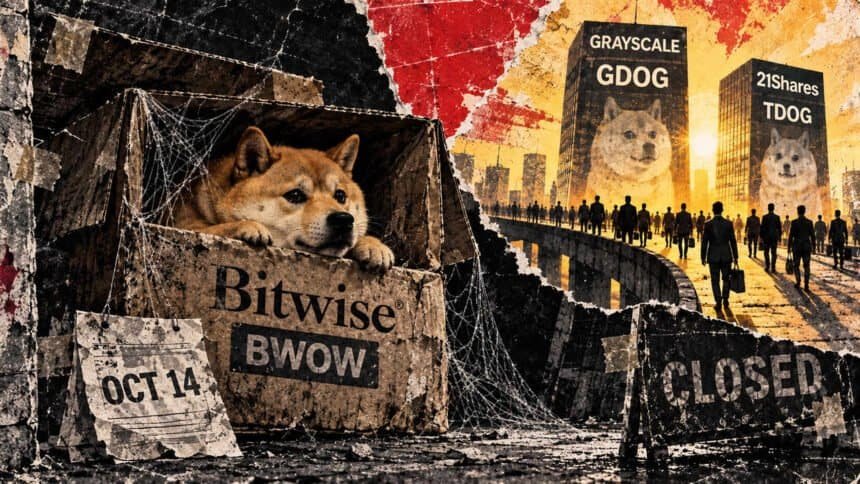
On Sept. 10, the asset manager said the Bitwise Dogecoin ETF, ticker BWOW, will stop trading on NYSE Arca on Oct. 14 and be liquidated the following week. That’s less than 11 months after launch.
Share creation stops before trading opens Oct. 15. Remaining investors are expected to receive cash based on the fund’s Oct. 21 net asset value, around Oct. 22. Bitwise said the liquidation is part of an effort to optimize its product lineup as investor needs evolve.

Translated out of fund-company language: almost nobody showed up.
Three days of activity in an entire lifetime
Here’s the number that tells the story. Over its full history, BWOW recorded a non-zero daily net flow on only three trading days.
Three. Not three weeks of flat performance, three days where any money moved at all.
The fund didn’t register a single inflow until Aug. 24, when about $146,000 came in. Before that, the flows ran the wrong way: roughly $972,000 withdrawn on Dec. 4, 2025, then another $406,000 on Jan. 20, 2026.
Net result across nearly 10 months: about $1.23 million of cumulative net outflows on a fund now holding around $700,000.
The low fee didn’t save it
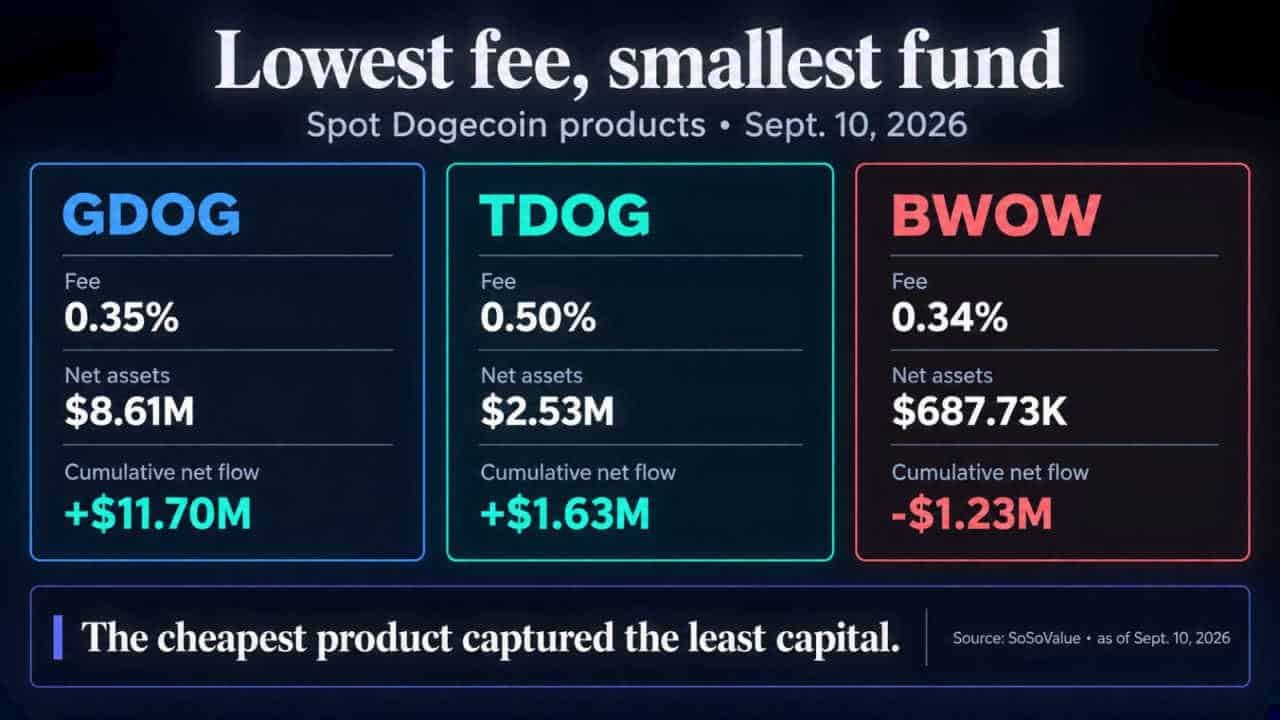
This is the part that should bother anyone who assumes expense ratios drive flows in crypto ETFs. Bitwise charges 0.34%. Grayscale’s Dogecoin Trust ETF charges a 0.35% sponsor fee. The 21Shares product charges a 0.50% management fee.
BWOW was the cheapest option on the board and finished last anyway.
Grayscale’s GDOG has pulled in roughly $11.7 million of cumulative net inflows. TDOG from 21Shares has attracted about $1.63 million. Those two are the reason the whole Dogecoin ETF category sits in positive territory despite Bitwise bleeding capital the entire time.
Grayscale had a head start, and it shows
Part of GDOG’s lead is structural rather than competitive. Grayscale’s Dogecoin trust had operated privately since January 2025 and held about $2.09 million in assets by Oct. 31, weeks before its shares traded publicly.
GDOG then debuted on NYSE Arca on Nov. 24, one day before BWOW launched. An existing investor base plus first-mover position on the listing is a real advantage, and it explains a chunk of the $11.7 million gap.
The 21Shares comparison is the one Bitwise can’t explain away.
A later launch and a higher fee still beat it
TDOG launched Jan. 22, nearly two months after BWOW. It charges 16 basis points more. And it still gathered roughly $1.63 million of net inflows and built an asset base several times larger than Bitwise’s.
Later to market, more expensive, more money. Whatever distribution or advisor relationships moved capital into these products, BWOW wasn’t part of it.
The category itself is tiny
Context matters here, because none of these funds are large. The US Dogecoin ETF market has recorded about $12 million of cumulative net inflows and manages roughly $11.83 million in assets total.
That’s the entire category. Every Dogecoin ETF in the country, combined, holds less than what a single mid-size crypto fund moves in a slow week.
Dogecoin itself is not a small asset. The original memecoin, a proof-of-work payment network launched in 2013, carries a market value of about $13.07 billion and sits as the 11th-largest cryptocurrency by market capitalization.
What this actually tells you
A $13.07 billion asset supporting $11.83 million in ETF assets is a gap worth staring at. The demand for wrapped, regulated Dogecoin exposure is not there, at least not yet, and shaving a basis point off the fee doesn’t create it.
If you hold BWOW, the dates are what matter: last trading day Oct. 14, cash out around Oct. 22 based on the Oct. 21 NAV. If you want Dogecoin ETF exposure after that, you’re choosing between a fund with an 11-month head start and one that costs more but keeps growing anyway.
Bitwise is walking away from a market where both an established incumbent and a later, pricier entrant beat it on the only metric that keeps a fund alive.