
In Brief:
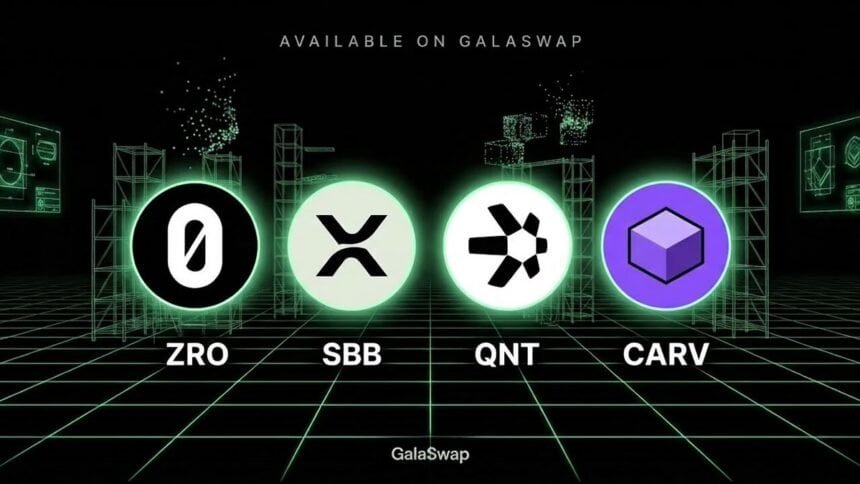
- Gala added four tokens to GalaSwap, its decentralized exchange on GalaChain: ZRO, SBB, QNT and CARV, all tradable through links.gala.com/swap.
- The batch lands about a week after SAND, ETHFI, ICNT and WKAS went live Aug. 3, extending a listing cadence Gala has held for most of 2026.
- Each round widens the set of outside assets settling on GalaChain, which Gala is positioning as a general utility chain carrying cross-chain liquidity rather than a gaming-only network.
Gala listed four more tokens on GalaSwap, opening ZRO, SBB, QNT and CARV to trading on the GalaChain decentralized exchange.
“You can now trade ZRO, SBB, QNT, and CARV directly on our decentralized exchange. Dive into the GalaChain experience today!” the company said in a post on X, pointing users to links.gala.com/swap.

You can now trade ZRO, SBB, QNT, and CARV directly on our decentralized exchange. Dive into the GalaChain experience today!
https://links.gala.com/swap
#GalaDefi #GalaChain #GalaSwapGala GamesView on X ↗
Gala gave no further detail on the four pairs, no liquidity figures and no launch incentives specific to the batch.
A weekly rhythm
The additions keep pace with a schedule Gala has run for months. SAND, ETHFI, ICNT and WKAS arrived Aug. 3. IRYS, AAVE, CARDS and MERL went live July 30, and ESTG, CVX, AI and COW followed days earlier.
June 29 brought a larger round of eight: FET, AAVE, ARB, ONDO, CRV, ETHFI, JTO and GRASS. Earlier batches this year added MOCA, IOTX, AXL, JUPUSD and USAT.
Four to eight tickers per round has been the pattern. Gala announces each batch the same way, through a post on X with a link to the swap interface.
What’s in the batch
QNT is the token of Quant Network, whose Overledger system connects separate blockchains through APIs and is aimed at banks and asset managers. It traded at $59.15 on Aug. 6 with a market cap of $860,530,050 and 24-hour volume of $5,829,752, against a circulating supply of 12,072,700 and a max supply of 14.88 million.
ZRO is LayerZero’s token. The messaging protocol carries data between chains including Ethereum, BNB Chain, Avalanche, Polygon, Arbitrum, Optimism and Aptos. GalaChain isn’t among the networks LayerZero supports, and Gala’s own bridge is a proprietary build that doesn’t run on LayerZero’s messaging layer.
ZRO has a market cap of roughly $292.5 million. Its next unlock releases 25.71 million tokens, about 2.6% of total supply and worth around $21.27 million at current prices.
Bridging happens elsewhere
Tokens reach GalaChain through GalaConnect, the separate product that handles bridging, wrapping, sending and asset management. It supports MetaMask and WalletConnect for Ethereum, Phantom for Solana, TonConnect for TON and the Gala wallet for GalaChain. Trading is then routed to GalaSwap.
Gala opened Solana, TON and Ethereum bridges earlier this year, a step up from the exchange’s early days, when it only supported trades between Ethereum-based tokens inside the Gala ecosystem.
The exchange itself has changed shape too. It launched as an on-chain order book with no partial fills, where users listed a trade and others accepted it outright. It now runs a concentrated liquidity AMM, with liquidity providers earning a share of every swap routed through their range.
The volume math
Gala put GalaSwap at 476,000 transactions and more than $72 million in cumulative volume as of March 19, with support for over 60 tokens. Total value locked sits near $10.8 million, down about 5%, with annualized fees running around $1.9 million.
Listings feed that. More assets means more pairs, more routed volume and more fees, and a community vote moved GalaChain to a tokenomics model that burns part of network fees and distributes the rest to ecosystem participants.
Behind the expansion is a $2 million ecosystem incentive program meant to pull on-chain activity through GalaSwap and GalaPump. The stated goal is to make GalaChain a general utility chain holding cross-chain liquidity, not a network confined to games.
Adding assets like AAVE, CRV and ONDO points the same direction. Most of GalaSwap’s volume already comes from wrapped majors rather than game tokens, with GWETH/GWBTC the busiest pair at roughly $411,500 in 24-hour volume.
Pools charge a protocol fee of 0.05%, 0.3% or 1% depending on tier, plus a network fee settled in GALA. Both appear in the quote before a user signs.