


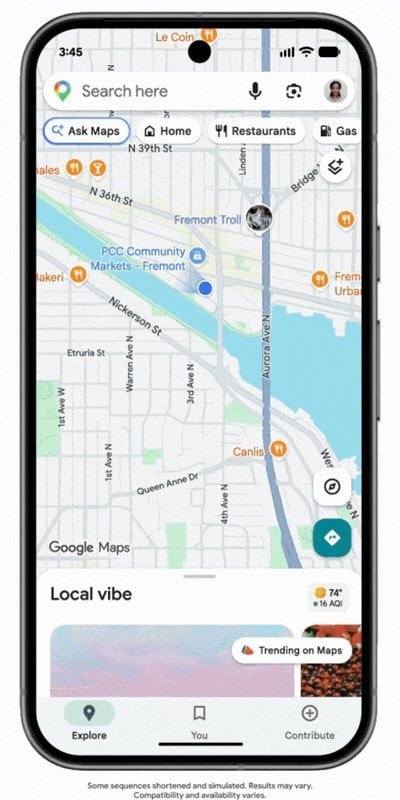
Google wants you to stop leaving Google Maps. That’s the actual pitch behind the batch of Ask Maps features announced today, and food ordering is the one that shows how far the company is willing to push it.
The example Google gave is oddly specific, which I appreciate. You can ask Maps to “order spicy pad kee mao with seafood for me to pick up on my way home” before you leave work. Ask Maps then hunts for open restaurants along your route that serve it. Pick one, and the tool can drop the dish into your cart automatically so you just finish the checkout.

Who’s actually wired up for ordering
Food ordering is rolling out with Square and Toast as launch partners, Google said, with Uber Eats support coming soon. That partner list matters more than the demo does. Square and Toast cover a lot of independent restaurants, but if your neighborhood spot runs on something else, the agentic part has nothing to grab onto.
The ordering flow, hotel and event discovery, and conversational contributions are rolling out now in the US, with more countries to come over time.
Hotels, events and editing the map by talking to it
Ask Maps can now search for hotels and local events against fuzzier criteria than a filter checkbox allows, like a particular aesthetic or being within walking distance of gyms and restaurants. Whether that holds up against a room you’d genuinely book is the part nobody can promise you in a launch post.
The contribution change is the quieter one. You can now add and edit location information conversationally through Ask Maps or the Contribute tab, including uploading a photo of a storefront sign that Maps reads for details like updated opening hours. It asks you to confirm the suggestion before submitting. Good. Crowdsourced hours are one of the things Maps still gets wrong often enough to strand you outside a closed door.
Gemini gets a look at your Gmail
Maps has started adding Personal Intelligence, a Gemini-powered feature that personalizes AI responses by connecting to data from other Google apps. In practice that means Ask Maps can factor in an upcoming flight or a dinner reservation when it answers you.
It connects to Gmail first, and Google said it’s disabled by default. Support for other apps like Calendar is coming soon. The off-by-default detail is the right call, and it’s worth knowing it’s there before you flip it on, because a mail-reading travel assistant is a different product than a map.
The transit widget is the one you’ll use daily
Real-time transit info is now part of Ask Maps, so you can check live updates on delays to your next bus, train, subway or ferry. That’s the least flashy thing here and probably the most used.
The live transit widget and the more personalized responses are rolling out now everywhere Ask Maps is available, which as of today includes Australia, Brazil, Canada, Indonesia, Japan and Mexico.
All of it is aimed at one goal, which Google Maps head Miriam Daniel framed as making it “make it easier than ever to get more done” without closing the app. If you’re in the US and your local takeout place runs Square or Toast, try the pad kee mao test on your commute home tonight. That’s the one feature here that either works on the first try or doesn’t.