

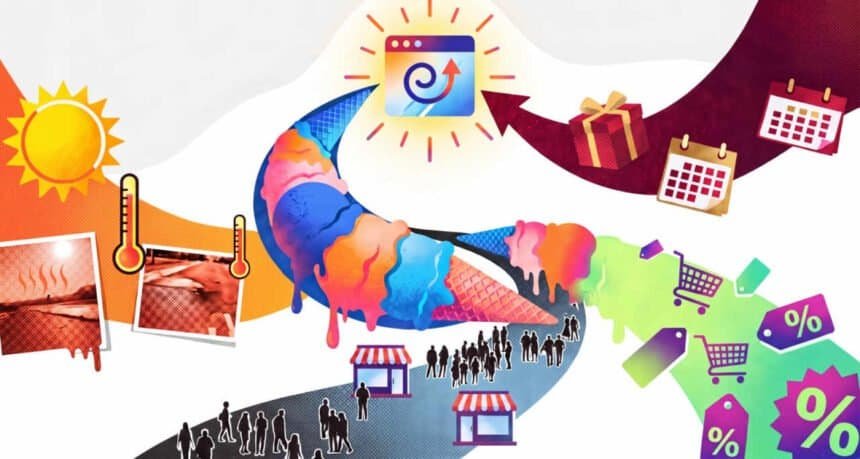
Give the old model a discount calendar and it shrugs. Give TimesFM-3 the same calendar and it expects roughly 20 percent more units moving on each promotion day.
That gap is the whole pitch for the forecasting model Google Research just released, and it’s a narrower pitch than the launch language suggests.
Every version of this family through TimesFM-2.5, which shipped in September 2025, could only look at one data series at a time. Feed it daily ice cream sales and it gave you back daily ice cream sales, extended forward. It couldn’t see the heat wave, the waffle cone numbers, or the Friday promotion you’d already scheduled.

What changed is the number of things it’s allowed to look at
Google’s own example is a retail chain trying to predict ice cream sales. A useful forecast there doesn’t hinge on one number. It leans on related products like waffle cones or syrup, plus past foot traffic, weather, discount campaigns and holidays.
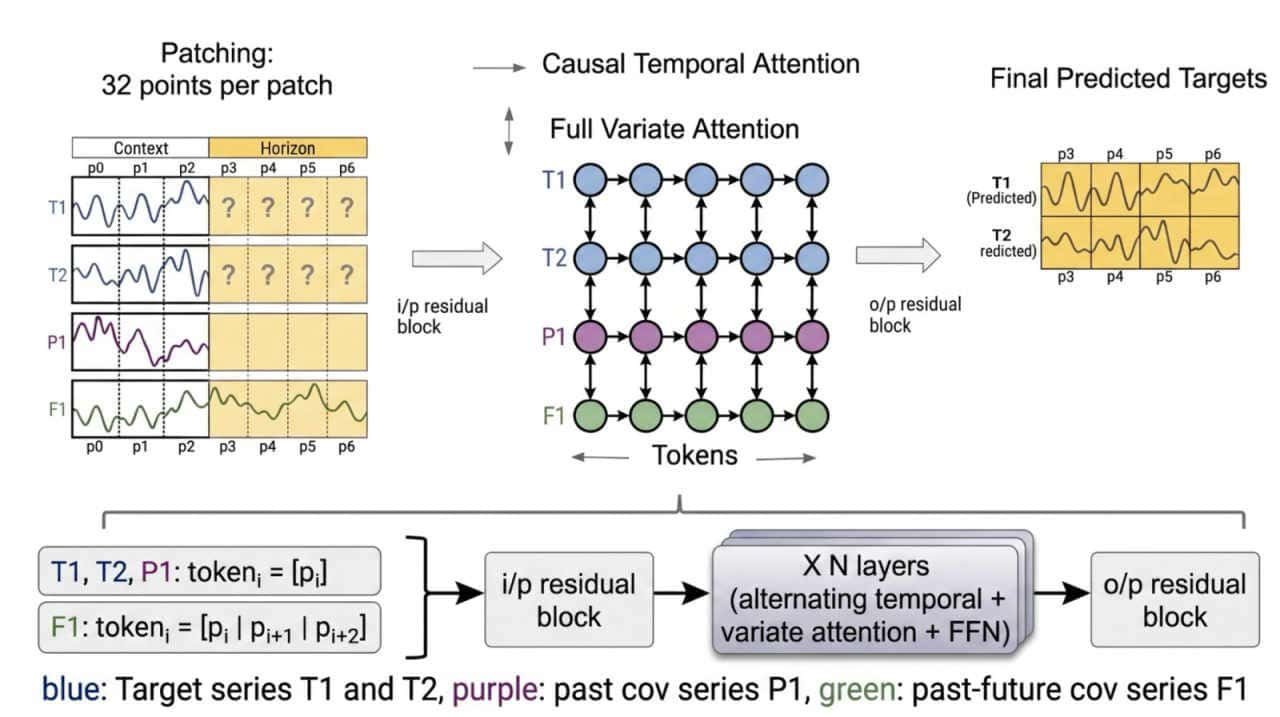
TimesFM-3 takes three kinds of supplementary data. It predicts multiple related variables at once, like different flavors. It takes in factors known only for the past, such as historical foot traffic. And it uses known future events, meaning planned discounts or weather forecasts.
The multivariate support is the real headline. Everything else is architecture in service of it.
Two passes, two directions
The model is still built on a Transformer, same base as its predecessors. It groups 32 consecutive data points into a single patch and normalizes each series to a common scale, so measurements of wildly different magnitudes can sit next to each other without one drowning the other.
Then it alternates directions. Along the time axis it hunts for patterns inside a single series, drawing only on past values so future information can’t leak backward. Across series it compares every variable at one point in time and learns the relationships, which is how it catches something like a discount on one product cannibalizing or lifting another.
It’s 330 million parameters, trained on real and synthetic time series totaling more than one trillion data points, according to Google. Like the earlier versions it works zero-shot, with no extra training required for a new task.
The slow part got cut out
Earlier versions predicted the future one block at a time. Google says that was slow, compute-heavy, and prone to compounding errors, because each prediction was built on the last one’s output.
TimesFM-3 marks every future time step as a blank and fills them all in a single pass. Whether that holds up on long horizons in production is a separate question from whether it’s faster, and Google is making the speed claim, not a stability one.
One detail worth more than it sounds: the output isn’t a single point estimate. TimesFM-3 emits nine values per time step, so you get the range and the uncertainty rather than a confident line that hides how confident it actually is. If you’ve ever had a forecasting tool hand you a number with no error bars and watched a planner treat it as gospel, you know why that matters.
The benchmark claims come from Google
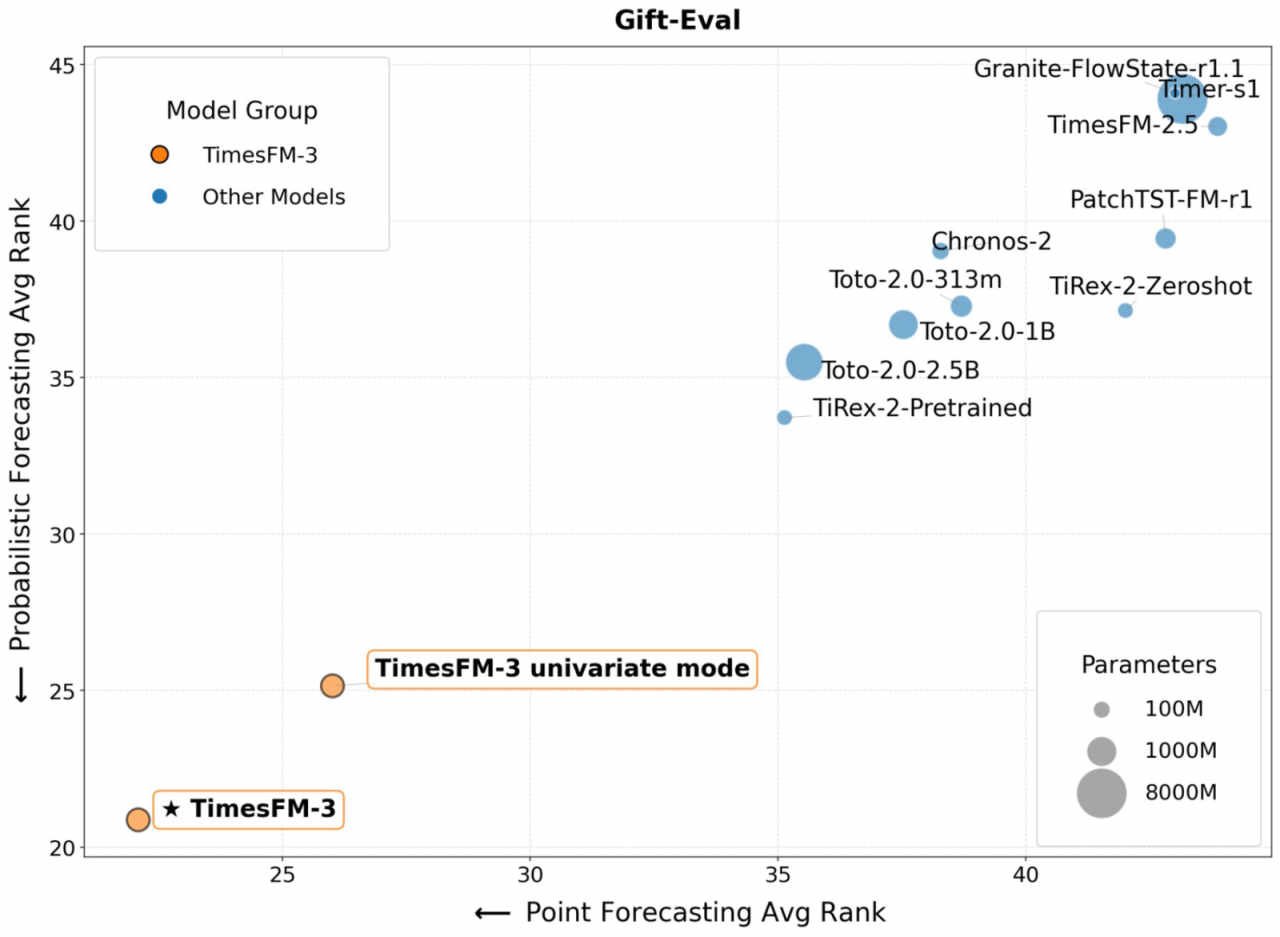
On Gift-Eval, FEV-Bench and Time, Google says TimesFM-3 ranks first among all pretrained forecasting models in both point accuracy and uncertainty calibration. The field it’s measured against includes Amazon’s Chronos-2, the Toto-2.0 family and Google’s own TimesFM-2.5.
Even restricted to a single variable, Google says TimesFM-3 matches or beats the field, and the gap widens as you add more data. Read that the way you’d read any vendor’s benchmark table: it’s the vendor’s table.
Where you can actually get it
It’s on GitHub and Hugging Face now. Google plans to add it to BigQuery in the coming weeks, which is the part most companies will care about, since TimesFM-2.5 already sits there handling single-variable forecasting through the AI.FORECAST command.
Until that lands, BigQuery users are still on the one-series-at-a-time model, and the ice cream example stays a demo rather than a query you can run.
Google says the family has been deployed in retail, finance, manufacturing, healthcare and the sciences since it launched in 2024.
Forecasting isn’t the only direction this work is going. In early August, Google DeepMind released WeatherNext Cyclones, an open-source system for tropical cyclones that predicts storm tracks and intensity about a day further out than leading operational models.
If you run demand planning and you’ve been feeding a model nothing but your own sales history, the discount schedule sitting in your promotions calendar is the cheapest input you’re not using. That’s the one to wire in first.