
In Brief:
- Lumiterra (official site) is directing its players to the $GONE Community Airdrop from Guess One, the second Fair Launch project out of LeverUp, now live on Monad.
- Guess One runs 60-second rounds on the price of MON, paying out GONE through what it calls mining; entry to the campaign requires an invitation code.
- GONE reached its Fair Launch target of 4,500 BNCB, a tokenized security that only recently gained a bridge route to Monad, and now trades as a graduated token on Nad.Fun.
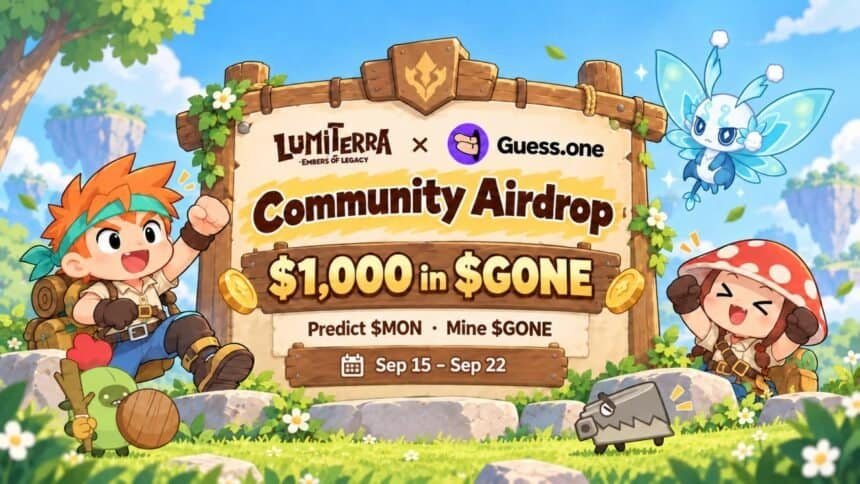
Lumiterra told its players to join the $GONE Community Airdrop campaign run by Guess One, which is live on Monad as the second Fair Launch project from LeverUp.
“Predict $MON. Mine $GONE. Earn your share,” Lumiterra said in the post announcing the tie-up. Players need an invitation code to take part.

Lumiterra is stepping into Guess One
@guess_dot_one, the second Fair Launch project from @LeverUp_xyz, is now live on Monad
Lumiterra players are invited to join the $GONE Community Airdrop campaign.
Predict $MON. Mine $GONE. Earn your share.
Get invitation code inLumiterra (mainnet arc)View on X ↗
Guess One is a short-duration prediction app built around the price of MON. Users enter 60-second rounds, make a price call and earn GONE through the product’s reward flow.
The raise
GONE came out of LeverUp’s second Fair Launch, which collected 4,500 BNCB. The launch thread set that figure as the target, and Guess One later confirmed it was fully reached. Roughly 50.04 million GONE was allocated to contributors.
The contribution asset is the part worth noting for anyone tracking Monad launch plumbing. The raise didn’t use MON or LVMON. It used BNCB, which had only just gained a route from BNB Smart Chain to Monad over LeverUp’s Wormhole-powered bridge, moving from bridged asset to contribution currency to launch pair. HOODB and BNCB are the first bStocks the bridge supports.
Guess One’s launch materials identify GONE/BNCB as the post-launch market pair. Nad.Fun records GONE as a graduated token.
How Fair Launch works
A Builder sets a fixed fundraising target and a contribution window. Hit the target and the token launches through Nad.Fun, where contributors claim their allocation. Miss it and contributors can reclaim their full contribution. Live raises can’t be refunded early, and launched plans can’t be refunded after the fact.
Everyone pays the same per-token price no matter when they contributed. Contributing more changes the token count, not the entry price.
A keeper executes the launch. The raised funds cover the Nad.Fun creation fee, buy out the bonding curve and seed the resulting DEX pool, so a completed raise produces live tradeable liquidity rather than just a filled target. The contract reserves contributor tokens first; whatever launchpad-held supply is left goes to the Builder’s incentive wallet, an allocation that scales with market cap rather than sitting at a fixed percentage.
The first Fair Launch was busy.land’s $BUSY. Contributors filled the full 2,500,000 LVMON target during the whitelist phase, and BUSY later hit an all-time high market cap of about $7.06 million.
Why Lumiterra is in this
The two projects were already linked through LeverUp. LVMON, a synthetic version of MON built with LeverUp, is Lumiterra’s in-game currency for purchases, marketplace transactions and core economic activity.
Lumiterra ran its LUMONAD campaign on Monad mainnet, where players claimed Lemon daily and shared in-game LVMON rewards while unlocking a LeverUp collaboration skin sponsored by Ledger. When $LV went live, LeverUp airdropped it to Lumiterra’s most active players.
Lumiterra runs on Ronin and went live on Monad mainnet on day one with its Survival Season, putting progression on-chain. Invite codes are familiar territory for its players: the Survival Season Check-in Rally handed out an Explorer Pass, an invite code and early launch rewards, and made Lumonad skins 1:1 usable in the season.
LeverUp has been direct about what a completed raise does and doesn’t prove. Fair Launch supplies the launch mechanism and nothing more, the firm said, with no guarantee of value or performance for any token launched through it. A filled target shows contributors were willing to commit under the stated terms. It says nothing about claim rates, whether GONE/BNCB develops usable liquidity, or whether anyone comes back for the 60-second rounds.
As for the asset that funded it: BNCB is issued by BTech Holdings Limited and is designed to give economic exposure to CEA Industries under the issuer’s certificate structure. It isn’t a share, and it carries no direct shareholder rights.