

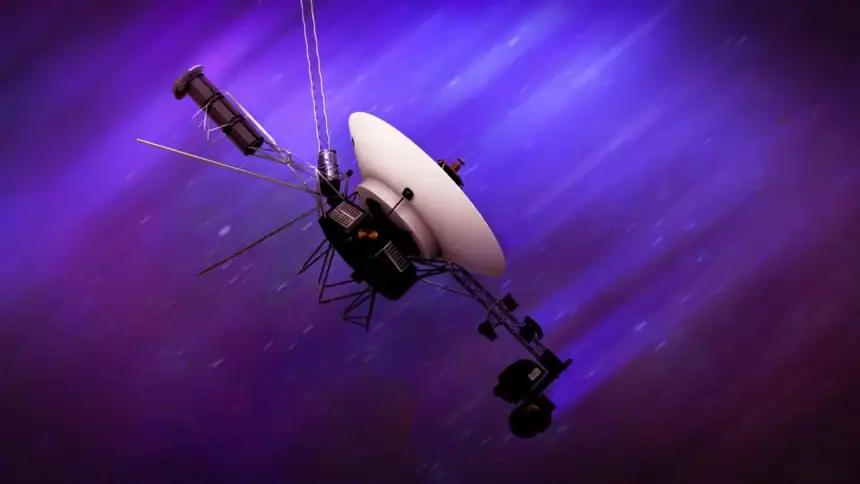
Voyager 2 loses about 4 watts of usable power every year, and it has been losing them since the Nixon administration was still in office. That arithmetic was about to cost the spacecraft another science instrument before the end of 2026.
It won’t. Engineers at NASA’s Jet Propulsion Laboratory ran a procedure they call the “Big Bang,” and the three instruments still running aboard Voyager 2 are now expected to keep running for at least one more year.
What the “Big Bang” actually did

The trick wasn’t clever software or a new operating mode. The team shut down certain powered components and swapped in options that draw less energy, all at the same time, while making sure the spacecraft stayed warm enough to keep functioning.
That last part is the constraint people tend to miss. Out there, heat isn’t a byproduct you can shed. It’s a system requirement, and every watt you claw back from one component is a watt that was helping keep something else from freezing.
The power supply has been shrinking the whole time
Voyager 2 and its twin, Voyager 1, run on radioisotope thermoelectric generators. Decaying plutonium releases heat, the generators turn that heat into electricity, and the plutonium supply steadily diminishes. There’s no refill, no upgrade path, no software patch for physics.
Four watts a year sounds trivial. Compound it across nearly half a century and you get spacecraft with almost nothing left to spare.
The instruments have been going dark one by one
Each Voyager carries 10 instruments. Some were switched off long ago because they only had a job during the mission’s planetary encounters.
The recent shutdowns are different. Since 2024, falling power levels have forced the team to turn off two science instruments on each spacecraft. Not because the hardware failed. Because there wasn’t enough electricity to keep them on.
Voyager 2 is down to three working instruments, and without the “Big Bang” effort, that number was headed to two before 2026 was out.
Voyager 1 is next
NASA plans to perform the same power-saving swap on Voyager 1, which is currently farther from Earth than Voyager 2. The mission team expects to finish that work in the coming months.
An extra year of data from a spacecraft launched in 1977 is a modest return by any normal engineering standard. It’s also the entire remaining upside available to a mission whose fuel source is a decaying isotope, and the team went and got it anyway.