

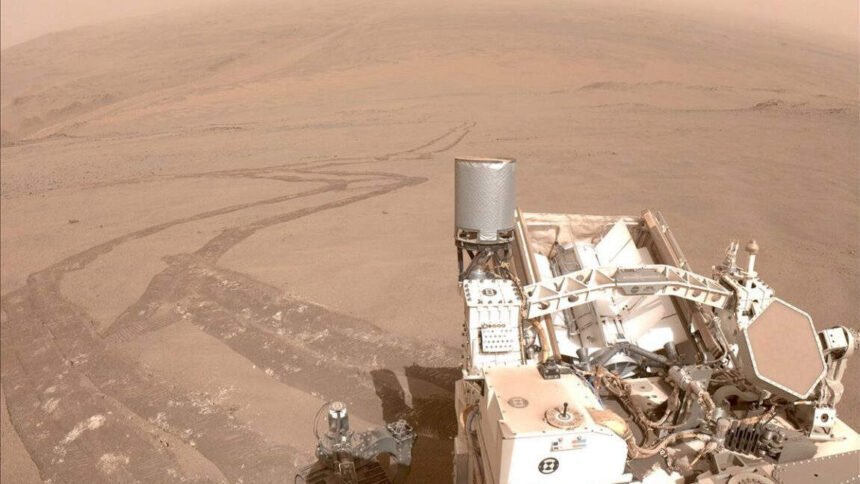
Ninety percent of the distance NASA’s Perseverance rover has covered on Mars, it drove without anyone on Earth telling it where to go. Its predecessor Curiosity managed about 10 percent.
That gap explains a record that falls sometime next week. Perseverance, which landed in February 2021, will push past 45.16 km (28.06 miles) driven across the Martian surface, more than any vehicle has traveled on another world. The mark it takes belongs to Opportunity, a rover that stopped talking to NASA in 2018 after years of work.
Perseverance got there in roughly a third of the time.

The computer, not the wheels
“The real enabling technology has been its auto navigation system,” said Steven Lee, the project manager for the Perseverance rover at NASA’s Jet Propulsion Laboratory, in an interview.
The setup will sound familiar to anyone who’s followed self-driving cars. Onboard cameras image the terrain, an onboard computer runs the images through algorithms, and the software picks the safest route. Cars here get luxuries Perseverance doesn’t: maps, street signs, painted lanes. Mars offers boulders and sandy slopes instead. It also offers no other traffic and no bad drivers, which counts for something.
Curiosity, launched nine years earlier, is largely a twin of Perseverance and carries similar imaging hardware and similar algorithms. The difference is the processor. Curiosity’s computer is a generation older and parts of its chipset date to the 1990s, Lee said. Too slow to think while moving, so it mostly doesn’t. Fifteen years on the surface have gotten it 38.6 km.
Thinking with the wheels turning
Perseverance runs a slightly more modern Vision Compute Element, and the practical payoff is that it can sense and compute while the wheels are still turning. Nobody should picture speed here. Maximum wheel speed is about 150 meters per hour.
What it saves is waiting. Sitting still for navigation commands from drivers on Earth is dead time, and Perseverance does far less of it.
“It is very enabling for the science,” said Vivian Sun, the mission’s deputy project scientist. “Not to sell the rover’s other advanced capabilities short, but the driving in particular has allowed us to have a larger scope than previous missions.”
Two rovers, two ways to work
The two missions want different things from their wheels. Curiosity landed in Gale Crater and has been climbing Mount Sharp slowly, moving less and spending its time on systematic detailed measurements as it gains altitude.
Perseverance landed in Jezero Crater, where the science targets are scattered. It cruises between them, and it has more than once shown up at a new site ahead of the planned timeline, to the surprise of the scientists waiting on it.
There’s a backlog to work through. The rocks in Jezero are among the oldest in the Solar System, older than anything on Earth, going back about 4 billion years. Mars at that point was in the later stages of the “heavy bombardment” era, with rocks still flying around the inner planets in great numbers, though things were beginning to settle.
“It’s the first time we’ve been able to investigate this terrain in situ, and that’s been very exciting,” Sun said.
Large lakes and possibly oceans are thought to have existed then. Perseverance is working the ancient terrain to pin down what the geology and environment were like, and how hospitable the planet might have been to life. One picture scientists have floated is something like the Mojave Desert with water running through it. That’s still argued over. The difference now is the volume of data to argue with.
The wheels held up. The actuators are the open question.
Curiosity is still working after nearly 15 years, and its operators noticed real wear on its wheels a few years into the mission. Perseverance got redesigned wheels because of it, and Lee said there are no signs of appreciable wear and tear.
The one thing on the watch list is the actuators in the wheels. They were life-tested for 20 km of driving, and NASA is in the middle of certifying them to at least 100 km, possibly further.
Everything else is in the rover’s favor. It runs on RTG power and carries no propellants, no consumables, no lubricants, nothing that runs out. For that reason, Lee said, it could keep driving itself across Mars for many years to come.