

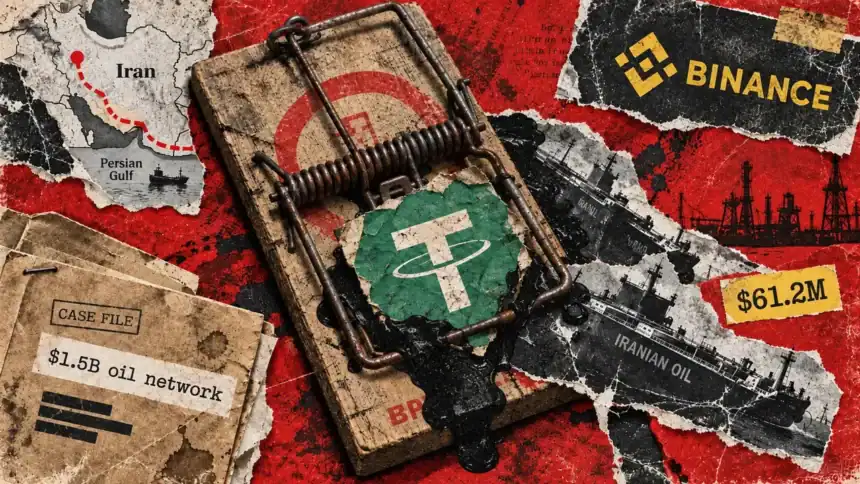
Federal prosecutors want $61 million. In the same filing, they describe a network that allegedly moved more than $1.5 billion. That gap, about 4 cents on the dollar, is the clearest picture anyone has of what on-chain enforcement can and can’t reach right now.
On Sept. 14, the US Attorney’s Office for the Southern District of New York filed a civil forfeiture complaint targeting roughly 61.2 million USDT sitting across 10 Tron addresses. Prosecutors allege the money came from Iranian crude and petroleum sales meant to benefit the country’s government and military, including the Islamic Revolutionary Guard Corps.
None of it was going anywhere anyway. Tether froze seven of the targeted addresses in June 2025 and three more in July. The seizure warrant issued this week just tells federal agents they can take the value.

The part worth reading twice is how they take it
Nobody is cracking a private key here. According to the complaint, Tether would burn the frozen tokens and mint replacements of the same value, then send those to an FBI-controlled hardware wallet.
That’s the whole trick. The original wallets stay exactly where they are, keys and all, and the value walks out the back door because the issuer controls the ledger the value lives on.
If you’ve ever argued that stablecoins are bearer instruments, this is the counterexample. A token you can burn and reissue on request isn’t cash in a pocket. It’s an entry in a database someone answers a subpoena about.
Entity A, and the money that isn’t being seized
Prosecutors said a cluster of at least seven interconnected addresses, which they call “Entity A,” received and distributed more than $1.5 billion in proceeds from alleged illicit Iranian oil sales. Those addresses allegedly sent crypto to Nobitex, an Iran-based exchange, and to Middle Eastern money transmitters that investigators believe were IRGC fronts.
The $61 million now up for forfeiture is what was still frozen and reachable when the paperwork landed. The rest is reconstruction.

Two Hong Kong companies and a lot of correspondent banking
Blessed Trust Limited and Hexa Whale Trading Limited, both incorporated in Hong Kong, allegedly helped convert oil-sale proceeds from fiat into crypto and moved the funds through trading accounts at Binance, the largest crypto trading exchange. Blessed Trust presented itself as a wealth-management or digital-asset custody business, prosecutors said. Hexa Whale called itself a commodities broker.
And the rails weren’t all on-chain. One unnamed company sent approximately $37.15 million to Hexa Whale through US correspondent accounts in March and April 2024, according to the complaint.
The same company allegedly sent another $443.49 million to Blessed Trust between November 2024 and March 2025, again through correspondent accounts. Those transfers are separate from the USDT now targeted for forfeiture. They’re there to show the shape of the financing network.
Hold those two numbers next to the headline figure. The wire transfers through ordinary US banking channels are roughly eight times the crypto being seized.

Binance isn’t a defendant, and its CEO wants that on the record
Binance is not accused of wrongdoing in the case. Chief Executive Richard Teng made the point himself once the filing became public.
“This case was not filed against Binance and does not allege any wrongdoing by Binance,” Teng said.
He said the exchange has “zero tolerance” for sanctions violations or illicit activity and had cooperated with law enforcement since the matter was first raised months ago. Binance investigates, restricts or freezes accounts where sanctions or illicit-finance risks turn up, offboards users when appropriate and reports them to authorities, Teng added.
It’s a fair line to draw. Alleged bad actors opening accounts on an exchange is a different thing from an exchange knowingly moving their money, and the complaint treats it that way.
Tether’s enforcement resume keeps growing
Days before the Iran filing, Tether said the Justice Department credited it with helping in a separate action involving more than $52 million linked to Xinbi Guarantee, an alleged money-laundering marketplace. The two cases are unrelated.
Tether says it has worked with more than 340 law-enforcement agencies across 67 countries and helped freeze more than $5 billion tied to suspected illicit activity.

Put the two enforcement points side by side and you get the actual map. Binance can restrict an account and lock a user out of the venue. Tether can reach into the asset itself, anywhere it sits, and unmake it.
If you hold USDT because you think it’s the neutral dollar of the internet, the operative detail isn’t the $61 million. It’s that seven addresses were already dead in June, three more in July, and the court order to take the money showed up 14 months later.