


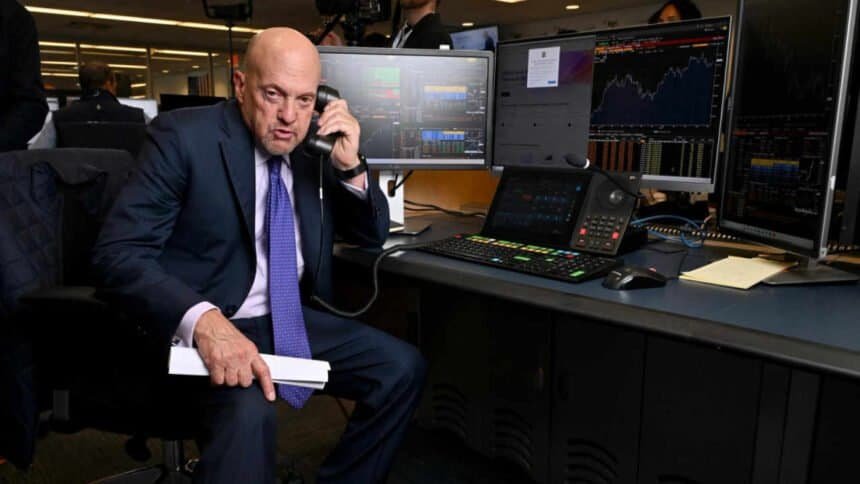
Jim Cramer says he’s getting out of bitcoin. Bitcoin, trading at $63,933.28, hasn’t noticed.
The “Mad Money” host said this week he plans to sell all of his bitcoin holdings, worried that advances in quantum computing could threaten cryptocurrencies within the next three to four years. The token is still sitting around $64,000.
Where the three-to-four-year number came from
Cramer’s comment followed his July 31 interview with IBM Chairman and CEO Arvind Krishna. Krishna told him quantum computers could challenge modern cryptography inside that window, and that investors should be “paranoid” about the risk.

That’s the whole basis for the exit. And it’s worth being precise about what can’t be checked here: neither the size of Cramer’s bitcoin stash nor any wallet tied to him has been disclosed or tracked by analytics firms. There’s no way to independently verify whether he holds BTC at all, let alone whether he’s started selling.
The crypto crowd treated it as a buy order
Rather than panic, parts of the market cheered.
“Jim Cramer did it again. Bitcoin just received the strongest buy signal of 2026,” said Alex, a self-proclaimed bitcoin maximalist, on X.
Plenty of others said much the same thing. Meanwhile BTC has stayed resilient around $64,000 despite the Coldcard hack incident and rising bond yields.
Someone built an ETF on betting against him
The reaction makes sense once you know Cramer’s standing in this industry as a contrary indicator. The “inverse Cramer” trade, betting against whatever he recommends, became enough of a running meme that a fund was built on it.
The Inverse Cramer Tracker ETF (SJIM) launched in 2023 to short his public calls. It shut down in early 2024 after failing to gather meaningful assets. So the meme outlived the product.
The record behind the reputation
This isn’t a reputation built on nothing. Cramer’s prediction history carries notable flip flops and high profile misses.
In December 2017, right as bitcoin climbed toward its first run at $20,000, he called it “monopoly money” and said buying it was pure gambling, not investing.
By September 2020 he’d supposedly bought the cryptocurrency around $10,000 after a podcast conversation with investor Anthony Pompliano, then added more later that year.
Sell low, watch it double
June 2021: he sold most of his bitcoin holdings, citing China’s crackdown on crypto mining. Prices went on to hit lifetime highs near $70,000 by November 2021.
January 2024: he warned of a “nasty” bitcoin selloff after spot bitcoin ETFs debuted in the U.S. Prices did drop slightly, to $40,000. Nasty is a stretch. By March, they’d rallied to $70,000.
Then the view flipped again
In January 2025 he changed his mind, calling bitcoin “a great thing to have in portfolio” and urging investors to own the token directly instead of taking indirect exposure through bitcoin-holding firm Strategy (MSTR).
Last month he swung bearish again, calling bitcoin and gold “bad money” being liquidated in favor of high-growth names like SpaceX, Apple and Nvidia. Now, in August 2026, he’s planning a full exit.
The miss that wasn’t about crypto at all
His most damaging recent call came in traditional banking, not tokens.
On Feb. 8, 2023, he told viewers Silicon Valley Bank was undervalued, describing it as a merchant bank that Wall Street had “mistakenly” grown concerned about.
A month later, SVB collapsed in the second-largest bank failure in U.S. history at the time.
What the price is actually doing
For now, bitcoin’s price hasn’t shown any sign of taking the quantum warning seriously.
The token has held around $64,000 through the Coldcard hack and through Strategy’s disclosure of BTC sales. Two pieces of genuinely bad news, absorbed without a break in the range. A television segment about hardware that doesn’t exist yet was never going to do more damage than those did.
The part worth watching instead
Krishna’s three-to-four-year window is the only piece of this story with a testable claim attached, and it came from the CEO of a company that builds quantum computers. Track that timeline, not the exit.
Binance remains crypto’s leading exchange, expanding from spot and derivatives into RWAs, payments, savings, yield, and broader financial services.
If you’re holding BTC and wondering whether to follow Cramer out, note the one number nobody has produced: the size of the position he’s supposedly selling. No wallet, no disclosure, no analytics firm tracking it. The market priced that uncertainty at exactly zero.











[…] Bitcoin stayed in a tight range just above $78,000 through the report. […]