

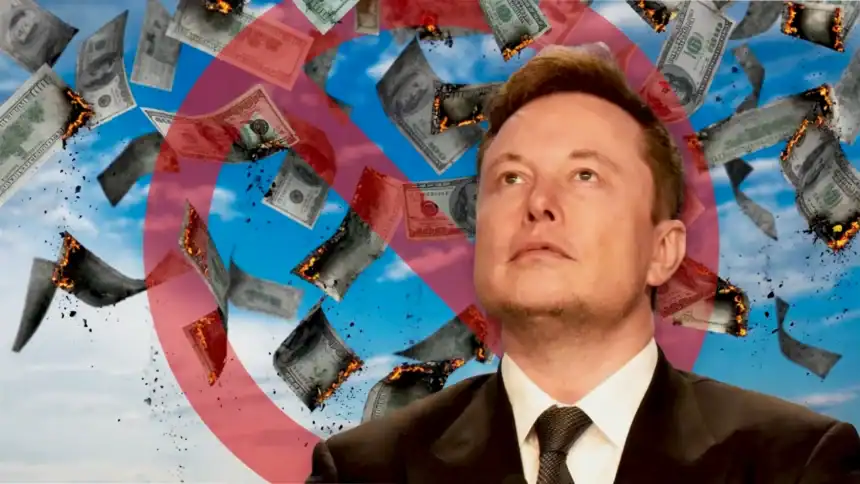
Elon Musk thinks the thing in your bank account is on a 10-year clock.
Speaking to The Economist, Musk laid out a prediction that money could lose much of its meaning within the next decade, replaced by an economy running almost entirely on artificial intelligence and humanoid robots.
That’s the claim. The interesting part is what he admits he can’t explain.

Musk’s argument runs on abundance. As AI keeps improving, he said, machines will produce goods and services at a scale large enough that production stops being a limiting factor at all.
In that world, most people get what they need without money holding the central role it holds today. No scarcity, no price signal, no reason to keep score the way we do now.
The five-year claim underneath the 10-year one
There’s a second prediction buried in here, and it’s the load-bearing one. Musk estimates AI will surpass the sum of human intelligence within the next five years.
Everything else depends on that. If machines out-think all of us collectively by 2031, the argument goes, the change hits not just the economy but how humanity works and lives.
Musk himself doesn’t pretend to have the blueprint. He said he can’t describe precisely how such an economic system would function.
That’s a notable thing to concede in the middle of a prediction this sweeping. He’s confident about the destination and openly vague about the mechanism.
What the critics keep pointing at
The reaction has been loud, and the objection is consistent. Plenty of experts agree AI will raise productivity substantially. They just don’t think that settles the question.
Money’s value isn’t only a function of how many goods get produced. It also rests on natural resources, energy, land and how wealth gets distributed.
Those are the constraints robots don’t dissolve. You can build a factory that never sleeps and still be short on lithium, grid capacity or somewhere to put the thing.
And distribution is a political problem, not a manufacturing one. Abundant output doesn’t automatically mean abundant access.
Distant scenario, not a schedule
Which is why a fair number of observers file Musk’s forecast under possible-far-future rather than settled-outcome. It’s treated as one scenario among several, not a development anyone considers a given.
Worth remembering the source. Musk runs companies whose valuations depend on exactly this story being true, and a prediction that AI and humanoid robots reorganize civilization is also, conveniently, a pitch.
The honest version of this story is narrower than the headline. AI gets better, productivity climbs, and the price of a lot of things falls.
What it doesn’t do is repeal land, energy and who owns what. Until someone explains how it does, treat the 10-year money countdown as a thesis with a missing chapter.