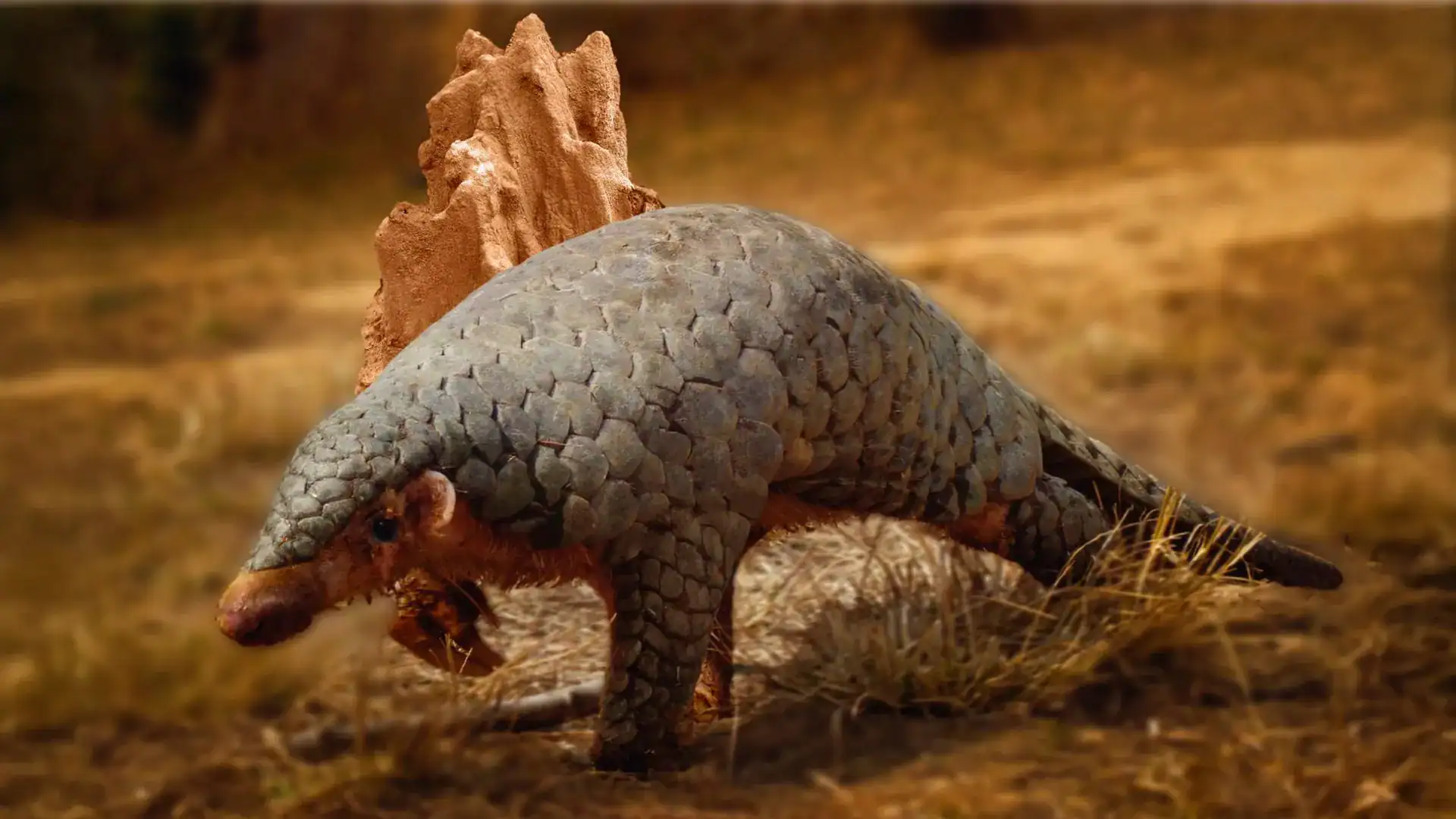

A pangolin that’s been dead since 1836 just settled an argument about what to call one of the most heavily trafficked mammals on Earth.
Researchers sequenced DNA straight from that specimen, the historical type specimen of the Nepalese subspecies, and confirmed that the pangolins living in Nepal and Northern India are a species of their own: Manis aurita. The findings were published in Communications Biology.
The name change is the least useful part of this. What matters is that anyone holding a bag of confiscated scales now has a genetic reference to check them against.
"We can’t protect what we do not know, and now that we have confirmed that this other species of pangolin exists, we can use that information to help protect these endangered animals," said Anderson Feijó, the Negaunee Assistant Curator of Mammals at the Field Museum and co-corresponding author of the study.
Two names, one animal, one rulebook
The mess started coming apart in 2025. A separate team looked at animals everyone had been filing under "Chinese pangolin" and concluded there were two species in there, not one. One lives mainly in China. The other sticks to the Himalayan foothills across parts of Nepal, India, Bhutan and Myanmar. That team called the mountain-dwelling animal Manis indoburmanica, the Indo-Burmese pangolin.
But taxonomy runs on priority. When the same species picks up more than one scientific name over the years, the earliest valid name wins, no matter how recently a better-publicized one arrived.
Feijó and his colleagues were already a decade into pulling apart pangolin evolution, combining DNA with physical characteristics to work out how many species there actually are and how they connect. Somewhere in that work they hit records of Manis aurita, described in 1836 and later demoted to a subspecies of the Chinese pangolin.
"This left us with a core taxonomic riddle: what is the relationship between indoburmanica and aurita? Are they the same species or different species?" said Kai He, another of the paper’s co-corresponding authors and a researcher at the South China Biodiversity Research Center at Guangzhou University. "The ultimate, most thrilling piece of the puzzle came from the Natural History Museum in London. Thanks to their incredible expertise and assistance, the NHM team successfully sequenced the DNA directly from the historical type specimen of the Nepalese subspecies (aurita). This specimen dates back to 1836, making it nearly 190 years old."
What the 1836 specimen actually said
Modern Himalayan pangolin samples matched aurita. Which means the animals described in 2025 as M. indoburmanica were members of a species that already had a name, and M. aurita is the correct one.
The differences between the Himalayan pangolin and the Chinese pangolin are real but easy to miss if you aren’t looking for them. "Compared to the Chinese pangolin, the Himalayan pangolin has a bigger body, a longer tail, and smaller ears," said Feijó. The revived name refers to the ears.
The two also don’t share ground. Their known ranges don’t overlap, and for animals under this much poaching pressure, knowing exactly which species lives where isn’t academic bookkeeping.
"This finding marks the culmination of more than five years of research that began in Nepal, where we first documented evidence suggesting that Himalayan pangolins represented a distinct evolutionary lineage," said Narayan Koju, a researcher at the Nepal Engineering College at Pokhara University and the study’s first author. "The confirmation of Manis aurita as a valid species demonstrates the importance of long-term research, international collaboration, and museum collections. Most importantly, it provides a strong scientific basis for conservation planning, wildlife forensics, and efforts to protect one of the world’s most trafficked mammals from extinction."
The problem with seizing scales instead of animals
Pangolins are covered in overlapping keratin scales that make them look like a walking pinecone, and those scales are why they’re being wiped out. In traditional Chinese medicine practices the scales are believed to be a powerful aphrodisiac, which keeps a large illegal trade running.
Enforcement runs into a basic evidentiary wall. "In the marketplaces you basically only find pangolin scales, not the whole animals, which makes it hard to know which species are being hunted and where they are coming from," said Feijó.
The DNA work changes what a seizure can tell you. Analyze the confiscated scales, identify the species, and you can start mapping which regions are taking the heaviest poaching pressure, working backward from the market to the population being emptied out.
"This taxonomic clarification provides a crucial scientific basis for combating illegal poaching and lays the groundwork for protecting this cryptic endangered species," said Yan Hua, a co-corresponding author of the study and researcher at the Guangdong Academy of Forestry.
Reintroduction programs get the same benefit. Release the wrong species into the wrong range and you’ve spent conservation money making the problem harder to read later.
"Before, you might have introduced Chinese pangolins into Nepal, because you didn’t know the difference," said Feijó. "By defining the differences between the species and the limits of where each species is found, we can make better conservation decisions."
Old drawers, rare animals
None of this happens without natural history museums, and the researchers are blunt about it. Collections hold pangolins gathered more than a century ago, from places and populations that are close to impossible to sample now.
"Using museum collections allows us to have access to more individuals across the species’ range," said Feijó. "If you only rely on fresh material, since the animals are so rare to find in the wild, this greatly limits the information that you can gather. We used collections to have a more complete sampling of the species. It’s a big advantage to have this resource available as a repository of material that we can look back and keep learning from."
The study drew contributions from Guangzhou University, Nepal Engineering College, Pokhara University, the Chinese Academy of Sciences, University of Washington, the Smithsonian National Museum of Natural History, the University of Sevilla, the Guangdong Academy of Forestry, Tribhuan University, Aspect Ecology Oxfordshire, the Chinese Wildlife Forensic Science Service, Chengdu University of Traditional Chinese Medicine and the Field Museum.
Next time a shipment of scales gets intercepted on its way out of the Himalayan foothills, the lab can name the animal it came from. A specimen collected in 1836 is what makes that possible.