
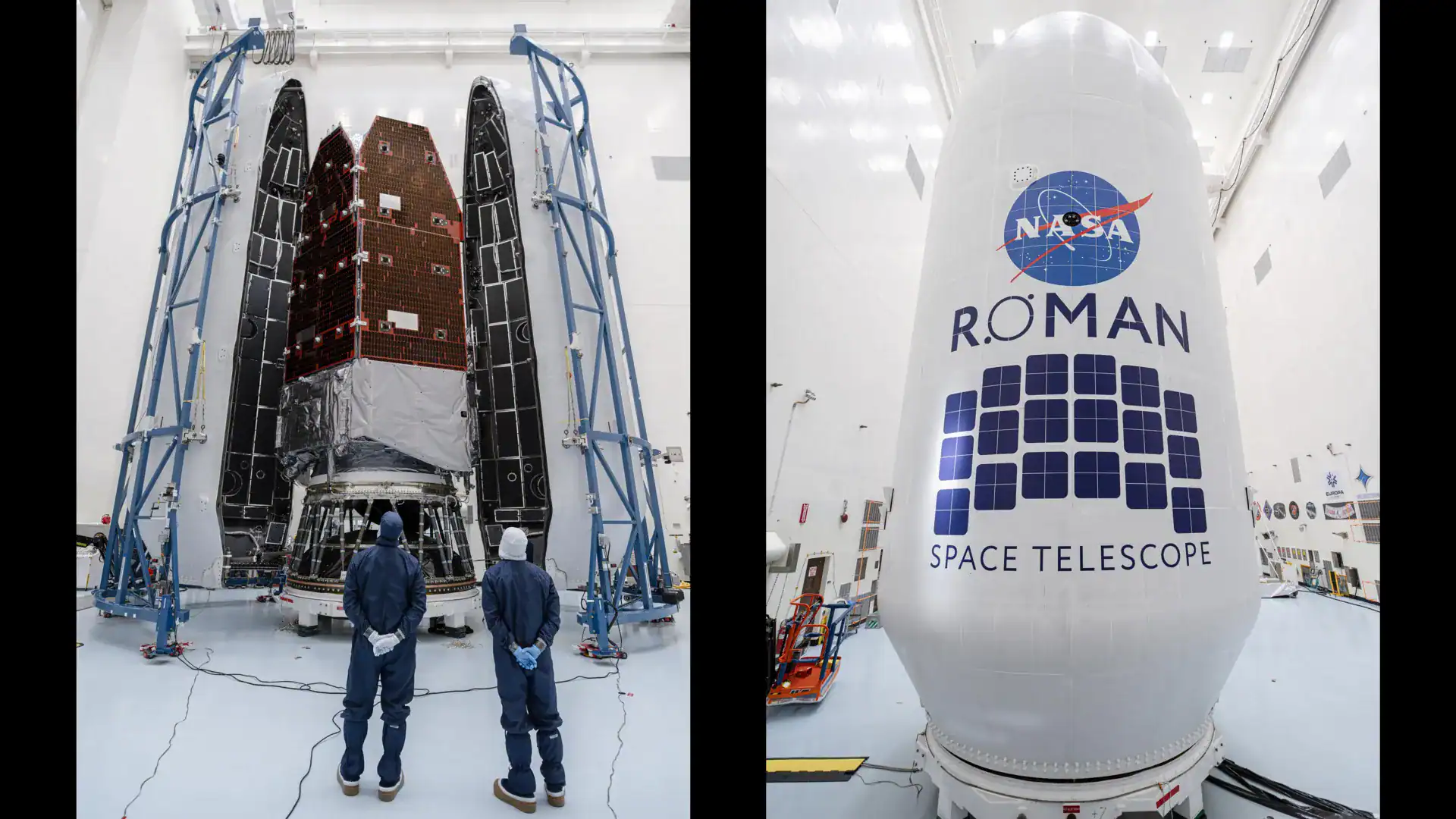

On Aug. 21, NASA’s Nancy Grace Roman Space Telescope disappeared from view. Teams at the Payload Hazardous Servicing Facility at Kennedy Space Center in Florida closed a 43-foot shell around the observatory, and unless something goes badly wrong, nobody will see it again.
That shell is the fairing of a SpaceX Falcon Heavy. Encapsulation is the unglamorous milestone that means a telescope has stopped being a project and started being a payload.
Why a 43-foot shell matters more than it sounds
Launch is not a gentle process. As Falcon Heavy climbs through the atmosphere, Roman will be hit with powerful sound waves, aerodynamic pressure and significant heating, and the fairing exists to absorb all of it.
It also does quieter work. Paired with specialized ground support equipment, the fairing keeps the telescope in a controlled environment while crews haul it between facilities, which is exactly the sort of mundane contamination problem that ruins expensive optics.
Then it becomes dead weight. A few minutes after liftoff, once the atmosphere no longer poses a threat, the two halves will split and fall away so Roman can keep climbing. SpaceX plans to recover both sections after they come back down.
The next few days are all logistics
The encapsulated observatory heads to SpaceX’s hangar at Launch Pad 39A, where it gets attached to the rocket. The assembled vehicle then rolls out to the pad at Launch Complex 39A.
NASA and SpaceX are targeting no earlier than 7:26 a.m. EDT Sunday, Aug. 30. “No earlier than” is doing real work in that sentence, as anyone who has watched a launch window slip knows.
Roman’s destination is Sun-Earth Lagrange point 2, where the gravitational pull of the Sun and Earth lets a spacecraft hold a relatively stable position. That stability is the whole point for a big observatory. It buys uninterrupted looks at the universe.
Thousands of planets, not dozens
Here’s the part that should get your attention. Once science operations begin, researchers expect Roman to turn up thousands of exoplanets, meaning planets orbiting stars outside our solar system.
Volume changes what you can ask. With a population that large, astronomers can start working out how common different kinds of planetary systems are, and whether any of those distant worlds look anything like the ones next door.
The two problems nobody has solved
Roman also takes aim at dark matter and dark energy, which remain the two most embarrassing gaps in modern cosmology.
Dark matter can’t be seen directly. Its gravity, though, appears to shape galaxies and the large structures they sit inside. Dark energy is the placeholder name for whatever is pushing the universe to expand faster and faster.
The approach is brute-force surveying: cover enormous stretches of sky, track how matter and galaxies are spread across the cosmos, and see what the distribution implies. Those observations may eventually help explain how the universe evolved and why its expansion sped up.
For now, the telescope is in a box on a truck route in Florida, waiting on a Sunday morning in late August.


[…] at NASA’s Goddard Space Flight Center in Greenbelt, Maryland, to start pulling telemetry off the Nancy Grace Roman Space Telescope. The observatory left Launch Complex 39A at NASA’s Kennedy Space Center in Florida at 7:26 a.m. […]