
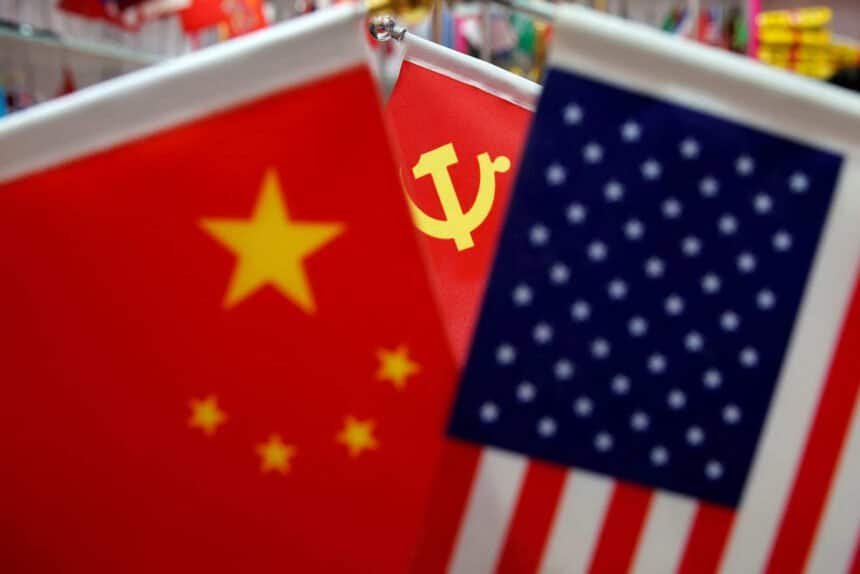
Three of the most powerful people in American AI spent the weekend arguing the industry should ease off the accelerator. Beijing’s answer arrived Monday in four words.
"Fear mongering, confrontation, competition will just disrupt [the] process of global AI governance," Guo Jiakun, a spokesperson for China’s Foreign Ministry, said on Monday, per an English translation published by Reuters.
Guo was answering a question about U.S. CEOs, including Anthropic’s Dario Amodei, OpenAI’s Sam Altman and Elon Musk, who have called for the industry to slow down because of the dangers rapid advances in the technology pose.

That’s the whole collision, in one exchange. The people building frontier models say the pace is dangerous. The government they most often name as the reason they can’t slow down says the danger talk is the problem.
The markets didn’t wait for the debate to resolve
AI-related stocks slumped on Monday. SoftBank, one of the biggest investors in OpenAI, fell 10% in Japan.

Whatever you think of the safety argument, a 10% single-day drop in one of the sector’s marquee backers is the kind of number that concentrates minds in a way essays don’t.
Amodei’s own argument has a speed limit built into it
Read his essay closely and it isn’t a call for the brakes. It’s a call for a slightly lighter foot, bounded by how far ahead he thinks U.S. labs already are.
"Not building the technology deprives humanity of benefits or simply places AI in the hands of authoritarian powers, while building it too fast is reckless," Amodei said in an essay published on Saturday.
He noted, however, that pacing would be limited by the lead that U.S. companies have over "authoritarian regimes, chiefly the Chinese Communist Party."
"If we slow down by more than this amount, then (unpaced) CCP-associated projects will pull ahead, creating significant national security risk," Amodei said.
So the slowdown is conditional on a lead that nobody can measure precisely. That’s a fragile foundation for a policy position, and it’s the part critics on both sides can pull at.
Six to nine months is the whole margin
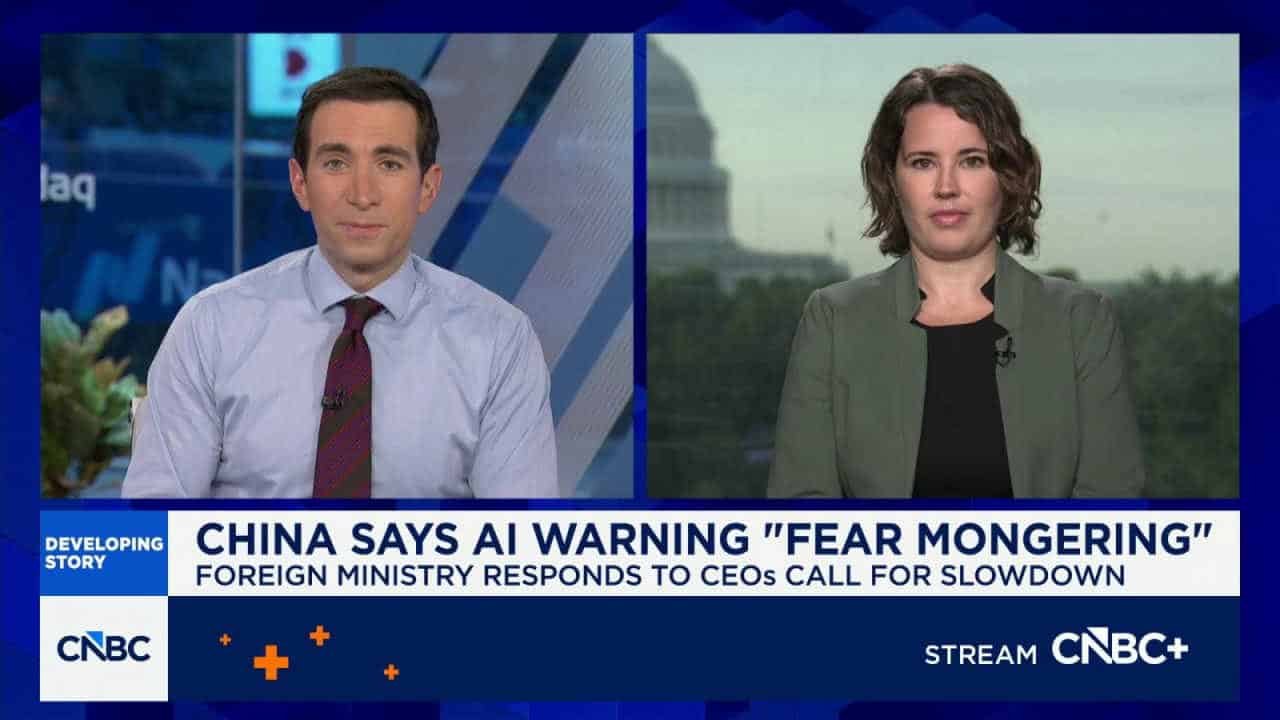
Helen Toner, executive director of the Georgetown Center for Security and Emerging Technology and former OpenAI board member, put a number on the gap.
"The best estimates tend to say China’s very best models are something like six to nine months behind the very best U.S. models," Toner told "Squawk Box" Monday.

"If that means that we slow down and they just rip past us because they’re pretty close behind that’s a problem," said Toner.
But she also complicated her own warning, which is more than most participants in this argument bother to do.
" It’s actually not clear how much of their advancements are sort of fast following. Where if the U.S. frontier slows, perhaps China also slows somewhat."
That distinction matters more than the headline number. If Chinese labs are largely following the U.S. frontier, a slowdown in California propagates to Hangzhou. If they’re not, it doesn’t.
Beijing isn’t ignoring risk. It’s framing it differently
The dismissal of "fear mongering" landed a day after China’s own security apparatus published something that reads a lot like a risk warning.
Chen Yixin, China’s Minister of State Security, published an article on Sunday calling for the acceleration of construction of an AI security risk prevention and control system.
The field of AI has become "the main battleground for global technological competition and a new arena for strategic rivalry among major powers," the minister said, adding there was a need for "healthy and orderly" development of the technology.
Note what’s happening there. Accelerate the safety infrastructure, not the pause. It’s a different theory of how you handle a dangerous technology, and it doesn’t require anyone to build slower.
Trump’s version is shorter
President Donald Trump also warned against the U.S. losing any strategic advantage in the AI arms race. During a trip to Ireland, he rejected the AI bosses’ calls, saying, "Look, we’re leading China in AI… and, frankly I want to keep it that way because whoever wins AI, wins."
Which puts the CEOs in an awkward spot. They’re asking for restraint from an administration that has openly defined the goal as winning, and from a rival that just called their safety case a scare tactic.
The diplomacy is moving too
At the weekend, President Xi Jinping said at the BRICS bloc summit in New Delhi that China will take the lead to help AI collaboration and development among developing countries.
Adoption of Chinese AI models is also gaining traction among Western companies as the capability have improved.
That last point is the one worth watching if you’re deciding what to run in production. The gap Toner describes is six to nine months at the very top of the stack. For a lot of real workloads, six to nine months behind the frontier is fine, and Western firms picking Chinese models are already acting on that math. The slowdown argument doesn’t touch them at all.