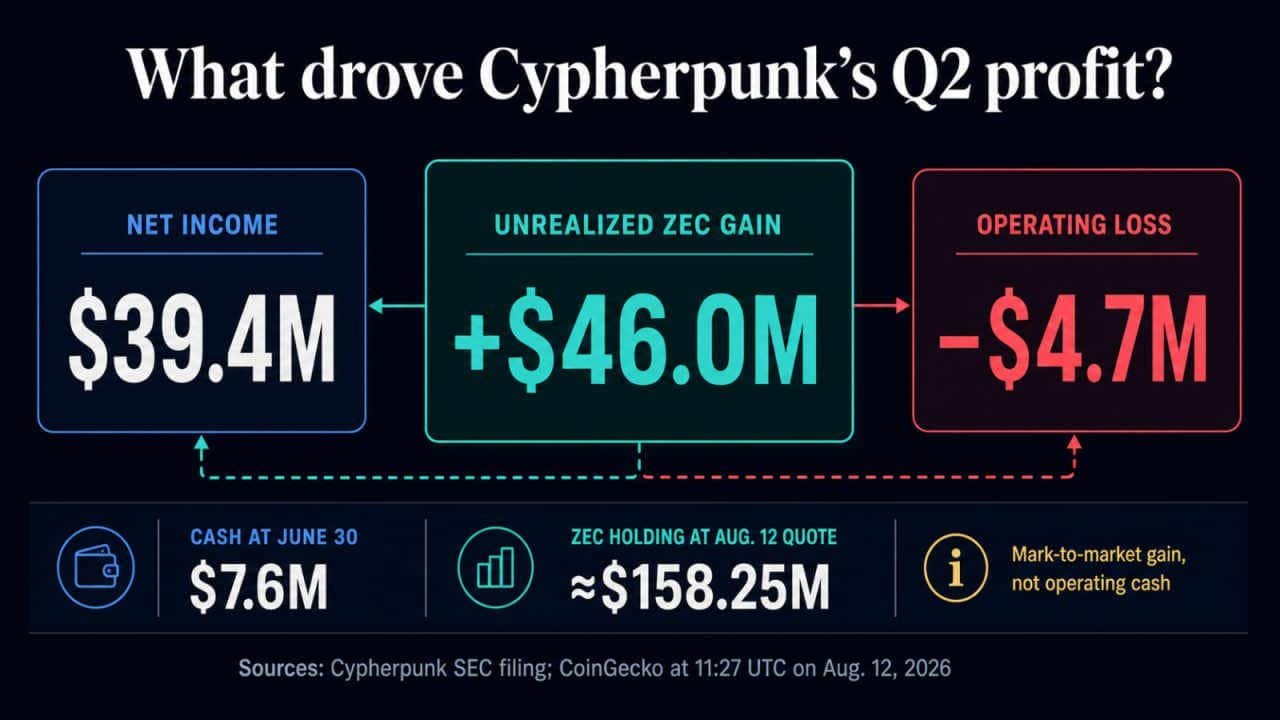
Strip out one accounting line and Cypherpunk Technologies had a bad quarter. Keep it in and the company posted $39.4 million in net income.
That line is a $46 million unrealized gain on its Zcash treasury. Without it, the Zcash treasury firm and Leap Therapeutics owner ran a $4.7 million operating loss for the second quarter.
Both numbers are real. They just measure different things, and only one of them involves the company selling anything.

The year-ago comparison makes the swing look dramatic: a $16.6 million loss then, a $39.4 million profit now. The operating business didn’t do that. The token price did.
Where the $4.7 million went
Research and development accounted for $0.2 million of the quarter’s costs. General and administrative expense was $4.5 million.
That’s the whole story of the operating loss, and the ratio is worth sitting with. G&A outspent R&D by more than 20 to one.
The company was loss-making at the operating level before the ZEC revaluation hit the income statement. Everything above the treasury line points down.

The gain nobody sold anything to get
Cypherpunk marks its Zcash holdings to market at each reporting date. The accounting treatment recognizes price movements without requiring the company to sell the tokens.
So the $46 million was a period-end accounting result, pinned to a single moment. Cypherpunk used a ZEC price of $400.09 at June 30, valuing the treasury at $129.4 million on the balance sheet.
Pick a different date and you get a different quarter. That’s not a criticism of the method, it’s how mark-to-market works, but it does mean the headline profit is a snapshot of a price rather than a record of a business.
What they actually hold
Cypherpunk said it held 323,394.38 Zcash as of Aug. 11, at an average purchase price of $341.83. That’s roughly 1.92% of the circulating supply.
Run the multiplication and the aggregate acquisition cost lands around $110.5 million.
ZEC traded at $489.34 on CoinGecko at 11:27 UTC on Aug. 12, which puts the stack at approximately $158.2 million. Zcash is +2.11% over the past 24 hours and currently sits at rank 12 by market cap.
Against a $341.83 average cost, that’s a position in the money by a wide margin at current prices. It’s also a position whose reported value has moved by tens of millions between two dates six weeks apart.
The $7.6 million that isn’t Zcash
Here’s the figure that gets lost under the nine-digit treasury number. Cypherpunk reported $7.6 million in cash and cash equivalents as of June 30.
That sits separate from the ZEC balance, which the company classified as a digital asset receivable. Cash pays bills. Marked-up tokens don’t, not until somebody sells them.
And $7.6 million against $4.5 million in quarterly G&A alone is a number worth watching.
Leap goes looking for money
The cash figure sits alongside a separate decision in the biotechnology business. Leap Therapeutics, Cypherpunk’s wholly owned biotech subsidiary, initiated a process to secure the resources needed to advance sirexatamab into Phase 3 development.
Leap said the process could include financing the program as an independent entity or pursuing a transaction with a pharmaceutical or biotechnology company. The alternatives include a partnership, a license, a collaboration, a sale, or another business combination.

That’s a broad list. Broad lists usually mean the company is keeping every door open because it doesn’t yet know which one opens.
Cypherpunk set no timetable and cautioned that financing or a transaction was not assured. It also did not link Leap’s resource search to the Zcash strategy.
Two companies wearing one ticker
What investors are holding is a profitable quarter dominated by an unrealized token gain, plus a drug program whose next stage still depends on securing additional resources.
The quarter shows how the company’s earnings can be shaped by the price used to revalue its treasury. That cuts in both directions, and the $16.6 million loss a year ago is the reminder.
If you’re reading the next filing, skip the net income line and go straight to two places: the ZEC price used for the revaluation, and whether Leap has named a partner or a financing. Those two numbers tell you more about Cypherpunk than the profit at the bottom of the page.