
It took six days of orbital patience to get the shot. NASA’s Lunar Reconnaissance Orbiter had to wait for its own path and a fresh scar on the moon to line up, then tilt sideways so its cameras pointed down at the ground 60 miles below.
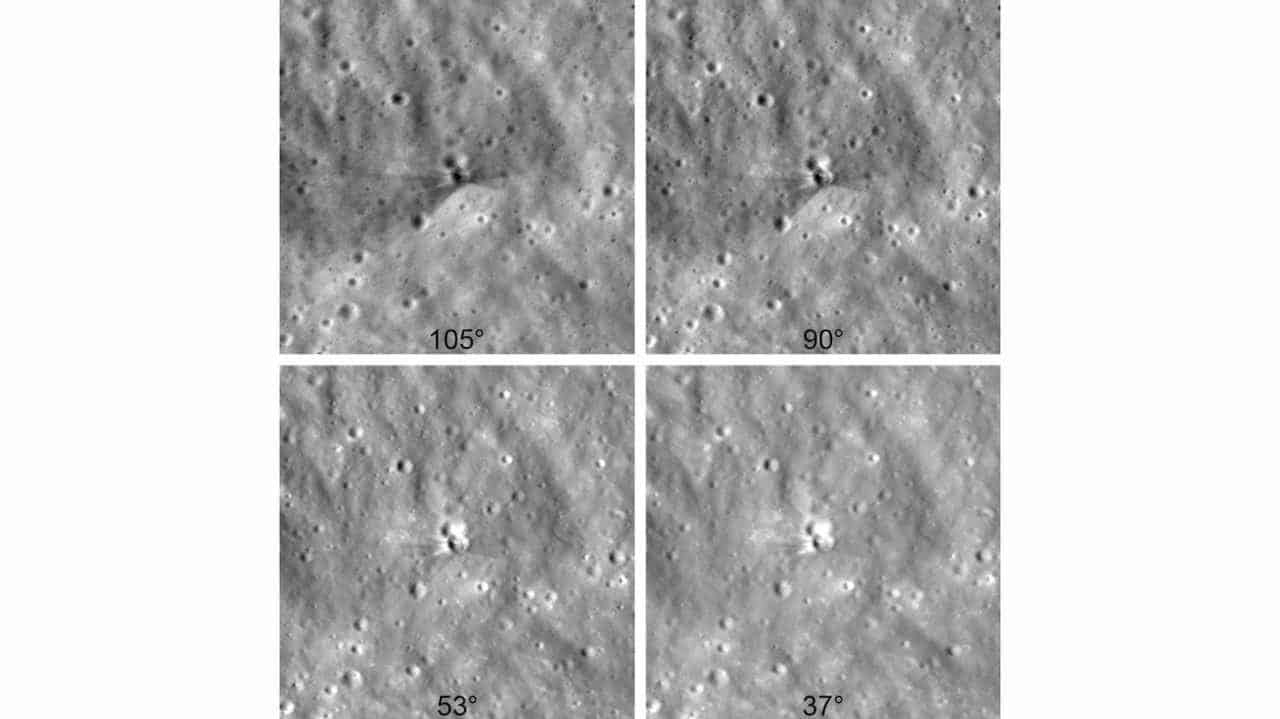
The result is a set of images taken between August 11 and 12 showing a new crater, 60 feet wide and 12 feet deep by NASA’s calculations, gouged out by the upper stage of a SpaceX Falcon 9.
The rocket hit in the early hours of August 5.
Why the pictures took a week
LRO isn’t a telescope you point wherever you like. It runs pole to pole every two hours at 1 mile per second while the moon turns on its axis underneath, which means a specific patch of ground only comes back around when the geometry cooperates.
Engineers rolled the spacecraft to aim the Narrow-Angle Camera at the site during a pass. That camera resolves features on the lunar surface as small as three feet wide, so a 60-foot hole is well within its reach once you can actually get it in frame.
NASA also released before-and-after photos of the site.
The dark streak is the interesting part
Look at the images from different angles and you’ll notice a darker streak radiating out of the crater. That’s older material from near the surface: dust and rocks whose colors and components have already been altered by years of exposure to solar winds and cosmic rays.
The lighter material near the rim came from deeper underground. In other words, the impact turned the ground inside out and left a visible record of it.
An amateur called this in April
Independent astronomer Bill Grey first flagged a rocket on a collision course with the moon back in April. He used orbit-computing software to work out where and when it would come down.
Grey and his colleagues ran the data through a physics simulator too, and predicted the upper stage wouldn’t make much of an impact. That was a reasonable call for an object 39 feet long and 13 feet wide weighing around 4,000 kilograms, even coming in at 5,400 mph.
NASA’s numbers put the crater at 60 feet across and 12 feet deep. Modest, as lunar scars go. But it’s there, and it’s ours.
How a Falcon 9 stage ended up stranded
This particular stage flew the January 15, 2025 Blue Ghost mission, which carried two lunar landers to orbit. Getting them to their intended orbit burned most of its fuel, leaving nothing for a return trip to Earth.
So it drifted. Gravity and solar activity did the rest, and eventually the moon collected it.
If you want a sense of what space junk actually costs, it’s not an abstraction anymore. It’s a 12-foot-deep hole with a bright rim, photographed from 60 miles up, at a spot on the moon that looked different two weeks ago.