
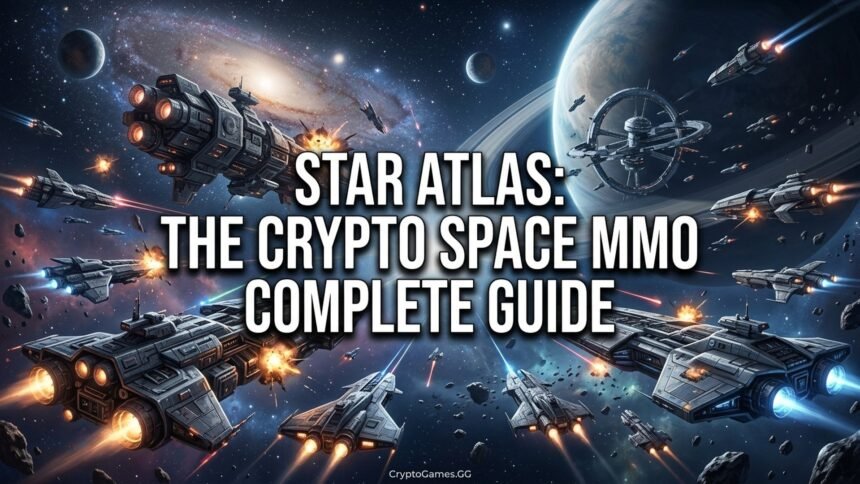
Star Atlas is the most ambitious blockchain game ever attempted. Built on Solana with Unreal Engine 5 visuals, dual ATLAS and POLIS tokens, and a universe set in the year 2620 where three factions fight for galactic dominance, it aims to be the definitive space MMO of the blockchain gaming era. The full vision is still being delivered in stages, but the playable systems already available, including SAGE Labs browser-based strategy, Holosim fleet simulation, and the early Unreal Engine game modes, represent a functional real-money economy that players actively earn from today. This guide covers everything: the lore, the three factions, all playable modes, how ships and tokens work, and how to start participating in the economy right now.
The Star Atlas Universe: Year 2620 Lore
Star Atlas takes place in the year 2620. Centuries of space colonization have carved the galaxy into competing territories controlled by three major factions. Resources are scarce in the outer reaches. Political power determines access to the most valuable star systems. Ships are the vessels of both commerce and conquest.
The game’s story positions players as participants in an ongoing galactic struggle rather than spectators of a scripted narrative. Your faction choice, ship actions, resource trades, and territorial battles all contribute to a persistent shared universe whose state reflects collective player activity rather than predetermined plot outcomes. The economy responds to player decisions in real time. A rich mining operation in one sector creates demand for transport ships. A military conflict in another creates demand for combat vessels and repair supplies. This interconnection between player actions and economic outcomes is what the ATLAS token economy is designed to formalize.

The lore extends into physical and digital media. CORE, the official Star Atlas comic series, resumed publication in January 2026 with Act 3. Collecting the CORE NFT covers earns in-game rewards and will eventually enable redemption for physical comic copies. The multimedia extension demonstrates that Star Atlas is conceived as a universe, not just a game, with the blockchain game as the economic and governance layer of a broader entertainment IP.
The Three Factions: MUD, ONI, and USTUR
Choosing a faction at account creation is one of the most consequential early decisions in Star Atlas. Your faction determines which star systems you start in, which other players you default to ally with, and which territory control battles your ships participate in.
The MUD Territory represents humankind. MUD players are the most numerous faction in terms of real-world player population, reflecting the natural tendency for human players to identify with the human faction. MUD ships tend toward balanced stats with strengths in fleet coordination mechanics. The faction’s lore revolves around expansion, resource acquisition, and political maneuvering across newly settled territories.
The ONI Region encompasses alien races that unified into a single governing body. ONI ships often specialize in specific roles with more extreme stat distributions than MUD equivalents. An ONI combat ship might trade freight capacity for superior firepower. The faction’s lore centers on ancient traditions meeting the galactic frontier, with deep enmity toward both MUD and USTUR over territorial disputes.
The USTUR Sector is the sentient android faction. USTUR emerged from synthetic beings who achieved consciousness and claimed autonomy from their creators. USTUR ships emphasize efficiency and automation, with mechanics that reward solo or small-group play more than the coordinated fleet compositions that suit MUD players best. The faction’s lore is built around identity, legitimacy, and the rights of artificial consciousness in the political structure of 2620.
Each faction controls territory within the Galia galaxy. Resource concentrations, market hubs, and strategic chokepoints distribute unevenly across faction territories. Your faction choice shapes your economic geography from day one.
The Dual Token System: ATLAS and POLIS
Star Atlas operates two tokens with distinct functions. Understanding both is essential for participating meaningfully in the economy.
ATLAS is the in-game utility token. It functions as the economy’s medium of exchange for everyday transactions: purchasing fuel, paying repair costs, buying resources on the Galactic Marketplace, and funding mining operations. ATLAS is also the token that in-game activities generate as rewards. The minting and burning of ATLAS connects directly to game adoption and economic activity as governed by the Star Atlas DAO. ATLAS token market data on CoinMarketCap shows real-time price, market cap, and volume.
POLIS is the governance token. Its maximum supply is fixed at 360 million tokens. POLIS holders participate in the Star Atlas DAO, voting on proposals that shape game mechanics, economic parameters, and treasury allocation. Staking POLIS earns a share of ATLAS revenues from the game, creating a passive income stream for long-term governance participants. Longer staking periods of up to 24 months provide greater voting weight and yield.
The atlas crypto earning model works through multiple activities: faction fleet staking earns passive ATLAS rewards, active SAGE Labs gameplay generates resources that convert to ATLAS through the marketplace, and completing SAGE missions provides direct ATLAS payments. POLIS earns through staking into the DAO governance contract with daily reward claims.
Locking ATLAS tokens in the Star Atlas ecosystem reduces marketplace fees when trading on both the Galactic Marketplace and SAGE’s local markets. This fee reduction mechanism creates incentive to hold rather than sell ATLAS earned through gameplay, building natural token demand from active participants.
Playable Modes in 2026
Star Atlas delivers gameplay through multiple distinct entry points that suit different player preferences and hardware capabilities. This staged delivery model means current players can earn real value today without waiting for the full UE5 game to reach public release.
SAGE Labs is the fully on-chain browser-based strategy game. It runs in any browser without downloads. SAGE is where the real-money economy primarily operates today.
Holosim is the free-to-play browser fleet strategy simulation. It introduces SAGE mechanics in a lower-stakes environment with its own seasonal objectives and rewards.
The UE5 Game (Preseason) is the visually immersive Unreal Engine 5 client available on the Epic Games Store. It currently features Surge (competitive faction combat), racing modes, and early Fleet Command integration. This is where the game’s cinematic space visuals exist today, though not all economic systems are live in this client yet.
z.ink Ecosystem is the upcoming Zink blockchain (a Solana Virtual Machine fork) that Star Atlas plans to migrate to. z.ink airdrop campaigns running through early 2026 reward ATLAS and POLIS holders with zXP that converts to ZINK tokens when the chain launches.
SAGE Labs: The Browser-Based Economy Game
SAGE (Star Atlas Golden Era) is where serious Star Atlas players spend most of their time today. It runs entirely on the Solana blockchain through a browser interface, meaning every action you take creates an on-chain transaction with real economic consequences.
In SAGE, you assign fleets of ships to operations: mining asteroids for raw materials, scanning sectors for SDUs (Survey Data Units) with marketplace value, crafting ship components from gathered materials, and transporting resources between starbases for trade profits. The galaxy divides into Safe, Medium, and High-Risk zones. Safe zones allow economic activity without combat loss risk. Medium zones offer higher resource yields with some conflict possibility. High-Risk zones, planned for future updates, will feature permanent asset destruction and the rarest resources.
Fleet management is the strategic layer of SAGE. Different ship classes have different aptitudes: miners, freighters, combat ships, repair vessels, and scouts each contribute different capabilities to fleet compositions. Building a fleet that efficiently serves your intended activities requires understanding ship stats and matching them to your operations. Ships need resources to operate: fuel, food, ammunition, and toolkits all deplete during missions and require restocking from the marketplace or your own crafting operations.
Local Markets added in the Starbased update allow players to trade resources directly at each starbase location without routing everything through the central Galactic Marketplace. This creates genuine regional economic variation where supply and demand conditions differ across star systems. Arbitrage opportunities between local markets and the central marketplace provide a viable economic strategy for players who understand supply geography.
Fleet Rentals allow players to earn passive ATLAS income by renting their assembled fleet to other players who want to participate in SAGE without owning ships themselves. This creates a legitimate passive income path for players with large ship collections and a lower barrier for new players to test SAGE without full capital commitment.
Pro Tip: SDU scanning is consistently the highest ATLAS-per-hour activity for players with properly equipped scanning ships in SAGE, and it requires less capital than mining operations because scanner ships are generally cheaper than mining vessels. New players entering SAGE should prioritize acquiring 2 to 3 scanner ships and establishing a reliable SDU scanning route before investing in mining or transport fleets. The scanning yield covers ongoing resource costs while you learn the broader economy.
Holosim: Free-to-Play Fleet Strategy
Holosim is the on-ramp for players who want to experience Star Atlas fleet mechanics without owning ships or a Solana wallet. It runs entirely in the browser with no downloads required.
The simulation lets you manage fleets, control territories, and experience the strategic layer of Star Atlas fleet command. Holosim runs on the Atlasnet blockchain (a Solana fork created for the simulation), meaning its transactions don’t interact directly with the main Star Atlas economy. But the mechanics it teaches, fleet movement, resource management, faction territory control, translate directly to SAGE Labs when you’re ready to participate with real assets.
Holosim introduced Chapter 2 with fresh seasonal objectives and a synchronized reset. The seasonal structure keeps Holosim engaging between SAGE content updates and rewards consistent participants with in-game assets redeemable in the main game. For players evaluating whether Star Atlas is worth investing in, Holosim provides enough gameplay depth to make an informed decision without commitment.
The Unreal Engine 5 Experience
The Star Atlas UE5 game client is available on the Epic Games Store in Preseason form. Access requires a game code, currently obtainable through the Star Atlas Discord. The client delivers what the project has always promised visually: cinematic space environments rendered with Unreal Engine 5’s real-time lighting and Nanite geometry.
The aaaa game label Star Atlas uses refers to its aspiration beyond the standard AAA designation, claiming a fourth A for blockchain and player-owned economies. Whether the game ultimately justifies that framing depends on the full game delivery, but the visual quality evident in current UE5 builds is unquestionably at the level of major traditional game releases.
Current playable UE5 experiences include Surge (PvP faction combat), racing modes, and early Fleet Command integration that mirrors SAGE’s strategic layer in a 3D environment. The transition between top-down SAGE fleet management and first-person UE5 flight combat in the same universe is the core design ambition of the final product. C4, the major SAGE overhaul planned for release by April 2026, will integrate more deeply with the UE5 client and introduce combat, crafting components, and the beginning of territory control through combined modes.
Ships: Classes, Uses, and How to Acquire Them
Ships are Star Atlas’s primary NFT assets. Every ship is a unique NFT on the Solana blockchain with a specific size class, faction affiliation, and set of aptitudes that determine its effectiveness at different operations.
Size classes range from XS (extra small) through XXXX (enormous capital ships). Smaller ships are faster and cheaper to operate. Larger ships carry more crew, have more module slots, and perform at higher efficiency for large-scale operations, but they cost significantly more to purchase and have higher ongoing resource costs. A practical entry fleet typically consists of two to four small ships in the XS to Medium range before scaling up.
Ship aptitudes define what each vessel does best. Combat ships maximize weapon output and hull resistance. Mining ships have high ore extraction rates. Freighters carry the most cargo per trip. Scanner ships locate SDUs efficiently. Repair ships keep fleets operational in extended operations. Matching your ship purchases to your intended activity in SAGE prevents expensive mistakes from buying combat ships when your strategy requires mining vessels.
Ships are available through three primary channels: the official Star Atlas Galactic Marketplace on play.staratlas.com, secondary markets like Magic Eden for Solana NFTs, and Fleet Rentals for accessing other players’ ships temporarily. Prices vary significantly by ship class, faction, and current market demand. Checking recent sales on the marketplace before purchasing prevents overpaying during periods of temporary demand spikes.
Decentralized Autonomous Corporations (DACs)
DACs are the organizational layer above individual players in Star Atlas. They function similarly to guilds in traditional MMOs but with genuine on-chain governance structures and treasury management. DAC members coordinate fleet operations, divide resource gathering roles, pool capital for large ship purchases, and compete for territorial control as a collective entity.
Joining an established DAC early in your Star Atlas career provides significant advantages: accumulated knowledge about efficient SAGE routes, shared resources during the startup phase when individual capital is limited, coordinated operations that reach yields individual players cannot, and social infrastructure that makes learning the game faster and more enjoyable.
Creating a DAC is available to any player with sufficient POLIS staked in governance. DACs can own property, manage treasuries, and exercise governance rights proportional to their collective POLIS stake. The most powerful DACs in Star Atlas are effectively small corporations with dedicated roles for different member specializations.
How to Get Started in Star Atlas
Step 1: Set up a Phantom wallet.
Phantom is the primary Solana wallet used in Star Atlas. Download it from phantom.app and create your wallet. Write your seed phrase down on paper and store it offline. Never store it digitally. Your Phantom wallet holds your ATLAS tokens, POLIS tokens, and all ship NFTs.
Step 2: Acquire ATLAS tokens.
Purchase SOL on an exchange and transfer to your Phantom wallet. Swap SOL for ATLAS on Jupiter Aggregator or directly through play.staratlas.com using the Topper fiat on-ramp. You need ATLAS to cover fuel and resource costs in SAGE operations.
Step 3: Try Holosim first.
Before committing capital to ship purchases, run Holosim for a week to understand fleet mechanics, resource management, and SAGE’s operational structure. Holosim is free and teaches the fundamentals that make your first real ship purchases more informed.
Step 4: Purchase your first ships.
Start with 2 to 3 XS or Small ships with scanning aptitudes. Keep your initial investment modest until you understand the SAGE economy and have optimized your daily operations. XS scanner ships provide immediate SDU income that teaches the market dynamics without heavy capital commitment.
Step 5: Enlist in Faction Fleet.
Staking ships in Faction Fleet generates passive ATLAS rewards even when you’re not actively playing. This creates a passive income baseline from your ship NFTs that runs continuously.
Step 6: Join a DAC.
Find an active DAC in the Star Atlas Discord that matches your play style and time commitment. Most established DACs have onboarding guides that accelerate the learning curve significantly.
Frequently Asked Questions
Is Star Atlas free to play?
Holosim and the UE5 Preseason client are free to play. SAGE Labs requires ship NFTs to participate in the full economy. The UE5 game modes like Surge are accessible without ships or tokens through the Epic Games Store with a game code from Discord.
Is Star Atlas dead?
No. is star atlas dead is one of the most searched questions about the game, reflecting community impatience with its development timeline. The game shipped major updates throughout 2025, runs an active community of thousands of SAGE players, launched the z.ink ecosystem in December 2025, and has C4 (a major SAGE overhaul) planned for April 2026. Development continues.
What wallet do I need for Star Atlas?
Phantom wallet is the primary Solana wallet for Star Atlas. Backpack and Solflare also work. All Star Atlas tokens and NFTs live on the Solana blockchain, so Ethereum wallets like MetaMask do not support Star Atlas assets natively.
Can I make money with Star Atlas?
Active SAGE Labs players currently earn ATLAS through mining, scanning, crafting, and trading. Fleet Rental provides passive income for ship owners. Faction Fleet staking generates passive ATLAS rewards. Earnings depend on ship quality, activity level, and ATLAS market price. This is a real-money economy, not a guaranteed return.
What is the Zink blockchain?
Z.ink (Zink) is a Solana Virtual Machine-based Layer 1 blockchain developed by ATMTA (Star Atlas’s studio) that Star Atlas is migrating to. It started in December 2025 with a centralized phase, targeting decentralization by mid-2027. Airdrop campaigns reward current ATLAS and POLIS holders with ZINK tokens ahead of the migration.
Conclusion
Star Atlas is the most ambitious blockchain game in existence, and in 2026 it is genuinely playable through SAGE Labs and Holosim while the full UE5 experience continues development. The ATLAS and POLIS token economy works today, ships generate real earnings through Faction Fleet staking and SAGE operations, and the z.ink migration promises reduced fees and expanded ecosystem rewards. Start with Holosim to learn the mechanics, acquire scanner ships as your first real capital commitment, and join a DAC to accelerate your learning curve. The full game will be worth being positioned for when it arrives.