
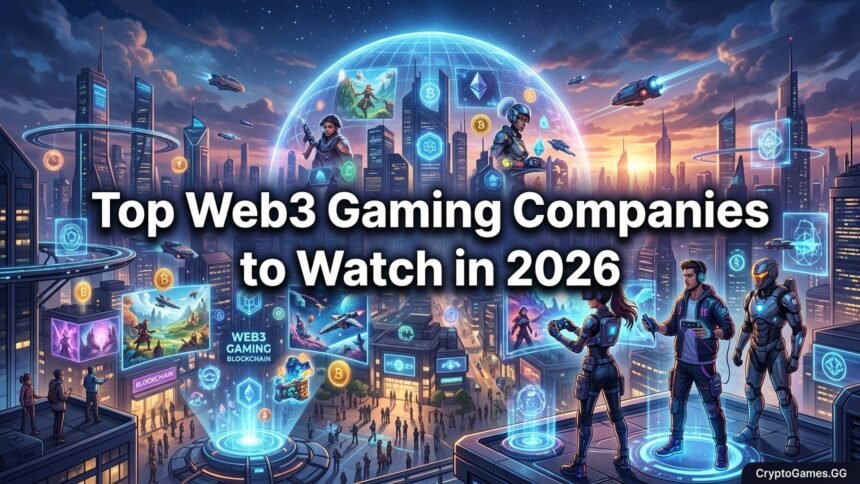
The web3 gaming companies that matter in 2026 are not the ones that raised the most in 2021. They are the ones that survived the crash, shipped real games, and built durable player communities. This list covers the leading companies across game publishing, blockchain infrastructure, and ecosystem building — with honest assessments based on player engagement data from DappRadar, not token price alone.
How This List Was Built
Every company here meets three minimum standards. First, they have a product players can actually use today — a game, a chain, or a platform with real activity. Second, their daily active wallet counts or ecosystem metrics are growing or stable, not declining. Third, they have operated for at least one full market cycle and are still building. No whitepapers, no vaporware, no token-only projects.
Game-First Companies
Sky Mavis (Vietnam, 2018) built Axie Infinity and the Ronin Network. Despite the 2022 hack, they rebuilt stronger and turned Ronin into a multi-game ecosystem. Ronin now hosts RavenQuest, Pixels, and Lumiterra alongside Axie, making Sky Mavis the most operationally important web3 gaming company for player volume.

Illuvium Games (Australia, 2020) set the current production quality ceiling for web3 gaming. Their open-world RPG on Immutable X demonstrates that AAA visual quality and blockchain ownership coexist. Their pace of development is methodical and the result is a game players keep coming back to for the gameplay itself.
Parallel Studios (US, 2021) built Parallel TCG into a genuinely competitive card game. The tournament ecosystem creates sustained engagement beyond NFT speculation. Their PRIME token has utility grounded in actual gameplay activity.
Mythical Games (US, 2018) brings traditional gaming executive backgrounds to web3. NFL Rivals introduced blockchain ownership to mainstream mobile gamers who had never interacted with crypto. Their accessibility-first approach represents a viable path to mass adoption.
Big Time Studios (US, 2020) built a visually polished action RPG by veterans of Epic Games and Activision. Their game quality is among the strongest in web3 gaming and their player base has remained active through multiple market cycles.
Infrastructure and Platform Companies
Immutable (Australia, 2018) built Immutable X, one of the leading gaming blockchains. Gas-free NFT trading using zero-knowledge proofs made NFT-heavy games economically viable. They also publish Gods Unchained directly, giving them skin in the game alongside their infrastructure role. According to DappRadar’s web3 gaming analytics, Immutable X consistently ranks among the top chains for NFT gaming transaction volume.
Dapper Labs (Canada, 2018) created CryptoKitties, built the Flow blockchain, and launched NBA Top Shot. Their focus on licensed premium IP and consumer-friendly onboarding has reached audiences traditional crypto gaming cannot. Flow remains a technically solid consumer blockchain with unique features optimized for NFT applications.
Sequence / Horizon (Canada, 2018) builds wallet infrastructure and developer tools for web3 gaming. The Sequence embedded wallet is used by dozens of blockchain games to eliminate crypto onboarding friction for new players. Horizon also makes Skyweaver, a card game. Their tooling is used industry-wide.
Alchemy (US, 2017) is not a gaming company specifically but powers the infrastructure behind more web3 games than any other developer platform. Their gaming-specific tools, APIs, and node infrastructure are used by the majority of serious web3 game studios. According to Alchemy’s web3 game studio tracker, they work with over 70% of the most active blockchain game developers.
Ecosystem and Investment Companies
Animoca Brands (Hong Kong, 2014) is the largest institutional force in web3 gaming. Their portfolio exceeds 400 projects including The Sandbox, Axie Infinity (investment), and dozens of others. Yat Siu’s advocacy for digital property rights has shaped the industry’s philosophical framing. Animoca’s breadth means their interests align with the entire ecosystem’s health.
Gala Games (US, 2019) operates a multi-title ecosystem with the GALA token spanning multiple genres. Spider Tanks, Mirandus, and Town Crush give them genre diversification that single-game studios lack. Their node operator community creates a decentralized infrastructure base for the platform.
TreasureDAO (Decentralized, 2021) built an interconnected multi-game economy on Arbitrum with the MAGIC token connecting games through shared lore and economics. Bridgeworld anchors the ecosystem economically. Their model creates cross-game network effects that isolated game economies cannot generate.
Emerging Web3 Gaming Companies
Gunzilla Games is developing Off The Grid, a battle royale with blockchain item ownership that has attracted mainstream FPS gaming press attention. If they deliver the gameplay quality their footage suggests, they could be the crossover title that mainstream FPS audiences adopt first.
NEON Machine is building Shrapnel, a tactical FPS on Avalanche where player-created content items are NFTs. The modder-ownership angle has not been fully proven at scale but represents a genuinely new direction for blockchain gaming mechanics.
Yuga Labs built Bored Ape Yacht Club and is developing Otherside, a browser-based metaverse game. Their cultural reach and community loyalty give them an adoption runway that newer studios cannot match if the game quality meets expectations.
Pro Tip: The most reliable signal for web3 gaming company health is not token price. It is 90-day daily active wallet trend on DappRadar combined with evidence of continued game development investment. Companies where both are positive are the ones building durable value rather than maintaining speculative momentum.
Frequently Asked Questions
What are the top web3 gaming companies in 2026?
By player volume, Sky Mavis’s Ronin ecosystem and Immutable’s platform lead. By production quality, Illuvium Games and Big Time Studios set the current ceiling. By ecosystem breadth and investment influence, Animoca Brands is the most significant single company in the space. The answer depends on whether you measure by players, quality, or industry influence.
Are web3 gaming companies profitable?
Some are. Immutable generates protocol fees from all games on their platform. Sky Mavis earns marketplace fees from Axie and the Ronin ecosystem. Gods Unchained generates card pack revenue. Profitability varies significantly by company and market conditions. Most web3 gaming companies at scale have meaningful revenue streams but profitability in traditional accounting terms varies.
How do I invest in web3 gaming companies?
Most web3 gaming companies are private. Exposure can come through governance tokens (AXS for Sky Mavis ecosystem, GODS for Immutable’s Gods Unchained, ILV for Illuvium), through Animoca Brands if they go public, or through blockchain gaming ETFs and crypto funds that hold baskets of gaming tokens. Governance token investment carries the same risks as other cryptocurrency investments.
The web3 gaming companies that matter most in 2026 are distinguished from the 2021 generation by one quality: they built games players want to play. Token economics are secondary to that foundation. Companies on this list have demonstrated they understand the difference.