



Ronin is the blockchain that proved blockchain gaming could scale. Built by Sky Mavis in 2021 specifically because Ethereum’s gas fees were destroying the Axie Infinity AXS $1.17 ▲ +2.1% player experience, Ronin grew from an emergency infrastructure solution into a thriving gaming ecosystem with over 3 million daily active users at its peak. It survived one of the largest crypto hacks in history, rebuilt its security architecture, and now powers a portfolio of games far beyond its Axie origins. Understanding the Ronin network is understanding how game-specific blockchains work and why the model succeeded where general-purpose chains struggled.
Why Sky Mavis Built Ronin
In 2021, Axie Infinity exploded into mainstream awareness. Players, particularly in Southeast Asia, were earning meaningful income from the game during a period of economic disruption. Daily active users surpassed 2 million. Daily transaction volume hit millions of NFT trades and token transfers.
Every single one of those transactions needed to process on Ethereum. At peak congestion, Ethereum gas fees reached $50–$100 per transaction. For a player in the Philippines earning $20 per day from the game, paying $30 in gas fees to move their earnings to an exchange wasn’t just inconvenient — it was economically impossible. The game’s growth was being strangled by the infrastructure it ran on.
Sky Mavis spent six months building a sidechain solution. The decision was deliberate: rather than wait for Ethereum to scale or migrate to an existing alternative chain, they built infrastructure optimised for exactly the transaction patterns their game required. The result was Ronin: a proof-of-authority sidechain that could process thousands of game transactions per second with near-zero fees.
The tradeoff was clear from the start. Ronin’s proof-of-authority model sacrifices Ethereum’s decentralisation for speed and cost. A small number of validators control the network. This is less battle-tested than Ethereum’s thousands of validators. Sky Mavis accepted that tradeoff because their players needed usable economics immediately, not theoretical security maximalism that prevented them from playing.
What Ronin Is: Sidechain Architecture Explained
Ronin is an Ethereum-compatible sidechain. “Sidechain” means it runs as a separate blockchain that connects to Ethereum through a bridge rather than inheriting Ethereum’s security directly. This is different from layer-2 solutions like Immutable X, which settle cryptographic proofs back to Ethereum for security.
On a sidechain, your assets live on the sidechain’s own validator set. When you bridge ETH or an NFT from Ethereum to Ronin, the Ethereum asset gets locked in a bridge contract and an equivalent representation is minted on Ronin. When you withdraw back to Ethereum, the Ronin representation is burned and the locked Ethereum asset releases.
The bridge is where sidechain security concentrates. If the bridge contracts are compromised, funds locked in the bridge can be stolen — which is exactly what happened in 2022. The sidechain’s internal security model (which validator nodes can process transactions) is separate from the bridge security (which wallets control the locked Ethereum funds).
Ronin uses a proof-of-authority consensus mechanism. A defined set of validator nodes, operated by Sky Mavis and partner organisations, produce and validate blocks. This small validator set enables fast block times (around 3 seconds) and negligible transaction costs. The same small validator set is a meaningful centralisation risk compared to Ethereum’s permissionless validator system.
Ronin’s Key Technical Specs
Block time is approximately 3 seconds. For comparison, Ethereum averages 12–13 seconds per block. Faster block times mean faster transaction confirmation and a more responsive game experience.
Transaction fees on Ronin are denominated in RON, the native token. For most game transactions, fees are fractions of a cent — functionally negligible for players. Sky Mavis subsidised many transaction fees entirely during the game’s peak growth period to further reduce friction.
Ronin is EVM-compatible (Ethereum Virtual Machine). This means Ethereum smart contracts deploy to Ronin without modification. Developers familiar with Ethereum development tools can build on Ronin without learning new languages or frameworks. This compatibility is why the ecosystem expanded from Axie to dozens of games quickly — the developer base transferred directly.
The Ronin bridge connects to Ethereum mainnet, enabling bidirectional asset movement. Bridging in or out incurs Ethereum mainnet gas fees on the Ethereum side (since the bridge transaction settles on Ethereum) but zero fees on the Ronin side. Bridging is infrequent for most players — day-to-day game activity happens entirely on Ronin with near-zero costs.
The 2022 Ronin Hack: What Happened and How They Recovered
On March 23, 2022, hackers compromised five of Ronin’s nine validator private keys. With five of nine validator signatures, the attackers were able to forge withdrawal approvals on the bridge contracts and drain $625 million in ETH and USDC — the largest DeFi hack in history at that time.
Sky Mavis discovered the hack on March 29, six days after it occurred, only because a user reported being unable to withdraw 5,000 ETH. The delayed discovery compounded the severity and highlighted the monitoring gap in the original security architecture.
The recovery process was extraordinary and, notably, successful. Sky Mavis raised $150 million in emergency funding from Binance and other backers specifically to reimburse affected users. Every user who lost funds to the hack was made whole. Sky Mavis absorbed the loss rather than passing it to their community.
The technical response rebuilt Ronin’s validator architecture. The validator set expanded from 9 to 22 nodes. Threshold requirements for bridge approvals increased. Hardware security modules became mandatory for validator key storage. Circuit breakers now pause bridge operations if anomalous withdrawal patterns are detected. A third-party security audit followed.
The reputational damage was severe and persistent. But Sky Mavis’ decision to reimburse users in full — rather than declaring the losses a force majeure event and moving on — preserved enough community trust to allow the ecosystem to survive and eventually rebuild. By 2024, Ronin’s developer ecosystem had expanded significantly and the platform hosted dozens of games.
The RON Token: Purpose and Economics
RON is Ronin’s native gas and governance token. Every transaction on Ronin pays fees in RON. Validators earn RON from transaction fees and block rewards. RON holders can stake with validators to earn a share of the staking rewards.
The RON token launched in January 2022, two months before the hack, at a time when Axie Infinity was still experiencing significant player activity. Its price history reflects both the Axie cycle and the broader crypto market, with a severe decline following the 2022 hack and market downturn.
Sky Mavis has worked to rebuild RON’s fundamental value by expanding the Ronin ecosystem beyond Axie. As more games launch on Ronin, more transactions process through the network, increasing fee revenue to validators and stakers. RON’s value connects to network activity across the entire ecosystem, not just Axie performance.
For current RON price and staking mechanics, CoinGecko’s RON page provides live data and market history.
Games on Ronin Beyond Axie Infinity
Ronin’s expansion beyond Axie Infinity is the most significant development for the network’s long-term value. Sky Mavis opened the Ronin ecosystem to third-party developers, and the combination of near-zero fees, EVM compatibility, and a built-in audience of crypto-native gamers attracted substantial developer interest.
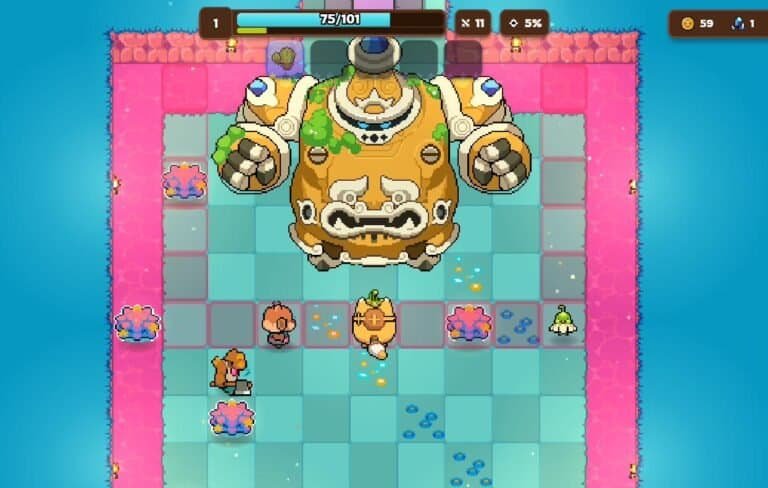
Key games on Ronin as of 2026 include Pixels (a farming and social game with millions of active users), Moku Grand Arena (AI-powered fantasy battle game with a $1 million Season 1 prize pool), Axie Infinity: Origins (the rebuilt battle game with a new economy model), and dozens of smaller titles across multiple genres.
The Sky Mavis App Store positions Ronin as a distribution platform for blockchain games, not just an infrastructure provider. Developers who build on Ronin get access to the existing Ronin wallet user base, Sky Mavis marketing support, and the Ronin App distribution channel. This distribution advantage is real — games launching on Ronin start with millions of potential players who already have compatible wallets, compared to games on newer chains that need to build their audience from scratch.
See Axie Infinity Complete Guide for the full guide to the game that built Ronin’s initial ecosystem.
Ronin vs Immutable X: The Two Dominant Gaming Chains
Ronin and Immutable X are the two most successful gaming-focused blockchains in 2026. They represent different architectural philosophies with different tradeoff profiles.
Ronin is a sidechain with proof-of-authority consensus. Its security depends on the integrity of its validator set rather than Ethereum’s security directly. The 2022 hack demonstrated this risk concretely. But Ronin’s simple architecture, EVM compatibility, and Sky Mavis distribution support make it extremely accessible for developers and players.
Immutable X uses ZK-rollup technology to settle cryptographic proofs on Ethereum, inheriting Ethereum’s security guarantees. The bridge risk that enabled the Ronin hack is different in character on Immutable X because ZK proofs are mathematically verified on Ethereum rather than depending on validator key management. Immutable X’s zero gas fee model serves the same player economics that Ronin pioneered.
The practical difference for players: Ronin hosts games with the largest existing player communities (Axie, Pixels PIXEL $0.005811 ▼ -2.4%, Moku). Immutable X hosts games with the highest production quality (Gods Unchained, Illuvium ILV $3.79 ▼ -3.3%, RavenQuest QUEST $0.001047 ▼ -6.6%, Big Time). Both are legitimate choices. Many active blockchain gamers use wallets on both chains. See What Is Immutable X? The Blockchain Built for Gaming for the Immutable X counterpart.
How to Set Up a Ronin Wallet
The Ronin wallet is the official wallet for the Ronin ecosystem. It’s available as a browser extension for Chrome and Firefox and as a mobile app for iOS and Android.
Step 1: Download the Ronin wallet from wallet.roninchain.com (browser extension) or your device’s app store. Always use the official Ronin website to avoid counterfeit wallet apps.
Step 2: Create a new wallet. Write down your 12-word seed phrase on paper and store it securely offline. Never photograph or type your seed phrase digitally. The seed phrase is the master key to your wallet — anyone with it controls your assets.
Step 3: Set a wallet password for app access. This local password protects against someone using your device but does not replace seed phrase security.
Step 4: Enable Ronin in any game that supports it. Most Ronin games connect your wallet through a QR code or wallet connect prompt in the game client. Approve the connection in your Ronin wallet.
Step 5: Acquire RON for transaction fees. Small amounts are available through the Katana DEX (Ronin’s built-in decentralised exchange) or by bridging from Ethereum. Most games require minimal RON — a few dollars worth covers hundreds of typical game transactions.
Best Crypto Gaming Wallets covers Ronin wallet alongside MetaMask, Immutable Passport, and Phantom for players deciding which wallets to set up based on their game portfolio.
Frequently Asked Questions
Is the Ronin network the same as Ronin Blockchain?
Yes. “Ronin” and “Ronin Network” and “Ronin Blockchain” all refer to the same Ethereum-compatible sidechain built by Sky Mavis. The official branding is simply “Ronin.”
Is Ronin safe after the 2022 hack?
Significantly safer than before, with expanded validator sets, mandatory hardware security modules, bridge circuit breakers, and third-party security audits. The security architecture rebuild addressed the specific attack vectors exploited in 2022. That said, no blockchain bridge is risk-free. Use bridge activity for necessary transfers rather than as long-term storage.
What games run on Ronin?
Axie Infinity (Origins and Classic), Pixels, Moku Grand Arena, Apeiron, and dozens of other titles. Sky Mavis maintains an official game directory at app.roninchain.com listing all ecosystem games.
Do I need RON to play Ronin games?
Small amounts of RON for transaction fees are technically required, but many games and Sky Mavis itself has historically subsidised fees for new players. Most Ronin games provide small RON allocations to new wallets to cover initial transactions. Check the specific game’s onboarding process for current fee handling.
Conclusion
Ronin’s story is one of the most instructive in blockchain gaming: a team with a real problem built focused infrastructure to solve it, experienced a catastrophic security failure, rebuilt with integrity by making affected users whole, and emerged with a stronger and more diverse ecosystem. The network’s architecture involves tradeoffs that Immutable X’s approach doesn’t. But its distribution advantages and existing player base make it a legitimate choice for both developers and players building crypto gaming portfolios in 2026.