
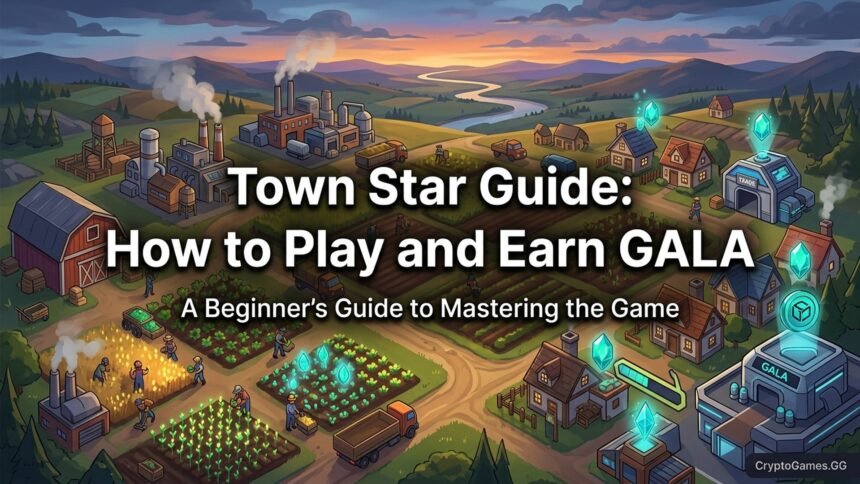
Town Star is Gala Games‘ flagship blockchain strategy game — a competitive town-building simulation where optimising your supply chain earns real GALA token rewards. If you’ve played farming simulations like FarmVille but want actual ownership over your assets and the ability to earn crypto from your time investment, Town Star is the most developed example of that experience in Web3 gaming. This Town Star guide covers everything from your first plot to competitive weekly events.
What Is Town Star?
Town Star is a town-building strategy game on GalaChain where players construct and optimise production towns to generate the highest possible output of crafted goods. Every week, the game runs a new competitive event on a fresh map. Players who rank highest in production value by the end of the week earn GALA token rewards. It’s a timed strategy competition, not a passive idle game.
The core loop: place resource buildings (farms, wells, mines), build processing facilities (mills, bakeries, wineries), craft progressively higher-value goods, and optimise the layout for maximum throughput within your plot size. Efficiency — producing the most valuable goods per unit of space and time — determines your competitive ranking.

Starting Out: Free Play vs NFT Play
Town Star has both free-to-play and NFT modes. In free play, you build with basic tools and default workers on a standard plot. You can experience the full supply chain mechanics without spending anything. Free players can participate in weekly events but compete in a lower-rewards tier compared to NFT landholders.
NFT play means owning Town Star land NFTs, which provide larger plot sizes, better resource nodes, and premium building slots. Land plots are the primary NFT asset class in Town Star and directly affect your competitive ceiling. NFT building cards add specific production bonuses that free-play equivalents don’t have. The gap between free play and top-tier NFT play is significant in competitive events — managing expectations about earning potential without NFTs is important.
Core Mechanics: Resources, Buildings, and Supply Chains
Basic resources: Every Town Star map provides access to water (wells), lumber (trees/sawmills), grain (wheat fields), and minerals (clay, stone, iron). These are the foundation of all supply chains. Your town’s location on the map determines which resources are accessible and how far you need to transport them.
Workers and transport: Workers harvest resources and transport goods between buildings automatically. The speed of your supply chain depends heavily on minimising worker travel distances. Buildings that feed into each other should be placed adjacent or as close as possible. Optimising layout for worker movement efficiency is the core strategic challenge in Town Star.
Crafting chains: Simple resources combine into more valuable goods through processing buildings. Wheat + water → Bread (in a bakery). Grain + barrel → Beer (in a brewery). Lumber + nails → Furniture (in a carpenter). Higher-tier goods require longer chains with more intermediate steps but produce significantly more Town Coin per unit. Identifying and building the most efficient high-tier craft for your map’s resources is the key weekly competitive decision.
Town Coin: This is the in-game currency generated by selling crafted goods. At the end of each weekly event, your Town Coin balance determines your ranking, which determines your GALA reward tier. Town Coin doesn’t carry over between events — each week starts fresh.
Pro Tip: Study the weekly event map before committing your build layout. Each new weekly map has different terrain, resource placement, and available building combinations. Spending 10 minutes at the start of each week to identify your map’s optimal craft chain — rather than copying last week’s layout — is the single biggest competitive advantage available to organised players.
Town Coin and GALA Earnings: How It Works
Town Star’s earn mechanic operates through weekly competitive events. At the end of each event, players are ranked by Town Coin production. The top-ranking players in each tier earn GALA token rewards. The exact reward amounts and tier cutoffs vary by event and are announced in advance through the Gala Games platform.
Town Coin → GALA conversion is not automatic — you need to rank within a qualifying tier during an event to receive GALA. Simply playing and accumulating Town Coin without competitive ranking doesn’t generate GALA. This is important for setting expectations: Town Star is a competitive game where GALA earnings require consistently performing in the top percentile of weekly events, not passive income from building a town.
NFT land and building bonuses significantly affect competitive ranking. Players with premium land plots can produce more Town Coin per week than free-play equivalents. The most competitive earning positions are typically dominated by players with meaningful NFT investment. Free-to-play GALA earnings are possible but limited compared to NFT holders in top tiers.
NFT Land and Buildings: What to Buy First
If you’re considering NFT investment in Town Star, prioritise in this order:
Land plots are the most impactful NFT. Larger plots allow more buildings and more complex supply chains. Premium resource node placement on some land plots provides passive resource advantages. Land is the foundation of any competitive Town Star play — without it, your ceiling in weekly events is capped by default plot limitations.
Building NFT cards add production bonuses to specific buildings. The most valuable building cards are for high-tier production facilities — advanced bakeries, breweries, or workshops that accelerate the most efficient crafting chains. Identify your preferred crafting specialisation before buying building cards, since cards that boost your specific chain are much more valuable than a generic collection.
Check current land and building prices on the Gala marketplace before purchasing. Town Star NFT values fluctuate based on game health, GALA price, and event reward structures. Buying at times when player activity metrics are strong provides better resale liquidity than buying when the community is declining.
Competitive Weekly Events
Weekly events are Town Star’s primary engagement driver and GALA earning mechanism. Each week introduces a new map with a fresh competitive start. The event runs for seven days. At week’s end, final rankings are calculated and GALA rewards distributed to qualifying tiers.
Within events, some maps feature special resource types or crafting chains not available in standard play. These “featured” weeks typically have higher reward pools and attract more competitive participation. Adapting your standard strategy to the weekly map’s specific resources and terrain is essential for maintaining top-tier ranking consistency.
Joining a Town Star community (Discord guilds, competitive groups) provides access to collective strategy knowledge — members share optimal layout discoveries, map analysis, and building combinations for each weekly event much faster than individual experimentation can achieve.
Town Star Strategy Tips
Prioritise water infrastructure first. Water is required by almost every production chain at some point. Undersupplying water creates production bottlenecks that cascade through your entire crafting operation. Start each week by building your well network before anything else.
Specialise rather than diversify. Running three production chains at 60% efficiency loses to running one chain at 95% efficiency. Identify your map’s best available craft, build a full pipeline for it, and resist the temptation to add secondary chains until your primary is fully optimised.
Worker coverage is your first layout constraint. Each worker has a coverage radius and movement speed. Buildings outside a worker’s effective range operate slower or not at all. Plan building placement around your worker stations before placing production facilities.
Track time-to-craft for each tier of goods. Higher-tier items take longer to craft but produce more Town Coin per craft. In early event hours, simpler goods let you accumulate Town Coin faster. Transitioning to higher-tier goods mid-event, once infrastructure is established, maximises total production by week’s end.
What Is Gala Games? The Web3 Gaming Ecosystem Explained for full platform context. Gala Games Review: Is the Platform Worth Using in 2026? for an honest assessment of the platform’s current state.
Frequently Asked Questions
Is Town Star free to play?
Yes. Town Star has a free-to-play mode with all core mechanics accessible. NFT land and building cards provide competitive advantages in weekly events but are not required to experience the game. Free players can earn GALA in lower-reward event tiers.
How much GALA can I earn from Town Star?
Earnings vary significantly based on your competitive ranking, NFT investment level, and current GALA price. Top-tier weekly event performers with premium NFT land plots can earn meaningful GALA rewards. Free-to-play players in standard tiers earn smaller amounts. No earning is guaranteed — it depends on consistent competitive performance.
Is Town Star still active in 2026?
Yes. Town Star has maintained weekly events continuously since its launch and remains Gala’s longest-running active game with an established competitive community.
Conclusion
Town Star is the most proven game in Gala’s portfolio — years of operation, a working competitive economy, and genuine strategic depth that rewards consistent skill over casual play. The learning curve around supply chain optimisation is real, and the gap between free-play and top NFT-holder earning is significant. But for strategy game players who want blockchain gaming with a working economy rather than promises, Town Star has delivered what it says it does more consistently than most competitors in the space.