

The federal ban on foreign-made robots that took effect July 28 doesn’t stop at Chinese humanoids. It reaches your next vacuum.
That’s the part most coverage skipped. The Federal Communications Commission added “foreign-produced advanced robotic devices” to its Covered List, the roster of technologies “deemed to pose an unacceptable risk to the national security of the US or the safety and security of US persons.” The justification cited cybersecurity holes found in robots built by Chinese companies. The rule itself doesn’t stop at China.
What counts as a robot now
The definition is broad enough to be worth reading closely. A covered device is “a mechanical mobile device, including autonomous mobile robots, humanoid robots, and quadrupeds” that moves across the ground and runs either autonomously or under remote human control.

Add three more conditions and you have the full net: sensors that perceive the robot’s environment, network connectivity such as Bluetooth or satellite links faster than 200 kbps in either direction, and software or AI models running onboard or on cloud servers.
Check that list against the robot vacuum you were thinking about buying. Sensors, yes. Wi-Fi, yes. Cloud mapping, yes. Roborock and its Chinese peers dominate that category, and their newest models fall inside the line.
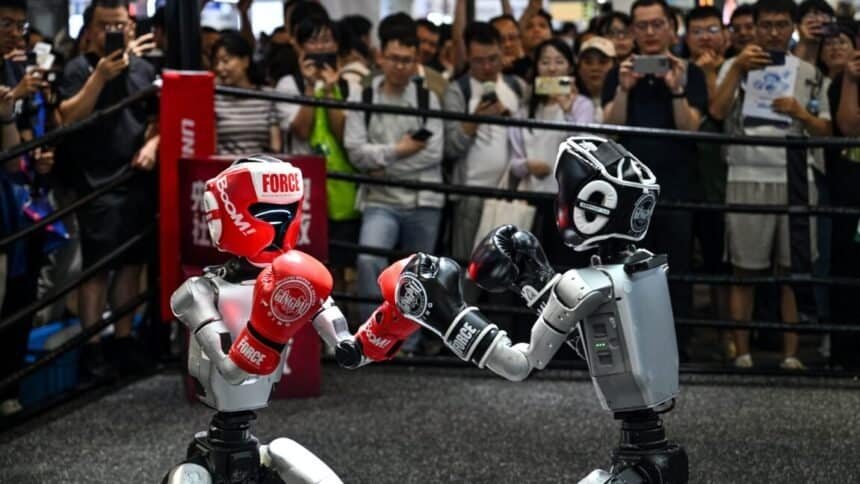
Unitree's humanoids are the more consequential casualty. Robotics labs buy them because they’re cheap, and researchers have used them for work including experimental robot surgeries. Those platforms are now off the table for new models.
Allies got caught in the same net
Japan, South Korea and Germany build robots too. The ban applies to them as well, despite the China-specific cybersecurity findings the FCC used to justify it.
There’s a procedural wrinkle worth flagging. The FCC can’t add to the Covered List on its own. It has to follow a “qualifying national security authority,” and the agency says the White House “convened an executive branch interagency body” that “included appropriate national security agencies” and reached the risk determination.
The exemptions are stranger than the rule
A covered robot has to weigh more than 4.4 pounds, counting a docking station if it has one. Robotic toys survive. Most robot vacuums don’t clear that bar in the other direction, meaning they’re heavy enough to be covered.
The rule also applies only to new models. Anything the FCC already authorized stays purchasable, and robots already sitting in labs, warehouses and living rooms keep working. What’s blocked is the unauthorized model that ships next.
Trains, drones, underwater vehicles and “connected vehicles” that drive on roads, robotaxis included, are all out of scope. Drones were handled separately, with their own import ban in December 2025. Anything the Food and Drug Administration classifies as a device is exempt too: medical and surgical robots, external limb prostheses, and mobility assistive devices such as wheelchairs.
Fixed and stationary robots are exempt outright. Industrial arms on a factory floor, foreign-built or not, are untouched.
One escape hatch stands out. The Department of Defense, rebranded the Department of War under the Trump administration and named that way in the FCC documents, can rule that a specific foreign robot or class of robots poses no security risk and pull it off the Covered List.
The domestic buildout the ban is betting on
The theory is that walling off imports pushes manufacturing onshore. Some of that is already happening. Agility Robotics, 1X Technologies and Figure AI are all racing to scale humanoid production in US factories, and Tesla has been shifting capacity away from older electric vehicle models toward its Optimus humanoid.
Boston Dynamics builds Atlas, the four-legged Spot and the wheeled Stretch at its main facility in Waltham, Massachusetts. It plans a major scale-up of Atlas manufacturing under Hyundai Motor Company, which took full ownership in July 2026. Note the flag on that parent company: South Korea, one of the allied countries the ban covers.
Industry cheered. Researchers didn’t.
“This is one of the strongest technology-security actions in modern US history,” wrote Evan Beard, CEO of Standard Bots, in a LinkedIn post. “The message is unambiguous: robotics is a technology America must lead and own, and foreign-subsidized robots will not be allowed to unfairly dominate US robotics as they did solar.”
Rush Doshi, director of the Initiative on China Strategy at the Council on Foreign Relations, called the decision “one of the most significant actions taken so far in support of the US robotics ecosystem” in a social media post.
Several robotics researchers and analysts see it differently, and their objection is about supply, not sentiment.
“In the near term, the measure could slow US physical AI innovation by cutting startups and researchers off from future low-cost Chinese platforms before comparable Western alternatives exist,” said Georg Stieler, a global robotics advisor and managing director for Asia at Stieler Technology & Market Advisory.
US production still trails China on high-volume, low-cost manufacturing, said Rueben Scriven, a senior analyst at Interact Analysis. “This announcement is more likely to inhibit the US humanoid robotics industry, as the presence of low-cost Chinese humanoid robots has been helping educate the US market through promotional and entertainment use cases, an effect this policy risks undermining,” Scriven said.
The drone ban is the tell
We’ve run this experiment already. Restrictions on Chinese drone makers such as DJI haven’t produced a “competitive mass-market consumer-drone producer” based in the United States, Stieler said. Instead, new companies appeared selling “barely disguised versions of DJI technology” to route around the rule.
So here’s the practical read. If you want a specific foreign-built robot, the model on shelves today is still legal to buy and legal to keep using. The one announced next quarter is the one you won’t get. Buy the current generation now, or plan on waiting for a domestic replacement that the analysts closest to the manufacturing math don’t expect to arrive soon.