

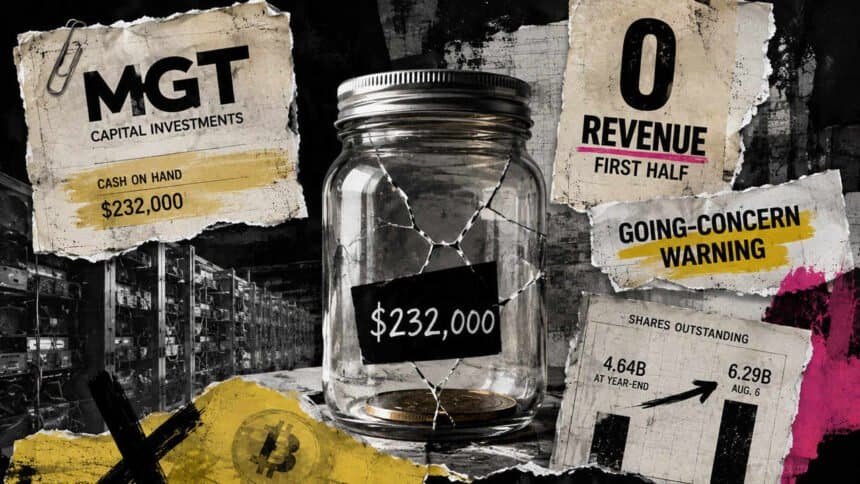
MGT’s cash balance is $232,000. The company added about 1.65 billion common shares to its count in a little over seven months. Both numbers come from the same filing, and the second one is what’s keeping the first one from hitting zero.
The quarterly report, submitted Aug. 7, puts outstanding common stock at 6.29 billion shares as of Aug. 6, up from 4.64 billion at the end of 2025. That’s a 35.6% increase in share count at a company that reported no revenue for the first half of 2026.
No mining revenue. No hosting revenue. Nothing.

The shares raised less than you’d guess
Here’s the part that makes the dilution look worse rather than better. Of that 1.65 billion, only 800 million shares were sold for cash, and they brought in $700,000. Run the division and you get roughly a tenth of a cent per share.
Another 100 million shares went out to settle $262,000 of payables. That’s not financing so much as paying the bills in equity.

And the single largest block wasn’t a raise at all. On June 30, MGT issued 750.1 million common shares plus 3.25 million Series E convertible preferred shares in an exchange that retired a $1.22 million secured convertible note. The 6.29 billion figure covers outstanding common stock only. It doesn’t include those preferred shares, which sit outside the count and can convert later.
The loss is mostly an accounting artifact, and that’s not comforting
MGT’s first-half net loss came to $2.96 million. Most of it, $2.81 million, is a non-cash loss on debt extinguishment tied to that June 30 exchange.
Non-cash losses don’t drain the bank account. But the operating burn does, and MGT used $531,000 of cash in operating activities over the six months. Set that against $232,000 on hand and the arithmetic gets short.
Total assets were $232,000, the same as the cash figure, against $693,000 of current liabilities. That leaves a $461,000 working-capital deficit, with a stockholders’ deficit reported separately at the same amount.
How MGT stopped being a miner
The company’s primary hosting contract expired in March 2025, and it stopped self-mining at the same time. It sold its LaFayette, Georgia mining site on May 13, 2025.
What’s left is 35 Antminer S19 Pro machines in storage. They generated no mining or hosting revenue during the latest six-month period, which is what you’d expect from hardware in a warehouse.

An S19 Pro isn’t a dead machine. It’s an older-generation unit that still hashes if you plug it in somewhere with cheap power. Thirty-five of them is not a mining business, though, and MGT hasn’t said where they’d go.
The money that isn’t in the bank yet
MGT said its equity offerings spanning December 2025 and the first half of 2026 raised $975,000. Its current $500,000 private placement had brought in another $25,000 after the quarter closed, leaving $225,000 of capacity for near-term working capital.
Capacity isn’t cash. That $225,000 is room to sell more stock, not a line on the balance sheet, and MGT said it cannot assure investors that additional capital will be available when needed or on acceptable terms.
Those conditions raised substantial doubt about the company’s ability to sustain operations for at least one year from issuance of the financial statements. That’s the going-concern language, stated plainly.
What a restart would actually require
In a July 20 update, MGT said it was evaluating growth opportunities and finalizing engagements with outside advisers. The update named no signed acquisition, no reopened operation and no other revenue-producing business.
Financing can keep a shell functioning for a while. It can’t manufacture a customer, and every dollar raised at these prices costs existing holders more of the company than the last one did.
The number worth tracking in the next filing isn’t the adviser engagements or the growth language. It’s whether 6.29 billion is still 6.29 billion, and whether any of those 35 machines have an address.