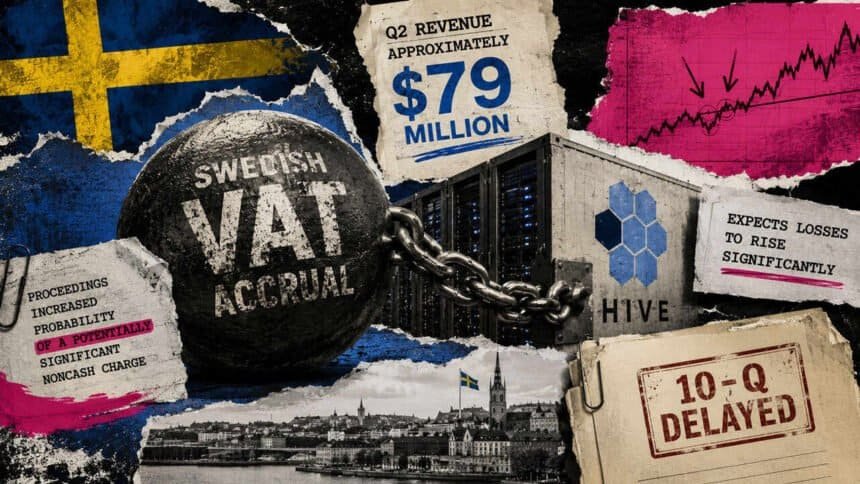
Three numbers now define HIVE Digital Technologies’ June quarter, and only one of them is close to final. There’s roughly $79 million in preliminary revenue. There’s SEK 765.6 million in assessed Swedish VAT exposure. And there’s an accounting accrual the company flat out says it can’t size yet.
That third number is the one that matters, and it’s the reason the Bitcoin miner blew through its Aug. 10 deadline for the Form 10-Q covering the quarter ended June 30.
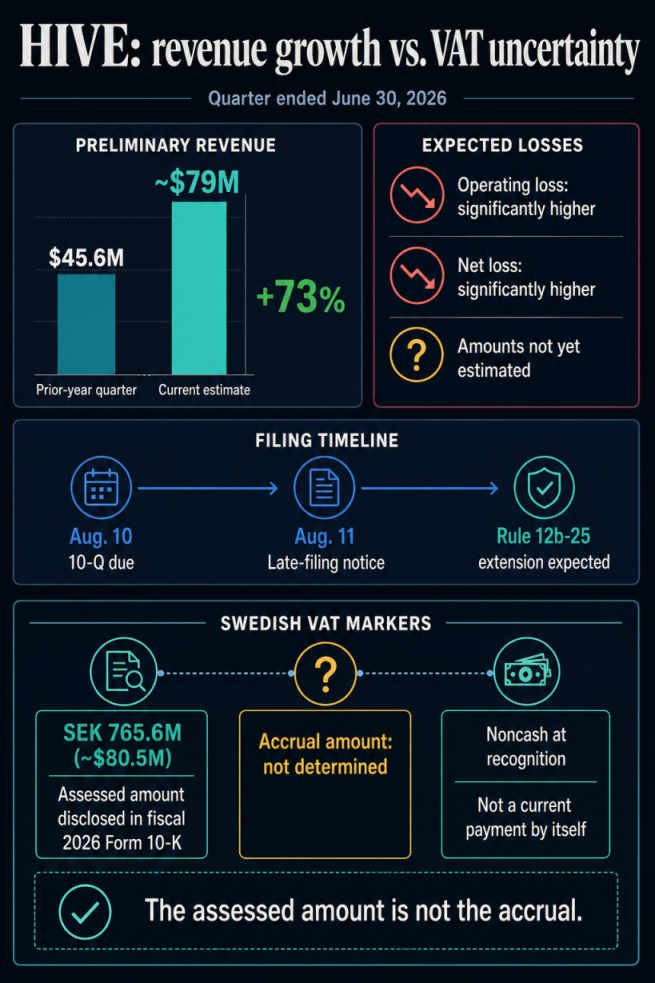
In an Aug. 11 late-filing notice, HIVE said the delay relates exclusively to the accounting and disclosures for contested Swedish value-added tax assessments. It expects to file within the Rule 12b-25 extension period.

The revenue line looks great in isolation
Preliminary revenue of about $79 million is up roughly 73% from $45.6 million a year earlier. HIVE credited more Bitcoin rewards from higher company hashrate, plus the start of revenue recognition under a previously announced high-performance computing contract.
Those figures are management estimates. They could change as the reporting process wraps up.
But a top-line estimate with no bottom line attached tells you almost nothing about the quarter. HIVE expects operating and net losses to increase significantly from the prior-year quarter, primarily due to a potential VAT-related charge, and said it can’t yet provide reasonable estimates for either loss.

For context on how far that swings: the comparable quarter produced $35 million of GAAP net income and carried no such charge, according to HIVE’s prior-year results.
What changed in Sweden
HIVE said recent developments in the Swedish proceedings increased the probability that it would record a noncash accrual. It needs more time to decide the accounting amount and finish the related financial statements and disclosures.
That’s a meaningful shift in posture. HIVE’s fiscal 2026 annual filing disclosed Swedish VAT assessments totaling SEK 765.6 million, then approximately $80.5 million, and management said at the time that the amount claimed as owed was not probable.
Probability language in filings isn’t decoration. It’s the trigger for whether a number lands on the income statement at all.
Don’t treat SEK 765.6 million as the answer
The temptation here is to subtract the assessed total from the revenue estimate and call it a quarter. Resist it.
That assessed total isn’t a proxy for any potential accrual. The Aug. 11 notice says HIVE still can’t determine the accounting amount.
HIVE also said an accrual would be noncash when recognized and wouldn’t, by itself, represent a current payment. The ultimate financial impact depends on how the proceedings are resolved and may differ from the amount booked.

So there are two separate questions in play. What HIVE eventually pays, if anything. And what HIVE books this quarter. Those can be very different figures, and only the second one shows up in the 10-Q.
What investors are actually holding right now
A revenue number. That’s it.
Until the accrual amount is set, investors have a preliminary top-line figure but no quantified view of expected losses. The hashrate growth story and the HPC contract revenue are both real contributors to the $79 million. Neither tells you whether the quarter ends in profit or a significant loss.
Late filings under Rule 12b-25 are routine enough that they don’t automatically signal trouble. What’s less routine is a miner naming a single tax dispute as the sole cause and admitting it can’t estimate the resulting hit in either direction.
The number to wait for
The completed 10-Q should answer the question the revenue estimate can’t: how much the Swedish VAT accounting decision weighs on reported earnings.
When it lands, skip the revenue headline and go straight to the accrual line. That single figure will tell you more about HIVE’s June quarter than the $79 million ever could, and right now the potential charge is still unpriced.